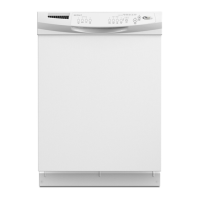
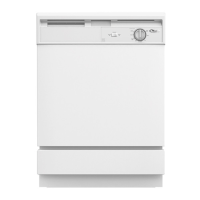
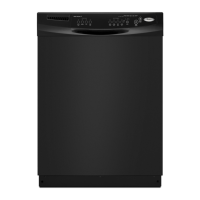
This document describes a Whirlpool dishwasher, providing instructions for its use, installation, maintenance, and troubleshooting.
Function Description
The Whirlpool dishwasher is designed for household use, offering various programs for washing dishes with different levels of soil. It features a water softening system to ensure optimal washing performance, especially in areas with hard water. The machine includes separate compartments for detergent, rinse aid, and softener salt, which are essential for effective cleaning and drying. An "Active Drying" system is incorporated to provide better drying performance for dishes. The control panel allows users to select programs, monitor the wash cycle status, and adjust settings like water hardness.
Important Technical Specifications
- Capacity: 12 place settings
- Dimensions:
- Height: 845 mm (815 mm without worktop)
- Width: 596 mm
- Depth: 598 mm
- Net Weight: 46 kg
- Electrical Input: 220-240 V, 60 Hz
- Total Power: 2200 W
- Heating Power: 2000 W
- Pump Power: 100 W
- Drain Pump Power: 30 W
- Water Supply Pressure: 0.03 MPa (0.3 bar) - 1 MPa (10 bar)
- Current: 10 A
- Service Life: 10 years (duration for spare parts availability)
- Conformity: Complies with 2004/108/EC, 2006/95/EC, IEC 436/DIN 44990, EN 50242 standards.
Usage Features
Installation:
The dishwasher requires a suitable, safe, and level installation spot. It must be connected to an earthed outlet with appropriate voltage and current (10-16 A fuse). Water inlet pressure should be between 0.03 MPa and 1 MPa; a pressure-relief valve is recommended if pressure exceeds 1 MPa. The water drain hose should be connected at a minimum of 50 cm and a maximum of 110 cm from the floor. For undercounter installation, the worktop can be removed, and the machine's adjustable feet allow for leveling.
First Use Preparation:
Before the first wash, users must set the water softener, add 2 kg of softener salt to the salt compartment (filling with water until it almost overflows), and fill the rinse aid compartment. A test strip can be used to determine local water hardness, which then informs the adjustment of the salt consumption setting via the program selector knob and Start/Pause button.
Loading:
The dishwasher has two baskets: a lower basket for round and deep items (pots, plates, cutlery) and an upper basket for tea plates, dessert plates, cups, and glasses. Long-stem glasses should be leaned against the basket edge or rack. Knives and sharp objects should be placed blade-down in the cutlery basket. Dishes must be placed to avoid obstructing the spray arms. The upper basket includes dish racks that can be used in open position for cups or closed position for long glasses, forks, knives, and spoons.
Detergent and Rinse Aid:
Only detergents specifically designed for dishwashers (powder, gel, or tablets) should be used. The detergent compartment can hold up to 40 cm³ of detergent, with recommendations of 25 cm³ for heavily soiled dishes and 15 cm³ for less soiled dishes. A pre-wash compartment can hold an additional 5 cm³ for very dirty dishes. Combined detergents (2-in-1, 3-in-1, 5-in-1) are available, but users should check product specifications and adjust salt and rinse aid settings to the lowest position for optimal results. Rinse aid prevents water drops, lime stains, and improves drying. The rinse aid level adjuster can be set from 1 to 6, with a factory setting of 3.
Programs:
The dishwasher offers several programs:
- Rapid 40°C (30 min): For lightly soiled items (coffee, milk, tea, cold meats, vegetables not kept long).
- Eco 50°C (155 min): For medium-soiled items, offering energy and water savings.
- Daily 65°C (50 min): For medium-soiled items (soups, sauces, pasta, eggs, pilaf, potato, oven dishes, fried foods).
- Intensive 65°C (110 min): For heavily soiled items.
Short programs do not include a drying step.
Operation:
To start, press the Power On/Off button, select a program with the selector knob, and press the Start/Pause button. The "Wash/Dry" and "End" indicators show program status. Programs can be changed or cancelled by pressing the Start/Pause button, selecting a new program, or turning the program selection button to Reset. The machine switches off by pressing the Power On/Off button when the "End" lamp lights up.
Maintenance Features
Regular Cleaning:
Cleaning the machine at regular intervals prolongs its service life.
- Oil and Lime Accumulation: Run a high-temperature program with detergent (and special cleansing material if needed) without dishes.
- Door Seals: Wipe regularly with a dampened cloth to remove residues.
- Filters and Spray Arms: Clean at least once a month.
- Filters: Remove the filter combination (micro, coarse, metal/plastic filters) by turning counter-clockwise and lifting. Rinse thoroughly under tap water. Ensure correct refitting.
- Spray Arms: Check for clogged holes. Remove (lower arm by pulling up, upper arm by turning nut left) and clean under water. Ensure the upper spray arm nut is perfectly tightened when refitting.
- Hose Filter: Check and clean periodically to prevent damage from contamination in the water supply. Turn off the tap, remove the hose, clean the filter under the tap, and refit.
Troubleshooting:
The manual provides a table of error codes (Wash/Dry, End, Start/Pause lamp combinations) and their descriptions, along with control actions. Common issues include inadequate water supply, continuous water input error, waste water discharge problems, temperature not reached, water overflow alarms, and faulty electronic cards. It also addresses problems like the program not starting, flashing lamps, detergent residues, water left in the machine, shaking noises, partial food wastes, whitish stains, and dishes not drying. For persistent issues or unlisted malfunctions, authorized service should be contacted.
Practical Information:
- Unplug the machine and turn off the water tap when not in use.
- Leave the door slightly ajar to prevent unpleasant smells.
- To eliminate water droplets, run an intensive program with no detergent and remove all metal containers.
- Remove coarse waste from dishes before loading.
- Operate the machine when completely full.
- Use pre-washing only when necessary.
- Do not mount near a refrigerator due to high temperatures.
- In freezing conditions, completely drain the machine by turning off the water tap, disconnecting the inlet hose, and allowing interior water to drain.


 To Next Page


 General