Before you start...
Proper installation is the installer's
responsibility. A qualified technician should
install this microwave oven. Make sure you
have everything necessary for correct
installation. It is the responsibility of the
installer to comply with the installation
clearances specified either on the
mounting bracket or in the Installation
Instructions.
Important: Observe all
governing codes and
ordinances.
Remove all
contents from
the upper
cabinet.
Electrical ground is
required. See "Electrical
requirements", Panel B.
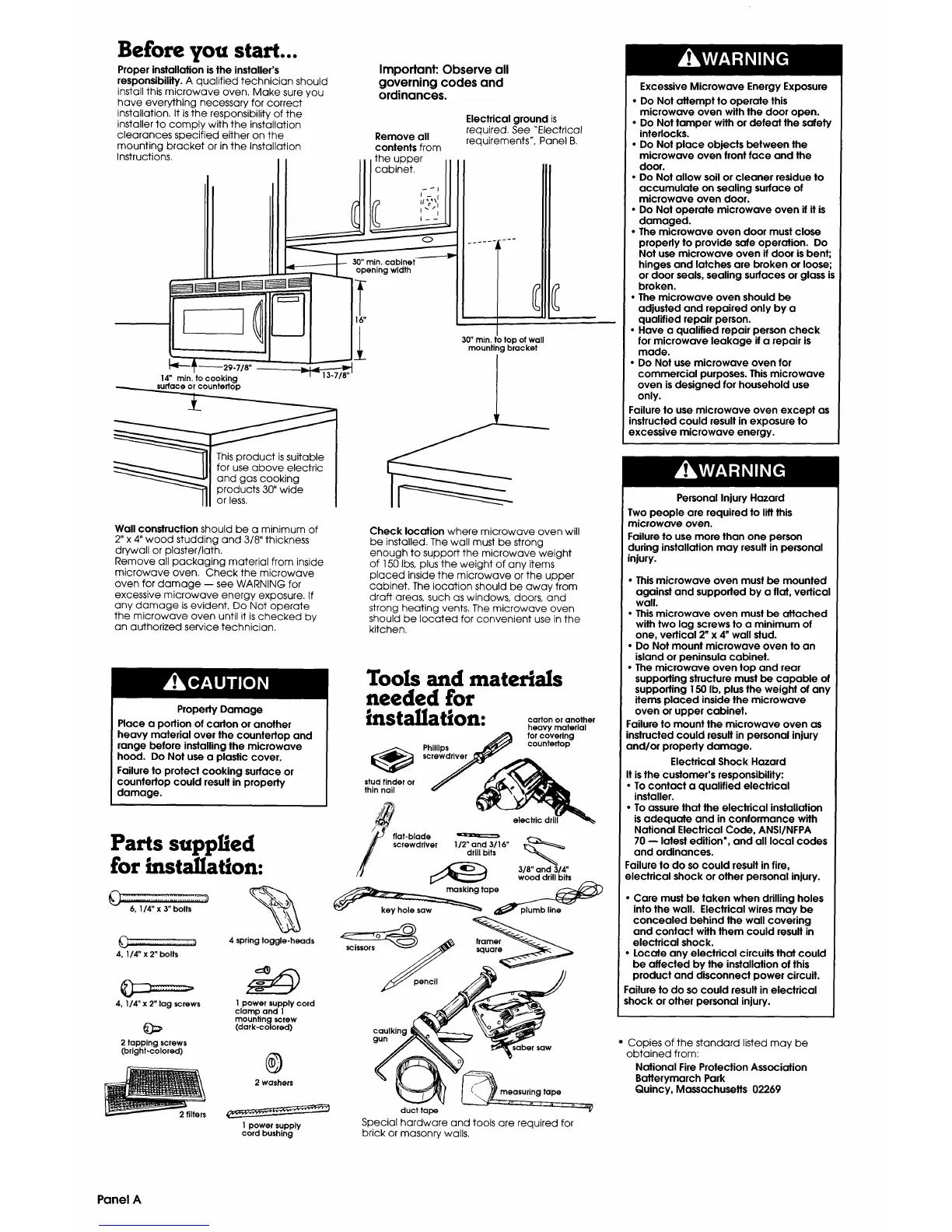
30" min. cabinet
opening width
16"
'_29-7/8" _i _ 13-'-Z_'_''.//_',
This product issuitable
for use above electricand gas cooking
products 30""wide
or less.
30" rain. to top of wall
mounting bracket
l
Wall construction should be a minimum of
2" x 4" wood studding and 3/8" thickness
drywall or plaster/lath.
Remove all packaging material from inside
microwave oven. Check the microwave
oven for damage -- see WARNING for
excessive microwave energy exposure. If
any damage isevident, Do Not operate
the microwave oven until it is checked by
an authorized service technician.
Check location where microwave oven will
be installed. The wall must be strong
enough to support the microwave weight
of 150 Ibs, plus the weight of any items
placed inside the microwave or the upper
cabinet. The location should be away from
draft areas, such as windows, doors, and
strong heating vents. The microwave oven
should be located for convenient use in the
kitchen.
Properly Damage
Place a portion of carton or another
heavy material over the countertop and
range before installing the microwave
hood. Do Not use a plastic cover.
Failure to protect cooking surface or
countertop could result in property
damage.
Parts supplied
for installation:
==========================================
6, I/4" x 3" bolts
4, I/4" x 2" bolts
4 spring toggle-heads
4, I/4" x 2" lag screws
2 tapping screws
(bright-colored)
2 filters
Tools and materials
needed for
installation:
j__ Phillips
screwdriver
stud finder or
thin nail
carton or another
heavy material
for covering
countertop
/'_ electric drill
318"and 3/4"
wood drill bits
2 washers
measuring tape
duct tape
1powersupply Special hardware and tools are required for
cord bushing brick or masonry walls.
Excessive Microwave Energy Exposure
• Do Not attempt to operate this
microwave oven with the door open.
• Do Not tamper with or defeat the safety
interlocks.
• Do Not place objects between the
microwave oven front face and the
door.
• Do Not allow soil or cleaner residue to
accumulate on sealing surface of
microwave oven door.
• Do Not operate microwave oven if it is
damaged.
• The microwave oven door must close
properly to provide sate operation. Do
Not use microwave oven if door is bent;
hinges and latches are broken or loose;
or door seals, sealing surfaces or glass is
broken.
• The microwave oven should be
adjusted and repaired only by a
qualified repair person.
• Have a qualified repair person check
for microwave leakage if a repair is
made.
• Do Not use microwave oven for
commercial purposes. Thismicrowave
oven isdesigned for household use
only.
Failure to use microwave oven except as
instructed could result in exposure to
excessive microwave energy.
Personal Injury Hazard
Two people are required to lift this
microwave oven.
Failure to use more than one person
during installation may result in personal
injury.
• Thismicrowave oven must be mounted
against and supported by a flat, vertical
wail.
• Thismicrowave oven must be attached
with two lag screws to a minimum of
one, vertical 2" x 4" wall stud.
• Do Not mount microwave oven to an
island or peninsula cabinet.
• The microwave oven top and rear
supporting structure must be capable of
supporting 150 Ib, plus the weight of any
items placed inside the microwave
oven or upper cabinet.
Failure to mount the microwave oven as
instructed could result in personal injury
and/or property damage.
Electrical Shock Hazard
It isthe customer's responsibility:
• To contact a qualified electrical
installer.
• To assure that the electrical installation
isadequate and in conformance with
National Electrical Code, ANSI/NFPA
70 -- latest edition*, and all local codes
and ordinances.
Failure to do so could result in fire,
electrical shock or other personal injury.
• Care must be taken when drilling holes
into the wall. Electrical wires may be
concealed behind the wall covering
and contact with them could result in
electrical shock.
• Locate any electrical circuits that could
be affected by the installation of this
product and disconnect power circuit.
Failure to do so could result in electrical
shock or other personal injury.
* Copies of the standard listed may be
obtained from:
National Fire Protection Association
Batterymarch Park
Quincy, Massachusetts 02269
Panel A



 To Next Page
 Loading...