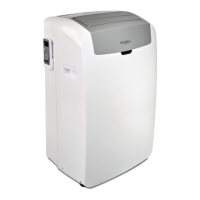
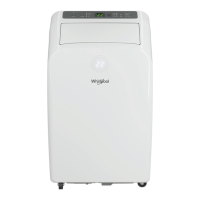
This document provides instructions for use of the Whirlpool portable air conditioner models PACF29CO W and PACF212HP W.
Function Description:
The Whirlpool portable air conditioner is designed to provide cooling, dehumidification, and fan-only operation. It uses a flammable refrigerant (R290) and is intended for use in rooms with a floor area larger than 12.5 m² and a room height greater than 2.2 m. The appliance is tested within 0.95 MPa - 1.05 MPa of external static pressures. It features a user interface with buttons for power, mode (Cool, Dry, Fan, Heat), temperature adjustment, and fan speed (High, Mid, Low). A remote control is also provided for convenient operation.
Important Technical Specifications:
- Refrigerant: The appliance uses R290, a flammable refrigerant. The maximum refrigerant charged amount is 0.26 kg.
- Room Size Requirements: The appliance should be installed and stored in a room with a floor area larger than 12.5 m² and a room height greater than 2.2 m.
- Power Supply: The appliance requires a 10A, 250VAC power supply. It must be connected to a properly grounded outlet with a dedicated circuit breaker.
- Exhaust Hose: The flexible exhaust hose allows placement of the air conditioner between 23" and 67" (60 cm and 170 cm) from a window or door. The appliance with supplementary heater needs to be kept a minimum distance of 100 cm from combustible surfaces.
- Electrical Safety: The power supply must be of rated voltage with special circuitry for the appliance. The diameter of the power cord must comply with requirements. The appliance must be earthed in conformity with national electrical safety standards. A time-delay fuse or time-delay circuit breaker is recommended. All wiring must comply with local and national electrical regulations.
- Sound Level: The manual does not specify the sound level, but it is implied that the appliance operates with a certain level of noise.
Usage Features:
- Starting the Air Conditioner: Press the POWER button to start or stop the appliance.
- Mode Selection: Press the MODE button to select the operation mode in sequence of Cool, Dry, Fan, or Heat.
- Temperature Adjustment: Use the "+" and "-" buttons to set the desired temperature.
- Fan Speed: Press the FAN button to choose the desired fan speed in sequence of High, Mid, or Low.
- Timer Function: The TIMER button allows setting a time for the appliance to turn on or off.
- Sleep Mode: The SLEEP button/DIM function provides a more comfortable environment for sleep.
- Around U Function: When this mode is active, the remote control transmits the actual room temperature to the indoor unit, and the appliance will operate according to this temperature.
- Remote Control: The appliance can be operated using the provided remote control, which offers all the functions available on the main unit.
- First Time Use: When the air conditioner is turned on for the first time or after a power failure, it will run in the Auto mode. The compressor will start after 3 minutes.
- Water Collection: In very humid environments, water will be collected in the tank inside the unit. The air conditioner will stop once the water tank is full, and the screen will display "ES" to inform the user to empty the internal container.
Maintenance Features:
- Draining the Air Conditioner: The appliance needs to be drained regularly to remove condensed water. This involves connecting a drain hose to the heating mode outlet or the primary drain hose plug.
- Cleaning the Air Filter: The air filter should be cleaned regularly to ensure maximum efficiency. This involves opening the filter panel door, removing the filter, cleaning it with a vacuum cleaner or warm water with a mild detergent, and then reinstalling it.
- Storage After Use: Before storing the air conditioner, it should be drained, the air filter cleaned, and the exhaust hose and window kit removed. The appliance should be stored in a dry, clean area.
- Troubleshooting: The manual provides a troubleshooting guide for common issues such as the air conditioner not operating, fuses or circuit breakers tripping, the air conditioner running too much, or displaying error codes.
- Refrigerant System Maintenance: Maintenance of the refrigerant system must be performed by qualified personnel. This includes checks for leaks, proper charging, and recovery of refrigerant.
- Electrical Connections: All electrical connections should be checked periodically to ensure they are secure and free from damage.
- Cleaning: The appliance should be cleaned regularly to prevent dust and debris buildup.
- Disposal: The appliance and its components should be disposed of in accordance with local waste disposal regulations, particularly regarding the refrigerant and electronic components.


 To Next Page
 General