EasyManua.ls Logo

White 2137 - Adjusting Pressure and Feeding of Fabric; Pressure and Feed Adjustment for General Sewing

Default Icon
38 pages
Print Icon
To Next Page IconTo Next Page
To Previous Page IconTo Previous Page
Loading...
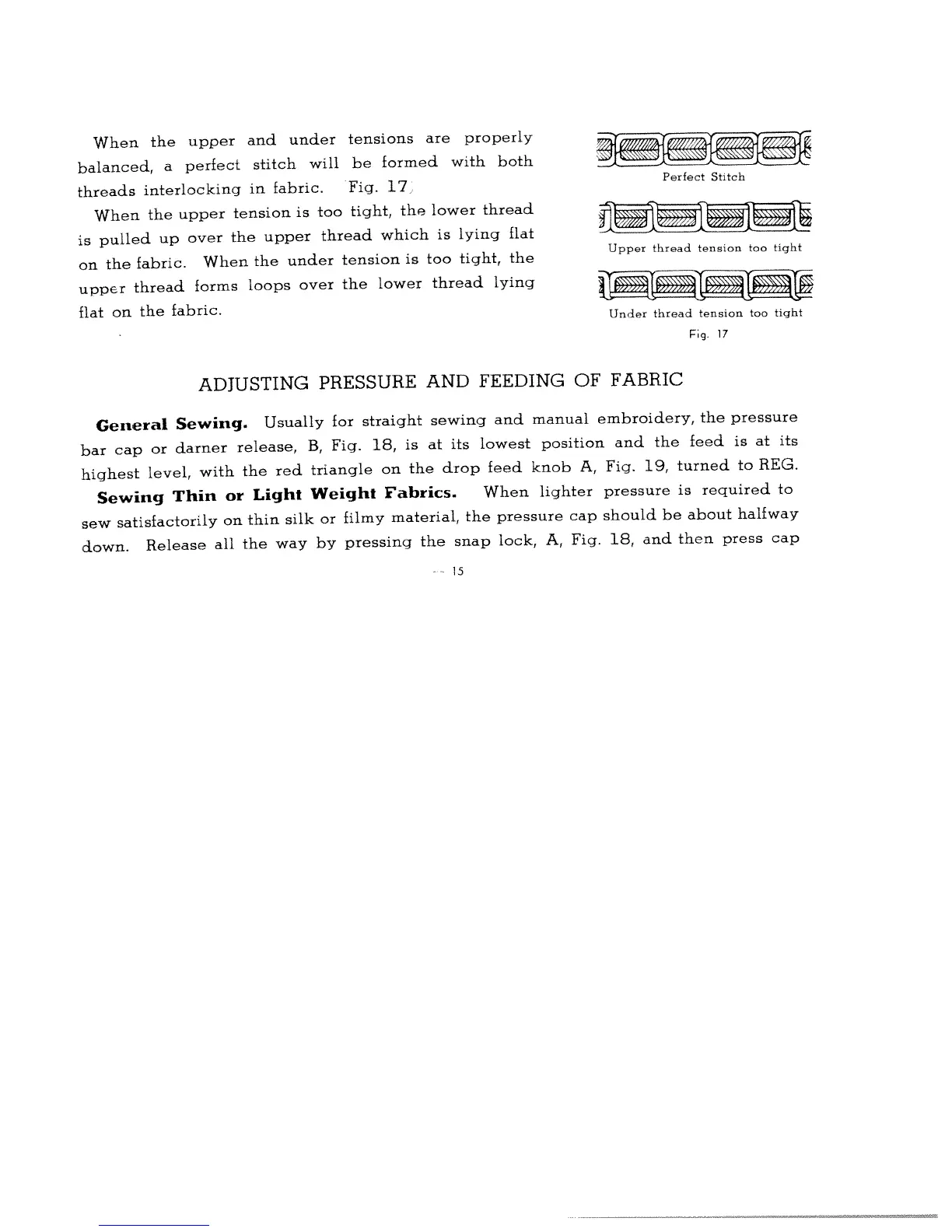
When
the
upper
and
under
tensions
are
properly
balanced,
a
perfect
stitch
will
be
formed
with
both
threads
interlocking
in
fabric.
Fig.
17
When
the
upper
tension
is
too
tight,
the
lower
thread
is
pulled
up
over
the
upper
thread
which
is
lying
flat
on
the
fabric.
When
the
under
tension
is
too
tight,
the
upper
thread
forms
loops
over
the
lower
thread
lying
flat
on
the
fabric.
Perfect
Stitch
Upper
thread
tension
too
tight
Under
thread
tension
too
tight
F
9
.
17
ADJUSTING
PRESSURE
AND
FEEDING
OF
FABRIC
General
Sewing
Usually
for
straight
sewing
and
manual
embroidery,
the
pressure
bar
cap
or
darner
release,
B,
Fig.
18,
is
at
its
lowest
position
and
the
feed
is
at
its
highest
level,
with
the
red
triangle
on
the
drop
feed
knob
A,
Fig.
19,
turned
to
REG.
Sewing
Thin
or
Light
Weight
Fabrics
When
lighter
pressure
is
required
to
sew
satisfactorily
on
thin
silk
or
filmy
material,
the
pressure
cap
should
be
about
halfway
down.
Release
all
the
way
by
pressing
the
snap
lock,
A,
Fig.
18,
and
then
press
cap
5

Related product manuals