EasyManua.ls Logo

White 219R - Page 8

Default Icon
22 pages
Print Icon
To Next Page IconTo Next Page
To Previous Page IconTo Previous Page
Loading...
10
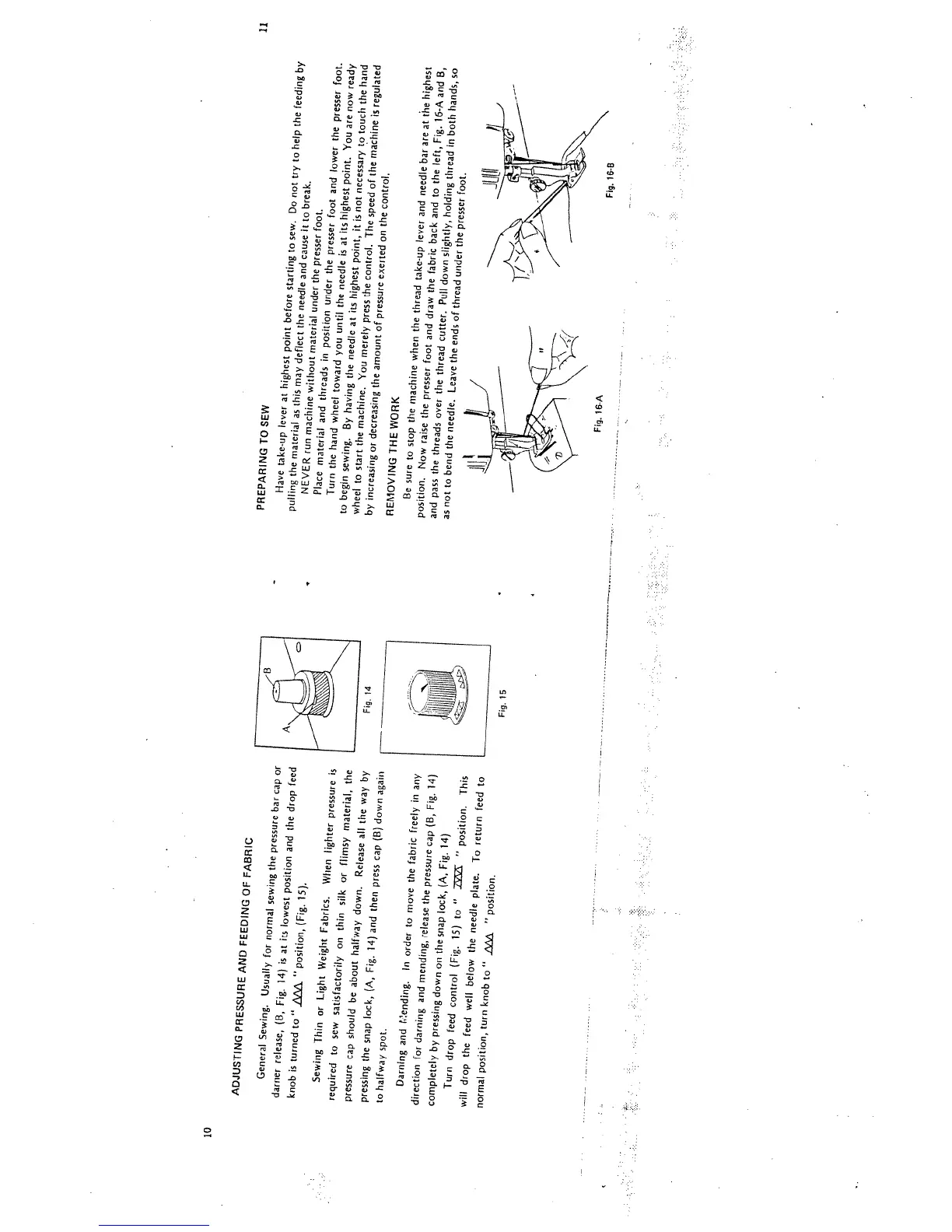
ADJUSTING
PRESSURE
AND
FEEDING
OF
FABRIC
General
Sewing.
Usually
for
normal
sewing
the
pressure
bar
cap
or
darner
release,
(B,
Fig.
14)
is
at
its
lowest
position
and
the
drop
feed
knob
is
turned
to
“position,
(Fig.
15).
Sewing
Thin
or
Light
Weight
Fabrics.
When
lighter
pressure
is
required
to
sew
satisfactorily
on
thin
silk
or
flimsy
material,
the
pressure
cap
should
be
about
halfway
down.
Release
all
the
way
by
pressing
the
snap
lock,
(A,
Fig.
14)
and
then
press
cap
(B)
down
again
to
halfway
spot.
Darning
and
Mending.
In
order
to
move
the
fabric
freely
in
any
direction
for
darning
and
mending,
release
the
pressure
cap
(B,
Fig.
14)
completely
by
pressing
down
on
the
snap
lock,
(A.
Fig.
14)
Turn
drop
feed
control
(Fig.
15)
to
position.
This
will
drop
the
feed
well
below
the
needle
plate.
To
return
feed
to
normal
position,
turn
knob
to”
“position.
PREPARING
TO
SEW
Have
take-up
lever
at
highest
point
before
starting
to
sew.
Do
not
try
to
help
the
feeding
by
pulling
the
material
as
this
may
deflect
the
needle
and
cause
it
to
break.
NEVER
run
machine
without
material
under
the
presser
foot.
Place
material
and
threads
in
position
under
the
presser
foot
and
lower
the
presser
foot.
Turn
the
hand
wheel
toward
you
until
the
needle
is
at
its
highest
point.
You
are
now
ready
to
begin
sewing.
By
having
the
needle
at
its
highest
point,
it
is
not
necessary
to
touch
the
hand
wheel
to
start
the
machine.
You
merely
press
the
control.
The
speed
of
the
machine
is
regulated
by
increasing
or
decreasing
the
amount
of
pressure
exerted
on
the
control.
REMOVING
THE
WORK
Be
sure
to
stop
the
machine
when
the
thread
take.up
lever
and
needle
bar
are
at
the
highest
position.
Now
raise
the
presser
foot
and
draw
the
fabric
back
and
to
the
left,
Fig.
16-A
and
B,
and
pass
the
threads
over
the
thread
cutter.
Pull
down
slightly,
holding
thread
in
both
hands,
so
as
not
to
bend
the
needle.
Leave
the
ends
of
thread
under
the
presser
foot.
Fig.
14
Fig.
15
Fig.
16-A
Fig.
16-8

Related product manuals