EasyManua.ls Logo

White 447 - Thread Tension Adjustment

White 447
37 pages
Print Icon
To Next Page IconTo Next Page
To Previous Page IconTo Previous Page
Loading...
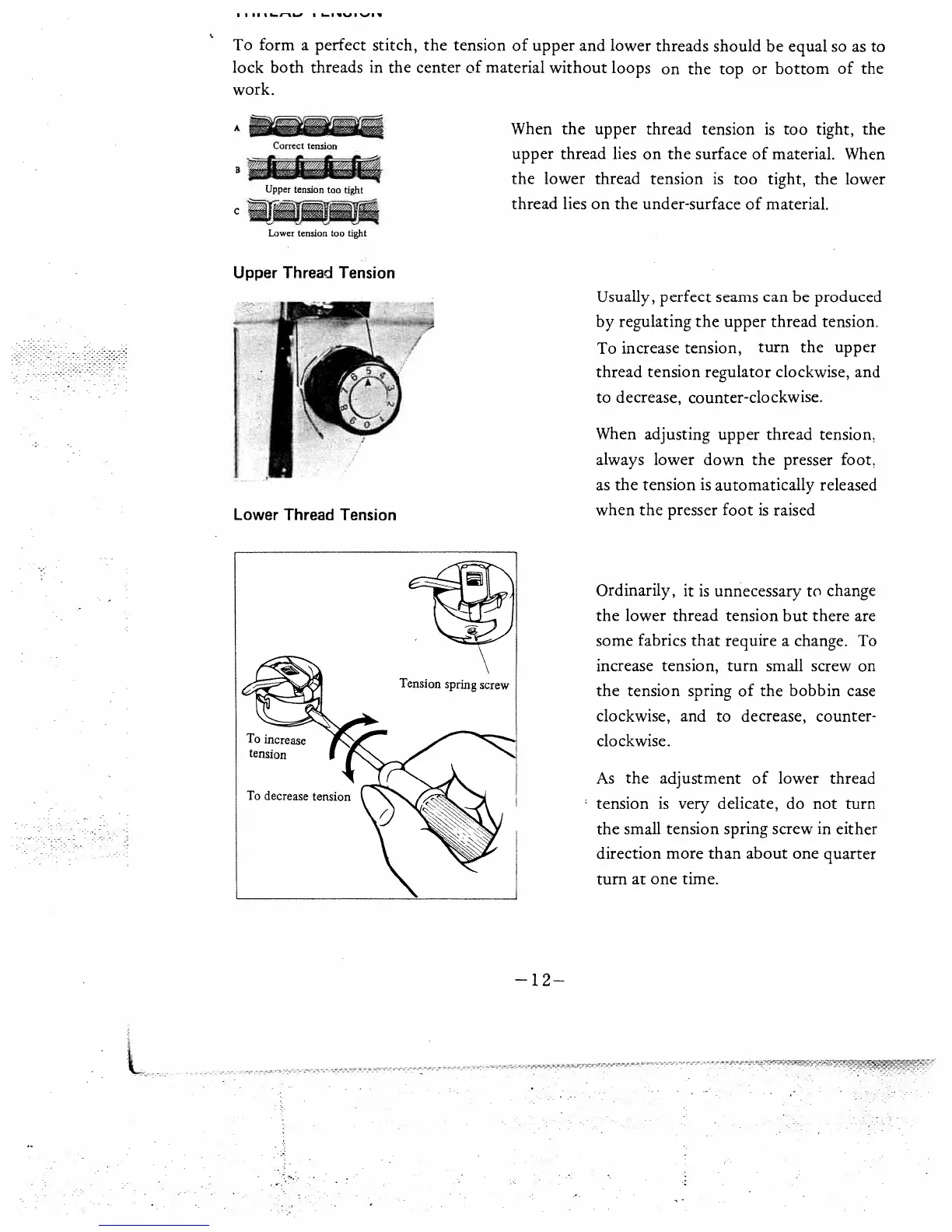
To
form
a
perfect
stitch,
the
tension
of
upper
and
lower
threads
should
be
equal
so
as
to
lock
both
threads
in
the center
of
material
without
ioops
on
the
top
or
bottom
of
the
work.
A
B
Correct
tension
Upper
tension
too
tight
Lower
tension
too
tight
Upper
Thread
Tension
When
the
upper
thread
tension
is
too
tight,
the
upper
thread
lies
on
the
surface
of
material.
When
the
lower
thread
tension
is
too
tight,
the
lower
thread
lies
on
the
under-surface
of
material.
Lower
Thread
Tension
Usually,
perfect
seams
can
be
produced
by
regulating
the
upper
thread
tension.
To
increase
tension,
turn
the
upper
thread
tension
regulator
clockwise,
and
to
decrease,
counter-clockwise.
When
adjusting
upper
thread
tension,
always
lower
down
the
presser
foot,
as
the
tension
is
automatically
released
when
the
presser
foot
is
raised
—12—
Ordinarily,
it
is
unnecessary
to
change
the
lower
thread
tension
but
there
are
some
fabrics
that
require
a
change.
To
increase
tension,
turn
small screw
on
the
tension
spring
of
the bobbin
case
clockwise,
and
to
decrease,
counter
clockwise.
As
the
adjustment
of
lower
thread
tension
is
very
delicate,
do
not
turn
the
small
tension
spring
screw
in
either
direction
more
than
about
one
quarter
turn
at
one
time.
L

Table of Contents

Related product manuals