Installation instructions DHW cylinders TSW-120/CSW-120
3048420_0707
10
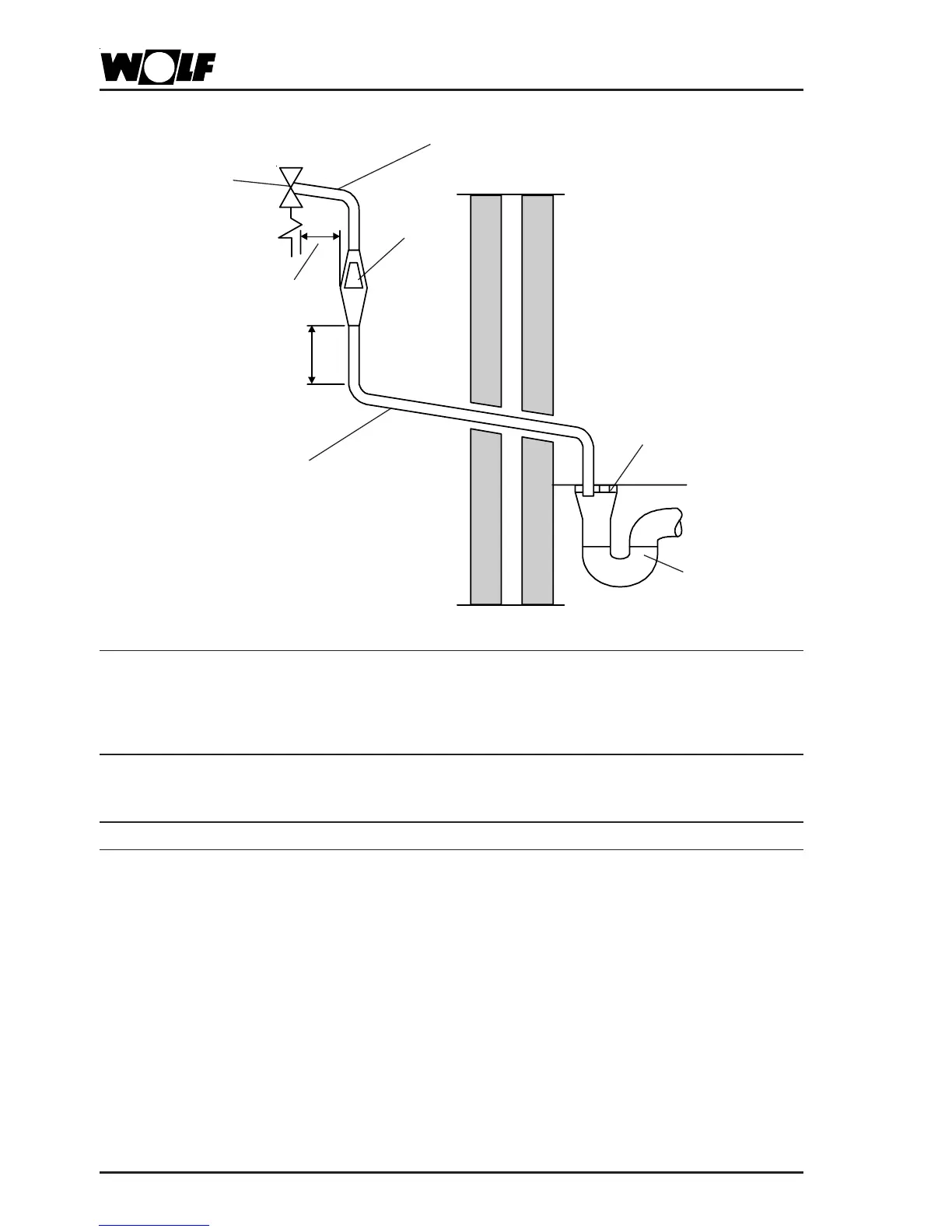
Installation of the tundish
Typical discharge
pipe arrangement
metal discharge pipe (D1) from
temperature relief valve to tundish
safety device
(eg.
temperature
relief valve)
300 mm
minimum
500 mm maximum
metal discharge pipe (D2) from
tundish, with continous fall,
see table an worked example
tundish
discharge below fixed
grating or as para 1 (b)
fixed louvred grating
trapped gully
Sizing of copper discharge pipe ‘D2’ for common temperature relief valve outlet sizes
Valve Minimum Minimum Maximum resistance Resistance
outlet size of size of allowed, expressed created by
size discharge discharge as a length of each elbow
pipe D1* pipe D2* straight pipe (ie. or bend
from tundish no elbows or bends)
28 mm up to 9 m 1.0 m
G½ 22 mm 35 mm up to 18 m 1.4 m
42 mm up to 27 m 1.7 m
* See Worked examples and scheme above
Worked example
The example below is for a G½ temperature
relief valve with a discharge pipe (D2) having 4
No. elbows and length of 7 m from the tundish
to the point of discharge.
From Table
Maximum resistance allowed for a straight length
of 22 mm copper discharge pipe (D2) from a G½
temperature relief valve equates to: 9 m
Subtract the resistance for 4 No. 22 mm elbows
at 0.8 m each = 3.2 m
Therefore the maximum permitted length equates
to: 5.8 m.
5.8 m is less than the actual length of 7 m
therefore calculate the next largest size.
Maximum resistance allowed for a straight
length of 28 mm pipe (D2) from a G½
temperature relief valve equates to: 18m
Subtract the resistance for 4 No. 28 mm
elbows at 1 m each = 4 m
Therefore the maximum permitted length
equates to: 14 m
As the actual length is 7 m, a 28 mm (D2)
copper pipe will be satisfactory.


 To Next Page