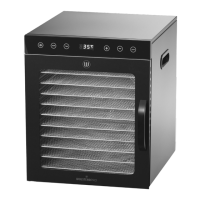
WOLSTEAD PRO 10 TRAY DEHYDRATOR OWNER’S MANUAL8
DEHYDRATING FOOD
While most food types can be dehydrated at a temperature of approximately 55°C,
when dehydrating meats, poultry and sh (making jerky, biltong etc) the temperature
needs to be raised to guard against pathogens such as Salmonella and E. Coli.
Choosing food to dehydrate
• For best results only use the freshest quality foods you can acquire.
• In season produce found at its peak will have more avour and more nutrients.
• Meats, sh and poultry should be lean and fresh.
• Avoid foods that appear with bruises and blemishes. Poor quality produce can spoil
the entire batch.
• Remove as much fat as possible from meats prior to dehydrating. You can use a
paper towel under meat when dehydrating to absorb fat.
Getting started
Select which layer you wish to use rst. When loading the food into the trays you can
use all of the tray‘s surface, but some air ow must be maintained.
Place the cut food as a single layer on a clean tray, ensuring no liquid is able to drip
onto the bottom of the electric heater to avoid the possibility of the unit to short
circuit.
Do not overload the trays.
Only ll with one layer of desired food as this will affect the drying time. If the food
cannot be dried within one day, you can dry it over the course of a few days as long as
the unit can have a break from continuous use after every 24 hours.
Ensure the appliance is switched off when changing and alternating between trays.
After the food has reached its preferred drying time, store the dried food in an airtight
storage container or bags to preserve the produce.


 To Next Page