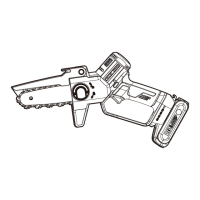
This document describes the WORX NITRO Cordless Pruning Saw (Models WG325E and WG325E.X), a battery-operated tool designed for cutting wood and branches.
Function Description
The WORX NITRO Cordless Pruning Saw is a specialized power tool intended for pruning wood and branches up to a diameter corresponding to the length of its guide bar. It is designed for outdoor use and must be operated at ground level or from a completely stable and secure platform. The saw is not intended for tree felling or for cutting materials other than wood, such as metal, plastic, masonry, or non-wood building materials. Using the tool for operations other than its intended purpose or with unauthorized modifications can lead to hazardous situations and will void the warranty.
The device features a BRUSHLESS MOTOR, which typically offers improved efficiency, longer runtime, and extended motor life compared to brushed motors. It is part of the WORX NITRO and PowerShare battery systems, indicating compatibility with other WORX 20V PowerShare batteries and chargers.
An optional extension pole (WG325E.X models) can be attached to the saw, allowing for increased reach, particularly for higher branches. When using the extension pole, it is crucial to ensure the battery pack has been removed during assembly and that the pole is securely locked into position before operation. The extension pole also features its own lock-out button and on/off switch for safe operation.
Important Technical Specifications
- Voltage: 20 V Max.** (Nominal voltage 18 V)
- Bar length: 12 cm
- Chain speed: 10 m/s
- Chain pitch: 7.6 mm
- Number of chain drive links: 28
- Chain gauge: 1.1 mm
- Adaptive chain type: WA0142
- Adaptive guide bar type: WA0151
- Extension pole length (for WG325E.X): 125 cm
- Maximum cutting height (with extension pole): 275 cm
- Extension pole weight: 0.9 kg
- Machine weight (chain & bar included, bare tool): 1.1 kg
- A-weighted sound pressure level (LpA): 84 dB(A)
- Uncertainty (KpA): 3 dB(A)
- A-weighted sound power level (LwA): 94 dB(A)
- Uncertainty (KwA): 3 dB(A)
- Vibration emission value (ah): 2.9 m/s²
- Uncertainty (K): 1.5 m/s²
Suggested Batteries and Chargers:
- 20V Battery: WA3551 (2.0 Ah), WA3639 (2.0 Ah)
- 20V Charger: WA3880 (2.0 A)
The ambient temperature range for tool and battery use and storage is 0°C-45°C. The recommended ambient temperature range for charging is 0°C-40°C.
Usage Features
The pruning saw incorporates several features for safe and efficient operation:
- Safety Warnings: The manual emphasizes reading all safety warnings, instructions, illustrations, and specifications to prevent electric shock, fire, or serious injury. General power tool safety warnings cover work area safety, electrical safety, personal safety, and power tool use and care.
- Kickback Safety Devices: The saw is equipped with a low-kickback chain and a reduced kickback guide bar to minimize the chance of kickback. However, users are advised to take precautions such as maintaining a firm grip, avoiding overreaching, not cutting above shoulder height, and using only specified replacement parts.
- Starting and Stopping: To switch on the tool, the lock-out button must be pressed, followed by fully pressing the on/off switch. Releasing the on/off switch turns the saw off. The chain must be running at full speed before making contact with the wood.
- Cutting Technique: When cutting, users should apply light pressure, allowing the saw to do the work to prevent overloading the motor. The base plate can be used to secure the saw onto the wood and as a leverage point. It is crucial to avoid operating the saw with arms fully extended, attempting to saw hard-to-reach areas, or standing on a ladder. The saw should never be used above shoulder height.
- Limbing and Bucking: Specific instructions are provided for limbing (removing branches from a fallen tree) and bucking (cutting a log into lengths). These include techniques for cutting branches under tension, making cuts from the top (overbuck) and bottom (underbuck) to prevent binding or log splitting, and maintaining proper footing and balance.
- Cutting Wood Under Tension: Extreme caution is advised when cutting limbs under tension due to the risk of spring back, which can cause the limb to strike the operator or throw the saw out of control.
- Extension Pole Operation: When using the extension pole, users must grip the pole saw with both hands in designated grip areas, maintain firm footing, and keep bystanders at a safe distance. It is strictly prohibited to stand directly below a branch being cut, use the tool on a ladder or unstable support, or near electrical power lines (maintaining a 3m clearance).
- Battery Use and Care: The manual provides detailed instructions for charging, installing, and removing the battery pack. It warns against short-circuiting, exposing the battery to heat or fire, mechanical shock, and using damaged or modified battery packs. Only specified chargers and battery packs should be used.
Maintenance Features
Regular maintenance is crucial for the safety, performance, and longevity of the pruning saw:
- Chain Lubrication: The pruning saw is not pre-filled with oil, and it is essential to fill the oil tank with bar and chain oil before use. Operating the saw without oil or with an empty tank will cause extensive damage. The manual specifies using bar and chain lubricant formulated for a wide temperature range and warns against using dirty, used, or contaminated oils. The automatic oiler's proper functioning can be checked by observing the oil pattern on cardboard during operation.
- Chain Tensioning: The chain tension must be checked frequently, especially with new saw chains, as they tend to stretch. Proper tension is achieved when the chain can be lifted approximately half the drivelink depth from the guide bar in the center. Instructions are provided for adjusting tension by turning the housing-cover knob.
- Chain Sharpening: The manual emphasizes keeping the chain sharp for faster, safer cutting and to prevent undue wear on the sprocket, guide bar, and motor. It advises using a 3mm round file at a 30° angle to the guide bar. Dull chains can be identified by slow cutting, the need to force the chain, or the production of sawdust instead of large chips.
- Guide Bar Maintenance: The guide bar should be inspected for wear, bending, cracks, or excessive heating. The bar rails should be cleaned every time the chain is removed. A wire brush or screwdriver can be used to clear residue from the inner groove, and oil passages must be thoroughly cleaned.
- General Cleaning and Storage: After each use, the saw chain and guide bar should be cleaned, and all sawdust removed. The saw should be stored in a high or locked, dry place, out of reach of children, with the bar and housing cover in place.
- Troubleshooting: A troubleshooting table is provided to help users identify and remedy common issues such as the saw failing to operate, operating intermittently, chain/chain bar overheating, or the saw ripping/vibrating and not cutting properly. For problems not covered, users are advised to contact a service agent.
- Authorized Service: For repairs, only qualified repair persons using identical replacement parts should service the power tool. Service of battery packs should only be performed by the manufacturer or authorized service providers.


 To Next Page

 General