
 Need help?
Do you have a question about the Worx Landroid M WG794E and is the answer not in the manual?
Read all safety warnings and instructions. Failure to follow may result in injury. Save for future reference.
Covers training, preparation, and general operating rules for safe use of the robotic mower.
Safety precautions for automatic operation, manual control, and environmental conditions like slopes.
Ensure safe working condition by checking nuts, bolts, blades, and using correct parts and chargers.
How to safely move the Landroid®M, including stopping, switching off, and carrying it correctly.
Details important warnings and symbols related to safe operation and handling of the Landroid®M.
Provides guidance on Li-Ion battery disposal, environmental impact, and recycling procedures.
Warning against high-pressure washing; information on WEEE compliance and battery recycling.
Details specifications like voltage, cutting diameter, battery type, weight, and protection degree.
Information on sound pressure and sound power levels, with recommendations for hearing protection.
Lists all accessories provided with the mower and provides advice on purchasing genuine parts.
Provides a comprehensive list of all parts and components of the Landroid®M with their respective names.
Explains how the Landroid®M randomly chooses direction to ensure complete and even lawn coverage.
Covers finding the charging base, rain sensor function, boundary wire sensing, and manual start/stop operations.
Details maximum mowing area (1000m²) and influencing factors like grass type, blade sharpness, and climate.
Addresses cutting height, optimal mowing conditions (dry grass), and storm protection measures.
Covers pegging, burying, and joining the boundary wire, ensuring correct placement for mowing area.
Procedure to test boundary wire connectivity and installation using charger base indicators.
Instructions on how to keep blades sharp by rotating or flipping them for optimal cutting performance.
Guidance on replacing worn blades, stressing the importance of replacing all blades simultaneously.
Instructions for cleaning the mower's body and underside, including the blade disc and ensuring free movement.
Procedure to clean contact pins and charging strips for reliable charging of the Landroid®M.
Details battery lifespan factors and manual charging procedures without the boundary wire.
Guidance on cleaning, charging, and storing the Landroid®M for winter hibernation.
Provides a step-by-step guide for safely replacing the Landroid®M's battery.
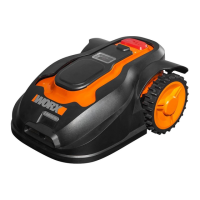
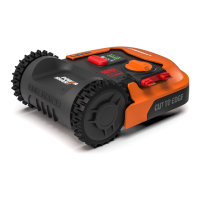
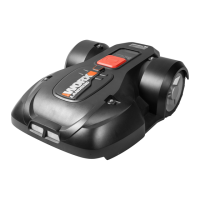
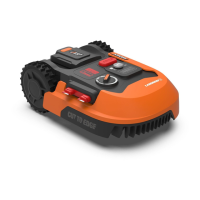
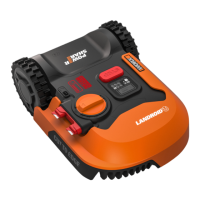
The WORX Landroid WG794E is a robotic lawnmower designed for automatic and care-free lawn maintenance. It operates autonomously, navigating the lawn to ensure even mowing without leaving unattractive paths.
The Landroid WG794E's primary function is to mow lawns automatically. It uses a random mowing pattern to cover the entire area. The device is equipped with sensors that allow it to detect its charging base, sense rain, and identify obstacles. When the battery is low, the Landroid will stop mowing and follow the boundary wire back to its charging base in an anti-clockwise motion. Its blade turning disc automatically stops rotating when returning to the charging base to prevent accidents. However, if you manually command it to return to the charging base (by pressing the home button), the blade turning disc will continue to rotate, allowing it to cut grass near the boundary wire. This feature is recommended when the battery power is above 75%.
The robotic lawnmower is fitted with a rain sensor that detects raindrops, prompting the Landroid to stop mowing and return to its charging base. It can be programmed with a delay start function (0-180 minutes) after rain, meaning it will only resume mowing once the rain sensors are dry and the countdown is complete.
The Landroid adheres to a border defined by a boundary wire, using two front sensors to detect when it is approaching the wire. It will typically overrun the boundary wire by up to 20 cm before changing direction, a recommended distance to ensure proper installation.
To stop the mower during operation, simply press the STOP button on top of the device. To restart mowing, open the control panel cover, press the ON/OFF key, then press the START key, or input further commands before pressing START again. If the Landroid detects a problem, it will display a fault message and turn itself off if no user input is received within 20 minutes. To resume operation after a fault, press the STOP key to address the issue, press the ON/OFF key twice to restart, and then press the START key.
The Landroid WG794E can mow areas up to approximately 1000m², though actual performance depends on factors like grass species, growth rate, blade sharpness, humidity, surrounding temperature, and the number of obstacles. It operates best in dry weather, as wet grass can build up on the blade turning disc and motor, potentially causing loose traction and slippage. The device is sensitive to lightning storms; in such cases, it should be protected by unplugging the charging base, disconnecting the boundary wire, and ensuring it is not charging.
The cutting height of the Landroid can be adjusted between 2cm and 6cm. Before its first use, it is recommended to cut the grass to a height of no more than 9cm, then set the Landroid's cutting height to its maximum of 6cm.
The Landroid is designed for ease of use and autonomous operation. Its ability to randomly mow ensures comprehensive coverage without repetitive patterns. The automatic return to the charging base simplifies battery management. The rain sensor feature prevents mowing in unsuitable conditions, protecting the device and ensuring optimal grass cutting. The boundary wire system allows users to define the exact mowing area, preventing the robot from straying into unwanted zones. The device's ability to stop and restart with simple button presses offers convenient control. The adjustable cutting height allows for customization based on lawn conditions and desired grass length.
Regular maintenance is crucial for the Landroid's longevity and performance. Key maintenance tasks include keeping the blades sharp and clean, and ensuring the device's body and underside are free of debris.
Blade Maintenance: The Landroid uses razor-sharp cutting blades with four edges, spinning in both directions for maximum cutting capacity. Each blade has four cutting edges. Depending on mowing frequency, the blades need to be flipped or rotated periodically for a new cutting edge. If the Landroid mows daily, blades should be rotated monthly for best results and can last up to four months. When blades become dull or worn, they should be replaced with new ones. It is important to replace all three blades simultaneously with new screws to maintain balance and ensure proper blade retention, preventing serious injury. Before any blade maintenance, the Landroid must be turned OFF using the ON/OFF button, and protective gloves should be worn. After screwing new blades to the blade disc, ensure they can spin freely.
Cleaning: Regular cleaning extends the Landroid's life. When cleaning the body, avoid using hoses, high-pressure washers, or pouring water directly onto the device, as it is an electric machine. A spray bottle with water, a soft brush, or a clean cloth is recommended. Solvents or polishes should be avoided. All grass clippings and debris should be removed. For cleaning the underside, the Landroid must be powered OFF, and protective gloves worn. Flip the device over to access the blade disc, chassis, front wheel, and driving wheel. Clean these areas thoroughly with a soft brush or moist rag. Rotate the blade disc to ensure it moves freely and that no debris is lodged between it and the motor frame box. Any lodged debris should be removed to prevent cracks in the blade disc, which can reduce mowing output.
Contact Pins and Charging Strips: The contact pins on the charging base and the charging strips on the Landroid should be cleaned periodically with a cloth to remove grass clippings and debris, ensuring successful charging each time.
Battery Life and Winter Hibernation: The Landroid is powered by a 28-volt lithium-ion battery that requires no maintenance. For proper storage, the battery should be fully charged and kept in a cool, dry place (20°C-60°C). The battery's lifespan is influenced by the mowing season duration, daily mowing hours, and maintenance during storage. The Landroid can be charged manually without the boundary wire by connecting the charging base to power, manually docking the Landroid (while powered off), and then pressing the ON/OFF button within 3 seconds of the charging base light turning red (before it turns green).
For winter hibernation, it is recommended to thoroughly clean the Landroid, fully charge the battery, and turn off the power. The boundary wire can remain in the ground if its ends are protected. If the charging base stays outside, the boundary wire should remain connected. Before bringing the Landroid back into service after winter, ensure the charging strips and contact pins are clean, using a fine-grade emery cloth if necessary, and verify the date and time settings. If the battery needs replacement, gently turn the Landroid upside down, remove the four screws on the battery cover, replace the old battery with a new one, and firmly replace the screws.
 General
| Type | Robotic Lawn Mower |
|---|---|
| Cutting Width | 18 cm |
| Cutting Height | 20-60 mm |
| Battery Voltage | 20 V |
| Battery Capacity | 2.0 Ah |
| Rain Sensor | Yes |
| Anti-Theft Protection | PIN Code |
| Boundary Wire | Yes |
| Working Time | 60 minutes |
| Smartphone App | Yes |





 To Next Page

