13
TESTING THE RANGE OF THE RADIO SYSTEM
PREPARING AND CHECKING THE STARTERBOX
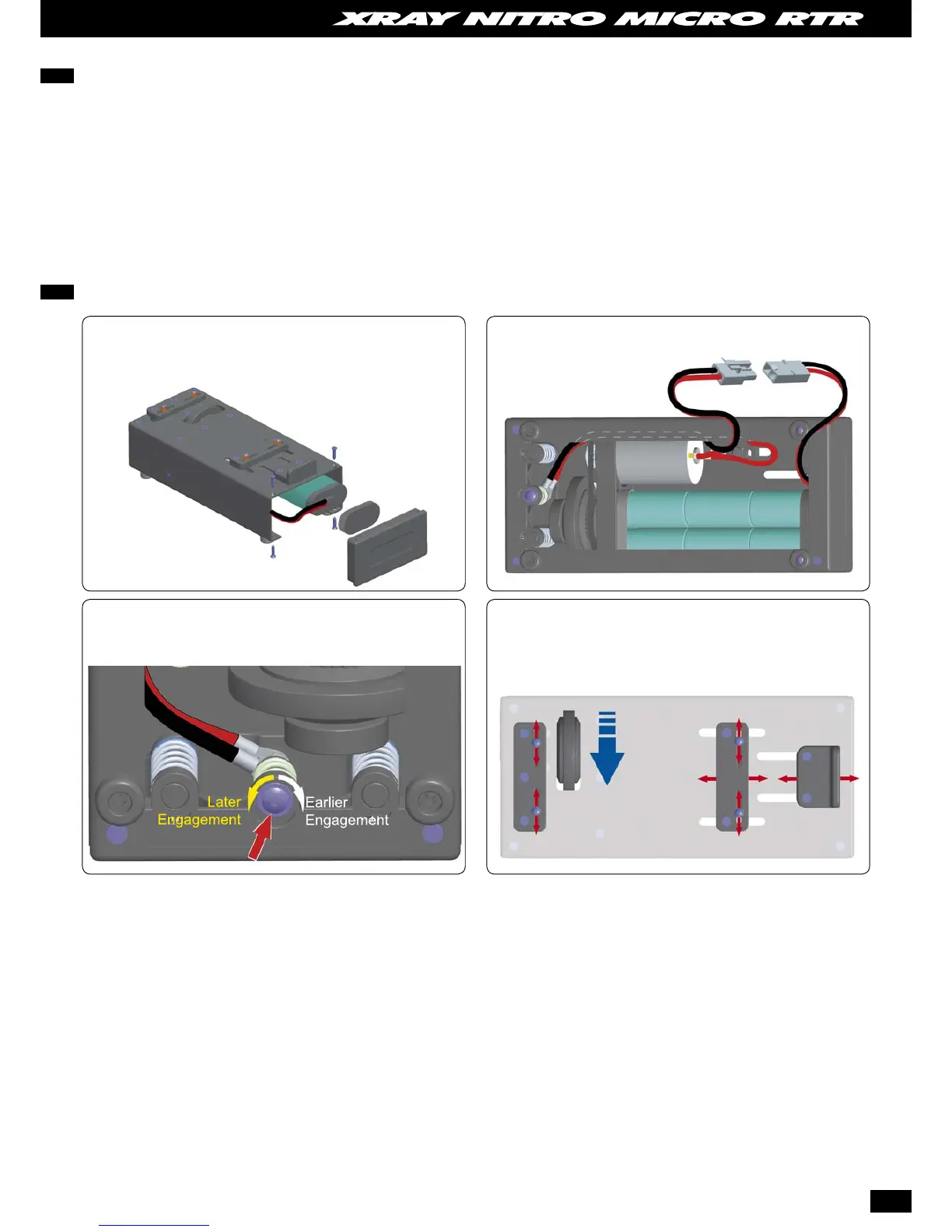
Use standard 6-cell 7.2V battery pack. To install the battery pack, dismantle
the rear cover and insert the battery pack within the battery slots and route
the cables within the slot. In case the battery pack is shorter, use the included
foam cushion. Reinstall the rear cover again.
Connect the battery pack to the motor.
You can easily adjust the start-box engagement point; it is pre-adjusted at the
factory for the XRAY micro nitro truck. Tighten or loosen the screw as shown
to set an earlier or later engagement
Place the truck on the box so that the fl ywheel of the engine matched up with
the starter wheel. If the truck does not fi t the back-stop properly, you can easily
adjust them in any direction. Before placing the truck on the start-box, operate
the start-box to ensure the starter wheel spins in the indicated direction.
IMPORTANT NOTES – ELECTRICAL
• Do not disassemble the battery pack or cut battery cables. If the running battery
short-circuits, approximately 300W of electricity can be discharged, leading to fi re
or burns. Never disassemble the battery pack or cut battery cables.
•
Use a recommended charger for the battery pack and follow the
instructions correctly. Over-charging, incorrect charging, or using
inferior chargers can cause the battery pack to become dangerously hot.
Recharge battery when necessary. Continual recharging may damage
battery and, in the worst case, could build up heat leading to fi re. If
battery becomes extremely hot during recharging, please ask your local
hobby shop for check and/or repair and/or replacement.
• Regularly check the charger for potential hazards such as damage to the
cable, plug, casing or other defects. Ensure that any damage is rectifi ed
before using the charger again. Modifying the charger may cause short-
circuit or overcharging leading to a serious accident. Therefore do not
modify the charger.
• Always unplug charger when recharging is fi nished.
• Do not recharge battery while battery is still warm. After use, battery
retains heat. Wait until it cools down before charging.
• Disconnect and remove the battery pack if you plan to not use the start-
box for a period of time (e.g., several days).
OPERATING TIPS
• Inspect the start-box wiring and components before each use, and do not use the
start-box if any wiring or components appear to be damaged, cut, or worn.
• Before placing a truck on the start-box, operate the start-box to ensure the starter
wheel spins in the proper direction.
• If the truck’s nitro engine seizes at TDC while the truck is on the starter box, do
not continue to try starting the engine; damage will result to the start-box and the
engine fl ywheel. Rotate the nitro engine fl ywheel until the piston is at BDC and try
starting the truck again.
• When the starter wheel speed is noticeably reduced, you should fully charge the
battery pack.
MAINTENANCE
Remove excess build-up of debris, dirt, fuel, etc. from the start-box to ensure proper,
clean operation. Do not use solvent-based chemicals to clean the components of the
start-box.
It is important to test the range of the radio system before driving the truck. This will let you know if there is any interference in the signal between your
transmitter and the truck, or if the batteries are low. It is best to perform a range test with 2 people.
1. Make sure that the transmitter batteries and receiver pack batteries are fully charged.
2. Turn on the transmitter, turn on the truck, and then start the truck engine.
3. Have someone hold the truck while it is running. Make sure s/he holds it safely.
4. While near to the truck, operate the throttle/brake and steering controls.
5. Walk away from the person holding the truck, and continue to operate the controls. The truck should respond to your transmitter without glitching.
6. Continue to walk away, still operating the transmitter controls, until the truck stops responding to your transmitter or it starts behaving erratically
(glitching).
7. Walk back towards the person holding the truck until the truck again responds properly to your transmitter. THIS IS THE MAXIMUM SAFE RANGE OF
THE RADIO SYSTEM.
8. Stop the truck engine, turn off the truck, and then turn off the transmitter.


 To Next Page
 Loading...