Need help?
Do you have a question about the Yaesu FT-8800 and is the answer not in the manual?
Explains Cross Band Repeat mode for extending HT coverage and emergency nets.
Covers proper IDing, keying delays, and waiting for squelch for clear audio transmission.
Stresses setting both bands to LOW POWER to prevent radio overheating and damage.
Advises testing the mode off-net, noting audio changes and delays for proper operation.
Crucial instruction to wait for the repeater to unkey before responding.
Guides setting desired frequencies on both bands, recommending memory mode and PL Decode.
Instructs to set both bands to their lowest power settings using the "LOW" button for safety.
Explains how to enter the radio's menu mode by pressing the center SET KEY button.
Details navigating to menu option "X-RPT" and activating the cross-band repeat function.
Provides the procedure to disable or exit the cross-band repeat operation.
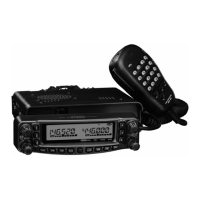
The Yaesu FT-8800 is a mobile radio designed for amateur radio enthusiasts, specifically for cross-band repeat operations. This function allows the radio to receive signals on one band and retransmit them on another, effectively extending the range of a handheld transceiver (HT) or providing coverage in areas with poor RF reception, such as inside buildings or for emergency nets.
The primary function of the Yaesu FT-8800 in cross-band repeat mode is to act as a relay. It receives a signal on one frequency (e.g., from an HT) and simultaneously transmits that signal on a different frequency (e.g., to a repeater or another radio), and vice-versa. This creates a communication bridge, enabling users with lower-power HTs to access distant repeaters or communicate over greater distances than their HTs would normally allow. The radio is designed to operate with two distinct bands, allowing for simultaneous reception and transmission across these bands. It supports both "Memory mode" for pre-programmed frequencies and "VFO mode" for manual frequency selection, though Memory mode is recommended for ease of use in cross-band repeat operations. A critical aspect of its operation is the requirement for PL Decode on both sides to prevent unwanted signals from activating the repeater and causing it to lock up in transmit.
To set up the Yaesu FT-8800 for cross-band repeat, users must follow a specific sequence of steps. First, both sides of the radio (left and right) need to be set to the desired frequencies. Typically, one side (e.g., the left) is configured for the "outside world" frequency (e.g., a repeater input), while the other side (e.g., the right) is set to the frequency used by the HT. The radio can enter cross-band repeat mode from either side; the choice determines which band becomes the main band.
A crucial usage feature is the power setting. For cross-band repeat operation, both bands on the mobile radio MUST be set to LOW POWER. This is a critical instruction repeated multiple times in the manual, emphasizing its importance to prevent the radio from overheating and potentially burning up. Users must push the "LOW" button on each side until the lowest possible power settings are selected.
Once frequencies and power levels are set, the user enters the menu mode by momentarily pressing the center "SET KEY" button (unmarked, not more than 1.5 seconds). Within the menu, the top DIAL knob is rotated until "X-RPT" (MENU #45) is displayed. To initiate cross-band repeat, the same DIAL knob is pressed momentarily, TWICE. To exit cross-band repeat mode, the center "SET" button is pressed momentarily.
When using the radio in cross-band repeat mode, it's important to note that there will be a slight delay in audio transmission as the radio processes and retransmits the signal. This necessitates a specific operating practice: users should key up and wait a moment before speaking to ensure their first words are not cut off. This practice is also generally good operating procedure. Similarly, when replying, users must wait for the repeater to drop before transmitting.
The radio is typically set up in a vehicle, but it can also be used with a base power supply in a tall building or on a hill, often with a magnetic mount antenna. The choice of location and antenna setup is crucial for achieving the desired coverage for the HT.
While the manual doesn't detail traditional maintenance features like cleaning or component replacement, it strongly emphasizes operational practices that contribute to the longevity and proper functioning of the device. The most significant "maintenance" instruction is the repeated warning to always set both bands to LOW POWER during cross-band repeat operation. This is a preventative measure against overheating and damage.
The manual also suggests periodically checking the mobile rig for overheating, especially when operating in cross-band repeat mode. This implies that while the low power setting is crucial, continuous monitoring of the radio's temperature is a good practice to ensure its stability and prevent potential issues.
Another aspect of "maintenance" in an operational sense is the recommendation to test the setup when the repeater is not in use and not during an active net. This allows users to identify and resolve any operational issues without disrupting ongoing communications. It also suggests asking another amateur radio operator to assist with testing, which can help in fine-tuning the setup and understanding the audio characteristics and delays introduced by the cross-band repeat function.
The manual also touches upon responsible operation, advising against leaving a cross-band repeater unattended without a control operator and without permission from the repeater owner. While not a direct maintenance feature, it promotes practices that ensure the radio is used responsibly and within the guidelines of amateur radio operation, which indirectly contributes to its long-term usability and the user's standing in the amateur radio community. Proper identification (e.g., "This is KA8SPW using a cross band repeater") is also encouraged to inform other operators about the operational mode, fostering better communication practices.
 General
| Supply Voltage | 13.8V DC ±15% |
|---|---|
| Channel Steps | 5/10/12.5/15/20/25/50/100 kHz |
| Antenna Impedance | 50 Ohms, unbalanced |
| Frequency Range | 144-148 MHz, 430-450 MHz |
| Modes | FM |
| Dimensions | 140 x 40 x 168 mm |
| Memory Channels | 1000 channels |
| Current Consumption | RX: 500 mA; TX: 8.5 A (50 W) |


 To Next Page