6-14
1
2
3
4
5
6
7
8
9
EAU17226
PERIODIC MAINTENANCE AND MINOR REPAIR
Tires<IXE>
EAUT2150
Tires
To maximize the performance, durabil-
ity, and safe operation of your scooter,
note the following points regarding the
specified tires.
Tire air pressure
The tire air pressure should be checked
and, if necessary, adjusted before each
ride.
EWA10540
w
Because loading has an enormous
impact on the handling, braking, per-
formance and safety characteristics
of your scooter, you should keep the
following precautions in mind.
●●
●●
● NEVER OVERLOAD THE
SCOOTER! Operation of an over-
loaded scooter may result in tire
damage, loss of control, or se-
vere injury. Make sure that the
total weight of rider, cargo, and
accessories does not exceed the
specified maximum load for the
vehicle.
●●
●●
● Improper tire air pressure greatly
affects tire life and handling.
If the tire air pressure is too high,
shocks from the road will not be
dampened but instead be trans-
mitted to the frame and handle-
bars, which impairs riding com-
fort. In addition, the scooter will
be unstable in curves.
If the tire air pressure is too low,
the tires will be damaged and the
tire life shortened. In addition,
the tires could slip off the wheel
rims during braking, which
could result in tube damage. The
scooter could also easily turn
over in a curve.
Tire air pressure* (measured on cold
tires):
Front:
175 kPa (25 psi) (1.75 kgf/cm
2
)
Rear:
175 kPa (25 psi) (1.75 kgf/cm
2
)
Tire inspection
ZAUM00**
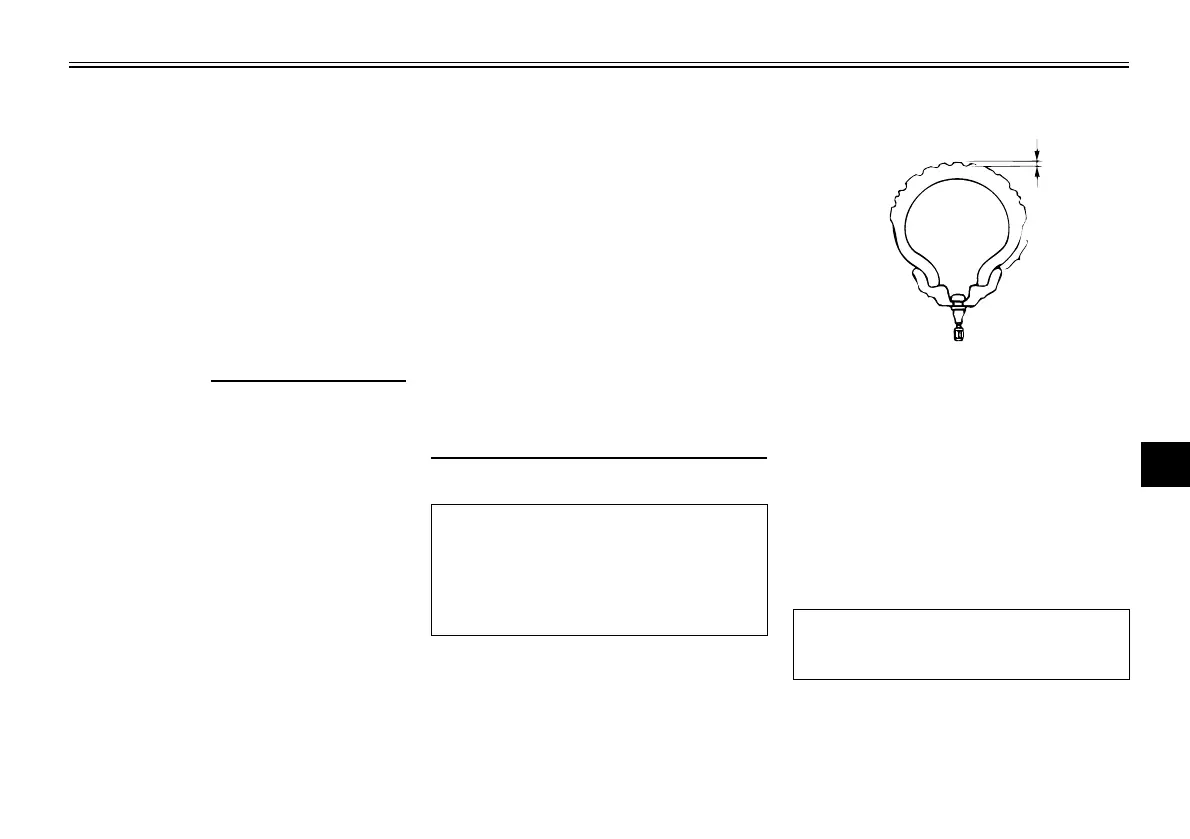
1
2
1. Tire tread depth
2. Tire sidewall
Always check the tires before operat-
ing the scooter. If a tire tread shows
crosswise lines (minimum tread depth),
if the tire has a nail or glass fragments
in it, or if the sidewall is cracked, con-
tact a Yamaha dealer immediately and
have the tire replaced.
Minimum tire tread depth (front and
rear):
0.8 mm (0.03 in)
Tire information
This scooter is equipped with cast
wheels and tubeless tires.
3B3-F8199-11_ch6.pmd 2007/07/30, 16:3614




 To Next Page