Instrument and control functions
5-27
1
2
3
4
5
6
7
8
9
10
11
12
13
EWA16051
Always keep a sufficient distance
from the vehicle ahead to match the
riding speed even with ABS.
The ABS performs best with
long braking distances.
On certain surfaces, such as
rough or gravel roads, the brak-
ing distance may be longer with
the ABS than without.
The ABS hydraulic unit is monitored by
the ABS ECU, which will revert the sys-
tem to conventional braking if a mal-
function occurs.
EWA20891
The brake control system is not a
substitute for the use of proper rid-
ing and braking techniques. The
brake control system cannot pre-
vent all loss of traction due to
over-braking from excessive speed,
or lateral wheel slip when braking on
slippery surfaces.
The ABS performs a self-diagnostic
test when the vehicle is started and
reaches a speed of 5 km/h (3 mi/h).
During this test, a clicking noise may be
audible from the hydraulic control unit,
and a vibration may be felt at the brake
lever or pedal, but this is normal.
ECA20100
Be careful not to damage the wheel
sensor or wheel sensor rotor; other-
wise, improper performance of the
ABS will result.
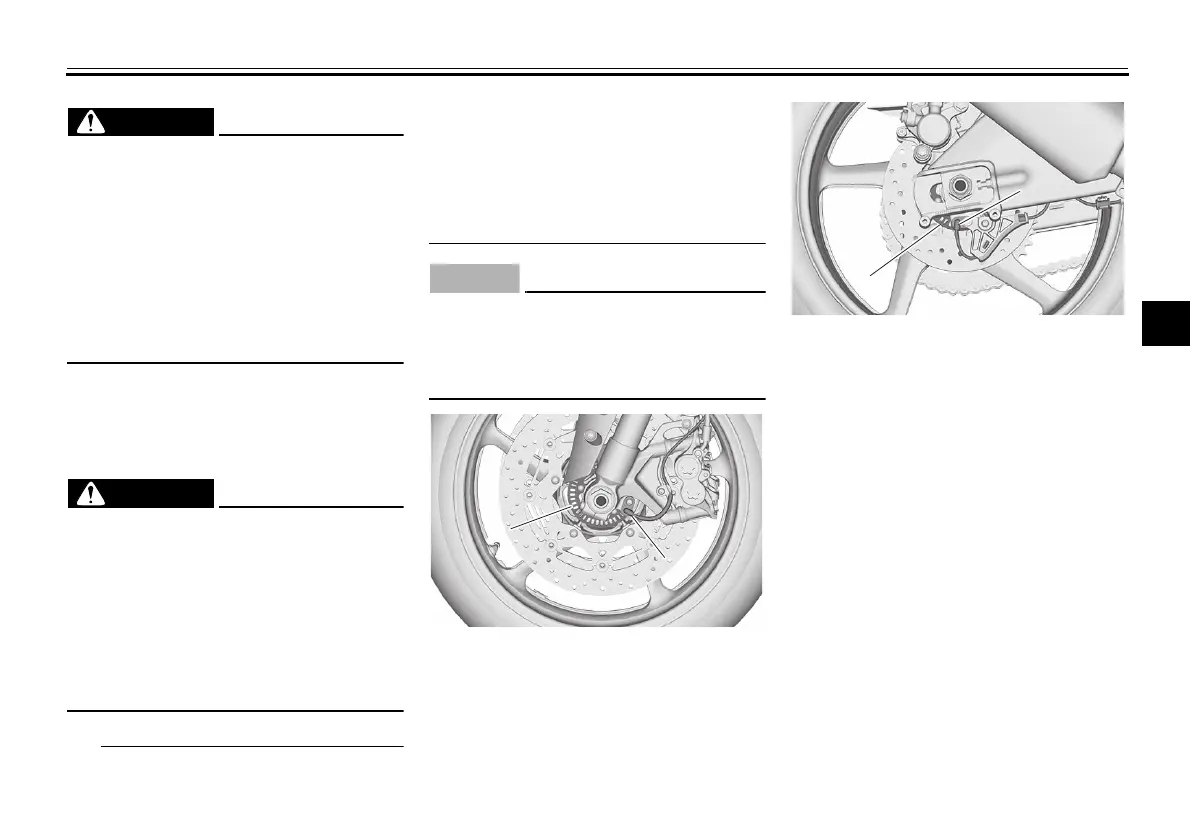
1. Front wheel sensor rotor
2. Front wheel sensor
2
2
1
1. Rear wheel sensor rotor
2. Rear wheel sensor
2
2
1
B5Y-9-10-E0.book 27 ページ 2021年12月15日 水曜日 午後1時30分



 To Next Page