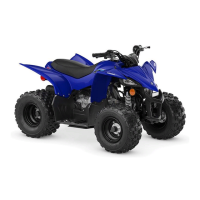
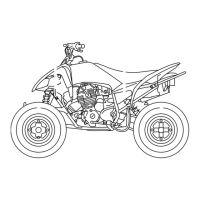
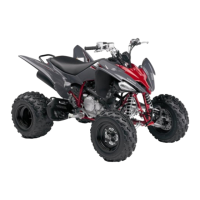
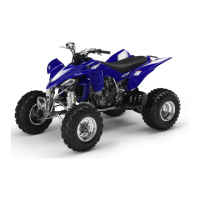
This document is the owner's manual for the Yamaha YFZ05YYXJ ATV, providing comprehensive information on its features, operation, maintenance, and safety guidelines. The ATV is designed for recreational use on unpaved surfaces only and is not a toy. It is recommended for operators aged 6 and older, with adult supervision required for those under 16.
Function Description:
The Yamaha YFZ05YYXJ is an all-terrain vehicle (ATV) designed for off-road recreational use. It features a 4-stroke, SOHC, air-cooled single-cylinder engine with a displacement of 49 cm³. The ATV is equipped with both an electric starter and a kickstarter for engine ignition. It utilizes a V-belt automatic centrifugal clutch transmission with a chain drive secondary reduction system. The front and rear brakes are mechanical leading, trailing drum brakes, operated by right-hand and left-hand levers, respectively. The suspension system includes a swing axle with coil spring/oil dampers for both front and rear.
Important Technical Specifications:
- Dimensions:
- Overall length: 1250 mm (49.2 in)
- Overall width: 820 mm (32.3 in)
- Overall height: 770 mm (30.3 in)
- Seat height: 585 mm (23.0 in)
- Wheelbase: 830 mm (32.7 in)
- Ground clearance: 88 mm (3.5 in)
- Minimum turning radius: 2300 mm (91 in)
- Weight:
- Curb weight: 100.0 kg (220 lb)
- Maximum loading limit (total weight of rider, cargo, accessories, and tongue weight): 41.0 kg (90 lb)
- Engine:
- Type: Air cooled 4-stroke, SOHC
- Cylinder arrangement: Single cylinder
- Displacement: 49 cm³
- Bore × stroke: 39.0 × 41.4 mm (1.54 × 1.63 in)
- Compression ratio: 8.5 : 1
- Starting system: Electric starter and kickstarter
- Lubrication system: Wet sump
- Engine oil: YAMALUBE, API service SG type or higher, JASO standard MA. Quantity: 0.80 L (0.85 US qt, 0.70 Imp.qt) for periodic oil change.
- Fuel:
- Recommended fuel: Regular unleaded gasoline only
- Fuel tank capacity: 5.6 L (1.48 US gal, 1.23 Imp.gal)
- Fuel reserve amount: 0.7 L (0.18 US gal, 0.15 Imp.gal)
- Carburetor:
- Type × quantity: VM12 X 1
- Spark plug:
- Manufacturer/model: NGK/CR6HSA
- Spark plug gap: 0.6–0.7 mm (0.024–0.028 in)
- Clutch:
- Type: Dry, centrifugal automatic
- Transmission:
- Secondary reduction system: Chain drive
- Secondary reduction ratio: 38/13 (2.920)
- Transmission type: V-belt automatic
- Operation: Centrifugal automatic type
- Transmission oil: SAE 80W-90. Quantity: 0.35 L (0.37 US qt, 0.31 Imp.qt)
- Air filter:
- Air filter element: Wet element
- Chassis:
- Frame type: Steel tube frame
- Caster angle: 1.10 °
- Trail: 10.4 mm (0.41 in)
- Front tire:
- Type: Tubeless
- Size: AT16 x 6.5-7
- Manufacturer/model: DURO/DI2040
- Recommended pressure: 13.8 kPa (0.138 kgf/cm², 2.0 psi)
- Minimum pressure: 12.4 kPa (0.124 kgf/cm², 1.8 psi)
- Rear tire:
- Type: Tubeless
- Size: AT16 x 7-7
- Manufacturer/model: DURO/DI2041
- Recommended pressure: 13.8 kPa (0.138 kgf/cm², 2.0 psi)
- Minimum pressure: 12.4 kPa (0.124 kgf/cm², 1.8 psi)
- Front wheel:
- Wheel type: Panel wheel
- Rim size: 7 x 5.2AT
- Rear wheel:
- Wheel type: Panel wheel
- Rim size: 7 x 5.2AT
- Front brake:
- Type: Mechanical leading, trailing drum brake
- Operation: Right hand operation
- Rear brake:
- Type: Mechanical leading, trailing drum brake
- Operation: Left hand operation
- Front suspension:
- Type: Swing axle
- Spring/shock absorber type: Coil spring/oil damper
- Wheel travel: 60 mm (2.4 in)
- Rear suspension:
- Type: Swingarm
- Spring/shock absorber type: Coil spring/oil damper
- Wheel travel: 51 mm (2.0 in)
- Electrical system:
- Ignition system: CDI
- Charging system: AC magneto
- Battery: GTX5L-BS, 12 V, 4.0 Ah
- Fuse: 7.5 A
- Noise and vibration level (for Europe only):
- Noise level (77/311/EEC): 74.0 dB(A)
- Uncertainty of measurement: 2.0 dB(A)
- Vibration on seat (EN1032, ISO5008): Will not exceed 0.5 m/s²
- Uncertainty of measurement: 0.1 m/s²
- Vibration on handle (EN1032, ISO5008): 4.7 m/s²
- Uncertainty of measurement: 0.4 m/s²
Usage Features:
The YFZ05YYXJ is designed for ease of use and safety, particularly for younger riders under adult supervision.
- Speed Limiter: The ATV comes with two speed limiting devices: a vehicle speed limiter adjusting screw and a removable engine speed limiter plate. Yamaha recommends starting with both fully engaged to limit speed for beginners. The vehicle speed limiter can be gradually adjusted as skills improve. The engine speed limiter plate can be removed for increased power once the rider is proficient with the vehicle speed limiter alone.
- Engine Stop Switch with Lanyard: This safety feature allows an adult supervisor to remotely stop the engine by pulling a cord (lanyard) if a potential hazard arises or if the child is not riding correctly. The ATV will not start without the cap attached to this switch.
- Parking Brake: A parking brake is provided for secure parking, especially on slopes, and must be applied before starting the engine.
- Starter (Choke): A choke system is used for starting a cold engine, with different positions recommended based on ambient temperature.
- Seat: The seat is designed for easy removal and installation, facilitating access for maintenance.
- Rear Shock Absorber Adjustment: The spring preload of the rear shock absorber can be adjusted to suit the rider's weight and riding conditions, offering settings from minimum (soft) to maximum (hard).
- Pre-operation Checks: A detailed checklist is provided for daily inspection of fuel, engine oil, transmission oil, brakes, throttle lever, drive chain, tires, chassis fasteners, and instruments/switches to ensure safe operating condition.
- Engine Break-in: Specific guidelines are given for the first 240 km (150 mi) or 20 hours of riding to ensure proper engine wear and longevity.
- Riding Techniques: The manual provides extensive instructions on proper riding techniques, including turning, climbing uphill, riding downhill, crossing slopes, and crossing shallow water, emphasizing safety and control.
- Safety Apparel: Always requires an approved motorcycle helmet, eye protection, over-the-ankle boots, gloves, long-sleeved shirt or jacket, and long pants.
- No Passengers: The ATV is designed for a single operator only; carrying passengers is strictly prohibited due to reduced balance and control.
- Off-Road Use Only: Emphasizes that the ATV is for unpaved surfaces only and unsafe on paved roads.
Maintenance Features:
The manual outlines a periodic maintenance and lubrication chart for the emission control system and general maintenance.
- Spark Plug: Regular checking, cleaning, regapping, and replacement of the spark plug are required.
- Engine Oil: Regular checking of the engine oil level and oil changes are essential. Instructions are provided for draining and refilling engine oil, including cleaning the oil strainer.
- Transmission Oil: Regular checking of the transmission oil level and oil changes are required.
- Air Filter Element: The air filter element needs to be cleaned or replaced at specified intervals, more frequently in wet or dusty conditions. Instructions include removing, cleaning with solvent, and re-installing the element.
- Spark Arrester: The spark arrester in the exhaust system requires periodic cleaning to remove carbon deposits.
- Carburetor Adjustment: While most carburetor adjustments should be done by a Yamaha dealer, the engine idling speed can be adjusted by the owner.
- Throttle Lever Free Play: Regular checking and adjustment of the throttle lever free play are necessary for proper operation.
- Brakes: Regular checking of front and rear brake shoe wear, and adjustment of brake lever free play are crucial. Brake component replacement requires professional knowledge.
- Drive Chain: The drive chain slack needs to be checked and adjusted regularly. Cleaning and lubricating the drive chain are also essential, especially after riding in wet or dusty areas.
- Cables: All control cables should be checked for smooth operation and lubricated as necessary.
- Lubrication Points: Front arm pivots, front knuckle pivots, and the steering shaft require lubrication with lithium-soap-based grease at specified intervals.
- Battery: The 12-volt VRLA battery requires checking lead connections, cleaning terminals, and recharging if discharged. Special chargers are needed for VRLA batteries.
- Fuse: Instructions for checking and replacing the fuse are provided.
- Wheels: Procedures for removing and installing wheels, including tightening torques, are detailed.
- Troubleshooting: A troubleshooting chart helps diagnose common issues related to fuel, battery, ignition, and compression.
- Cleaning and Storage: Guidelines for thorough cleaning after use and proper long-term storage, including fuel stabilization and engine protection, are provided.

 Need help?
 General

 To Next Page