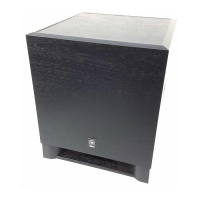
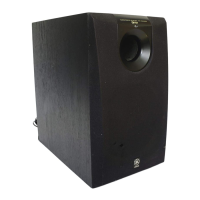
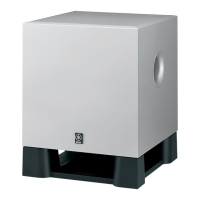
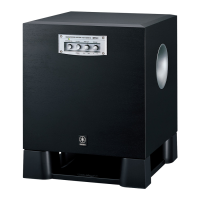
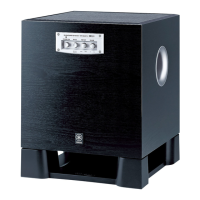
This document is an owner's manual for the Yamaha YST-SW012 Subwoofer System, a device designed to enhance the bass response of an audio system. The subwoofer utilizes Yamaha's Advanced Active Servo Technology II to deliver high-quality super-bass sound, aiming to create a more realistic, theater-in-the-home effect.
Function Description
The YST-SW012 is a subwoofer system that integrates a built-in power amplifier. Its primary function is to reproduce low-frequency sounds (bass) that are often challenging for standard stereo speakers to handle effectively. The Advanced Yamaha Active Servo Technology II, a core feature, is a sophisticated system that ensures powerful and high-quality bass reproduction. This technology involves a direct connection between the amplifier and the speaker, enabling precise control over the speaker's movement and accurate signal transmission. Unlike traditional bass reflex methods, Advanced YST II leverages the resonance generated between the speaker cabinet volume and a unique linear port, creating more resonant energy, referred to as the "air woofer" concept. This allows the subwoofer to produce deep bass from a relatively compact enclosure. The linear port itself is designed to provide smooth bass response while minimizing extraneous noise that is not part of the original input signal. The system's design incorporates a new circuit that combines negative-impedance and constant-current drives, resulting in stable performance and clear bass reproduction without muddiness.
Usage Features
The subwoofer is designed for straightforward integration into an existing audio/video system.
- Connections: The manual emphasizes connecting the subwoofer to the output jack of an AV amplifier using a subwoofer cable. It's crucial to complete all audio/video connections before plugging the power cables into an AC outlet.
- Power Control: The subwoofer features a POWER switch on its rear panel. Pressing this switch to the "ON" position turns on the unit, indicated by a green power indicator light. Pressing it again sets it to "OFF."
- Volume Adjustment: A VOLUME control knob allows users to adjust the bass level. Turning the control clockwise increases the volume, while turning it counter-clockwise decreases it.
- Pre-adjustment Procedure: Before initial use, the manual outlines a pre-adjustment process to balance the subwoofer's volume with the front speakers. This involves setting the VOLUME control to minimum, turning on all other components, pressing the POWER switch to "ON," playing a bass-rich source, adjusting the amplifier's volume, and then gradually rotating the subwoofer's VOLUME control until the bass is barely distinguishable from other speakers, aiming for natural bass sound. For multi-channel home theater systems, it's recommended to set the VOLUME control to approximately the middle position.
- Placement: The manual provides guidance on optimal placement. It's recommended to position the subwoofer outside either the right or left front speaker. If placed directly facing a wall, the bass effect might be diminished due to sound cancellation from reflected waves. To mitigate this, facing the subwoofer at an angle to the wall is suggested. The manual also notes that "standing waves" between parallel walls can cancel bass sounds in the center of a room, and suggests oblique placement or breaking up parallel surfaces with bookshelves to improve bass sound.
- Non-skid Pads: The subwoofer comes with non-skid pads to be placed at the four corners of its bottom. These pads prevent the subwoofer from moving due to vibrations during operation.
Maintenance Features
The manual provides several precautions and maintenance tips to ensure the longevity and safe operation of the subwoofer.
- Cleaning: The unit should be cleaned only with a clean, dry cloth. Chemical solvents are explicitly advised against as they may damage the finish.
- Environmental Conditions: The subwoofer should be installed in a cool, dry, and clean location, away from windows, heat sources, excessive vibration, dust, moisture, and cold. Sources of humming (transformers, motors) should also be avoided.
- Ventilation: Adequate ventilation is crucial. Spaces of at least 20 cm (approximately 8 inches) above, behind, and on both sides of the unit should be maintained to prevent overheating, which could lead to fire or damage. The rear panel should not be covered with items like newspapers, tablecloths, or curtains.
- Power Cord Protection: The power cord should be protected from being walked on or pinched, especially at plugs, convenience receptacles, and where it exits the apparatus.
- Disconnection: When not in use for extended periods (e.g., vacation), the AC power plug should be disconnected from the wall outlet. During lightning storms, the apparatus should also be unplugged.
- Handling: Force should not be used on switches, controls, or connection wires. When moving the unit, the power plug and all connected wires should be disconnected first. Wires should not be pulled directly.
- Cabinet Integrity: The cabinet should never be opened, as it contains high voltage and user-serviceable parts are not inside. Any foreign objects falling into the unit require contacting a dealer.
- Object Placement: No objects should be placed on the unit, especially vessels with water, burning candles, or fragile items like glass or china, as vibrations could cause them to fall, leading to damage, injury, or electric shock. Foreign objects or water drips should also be prevented from falling into the unit.
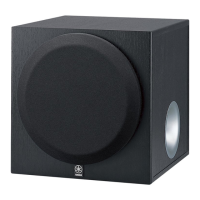
- YST Port: The YST port, located on the right side of the unit, should not be used to hold the unit when moving it, nor should hands or foreign objects be inserted into it. Fragile objects should not be placed near the port, as air pressure could cause them to fall.
- Distorted Noise: If distorted noise (e.g., "rapping" or "hammering" sounds) is heard, the volume level should be reduced immediately to prevent damage to the subwoofer system.
- TV Interference: Although magnetically shielded, placing the unit too close to a TV might impair picture color. If this occurs, the subwoofer should be moved away from the TV.
- Servicing: All servicing should be referred to qualified service personnel, particularly if the apparatus has been damaged in any way (e.g., damaged power cord/plug, spilled liquid, fallen objects, exposure to rain/moisture, abnormal operation, or being dropped).
- Troubleshooting: The manual includes a troubleshooting section to help users resolve common operating errors before concluding that the unit is faulty. If issues persist, users are advised to disconnect the power cord and contact an authorized Yamaha dealer or service center.


 To Next Page

 General
 Weight and Dimensions