25
5.10.4 Anchoring and mooring the boat
Always moor your boat carefully, even in sheltered places, because conditions can change rapidly.
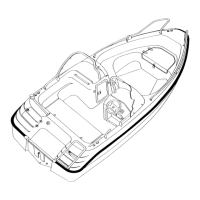
Mooring lines should be equipped with absorbers to dampen any jolts. Please refer to the image of
your boat model in the chapter on towing for anchoring bollards (cleats and trailer hook). To
prevent abrasion, use fenders that are large enough.
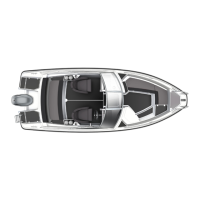
The locations of anchoring bollards are also depicted in the image of your boat model. It is the
responsibility of the owner/user to ensure that mooring, towing and anchor ropes, anchor chains,
and anchors are suitable for the boat's intended purpose, and that the breaking strength of ropes
and chains is no more than 80% of that of the corresponding anchoring bollards. However, you
should take into account wear and the loss of strength caused by knots.
Anchoring bollard strength and anchor weight for your boat:
- Forward 8.3 kN
- Backward 5.8 kN
- Anchor 3-5 kg
When beaching in a natural harbour, make sure that the water is deep enough, using a plumb line,
for example, and LOWER THE ANCHOR FAR ENOUGH FROM SHORE. A moderate grip is
attained if the anchor line length is 4-5 times the water depth.
WARNING! Do not try to stop the boat with your hands, and do not put your arm or
foot between the boat and the pier, shore or another vessel! Practise
beaching in good weather conditions. Use moderate but firm engine
power.
NOTE! When securing your boat, you must take into consideration possible
changes in wind direction, a rise or lowering of the water level, any
possible bow wakes, etc. You can get more information from your
insurance company, for example.
5.10.5 Towing
When towing another boat, use a floating line that is strong enough for the task. Tow carefully at
first, avoid jerks, and do not overload the engine. If you are towing a small dinghy, adjust the
towing line length so that the dinghy will ride the boat's bow wake. In narrow channels or rough
seas, however, keep the dinghy close to the transom to reduce weaving. Properly attach all
equipment on the dinghy, in case it should capsize. Cover the dinghy in rough seas on open
stretches of water to prevent it filling with water.
If you are towing, or if your boat has to be towed, attach the towline to the anchoring bollards
described for your boat model.


 To Next Page