GENERAL INFORMATION
23
@
b. Remove the housing from the oven or hot plate and
hold onto the housing with a kitchen potholder,
heavy gloves or heavy shop
cloths-it
is hot.
Spring
Dust
lip
..
e. While the housing is still hot, install the new bear-
ing(s) into the housing. Install the bearings by hand,
if possible. If necessary, lightly tap the bearing(s)
into the housing with a socket placed on the outer
bearing race.
Do not install new bearings by driving
on the inner bearing race. Install the bearing until it
seats completely.
SEALS
NOTE
A suitable size socket and extension works
well
for
removing
and
installing bearings.
c. Hold the housing with the bearing side down and
tap the bearing out. Repeat for all bearings in the
housing.
d. Prior to heating the bearing housing, place the new
bearing in a freezer,
if
possible. Chilling a bearing
will slightly reduce its outside diameter, while the
heated bearing housing assembly will be slightly
larger due to heat expansion. This will make bear-
ing installation much easier.
NOTE
Always install bearings with the manufac-
turer
s
mark
or numberfacing outward.
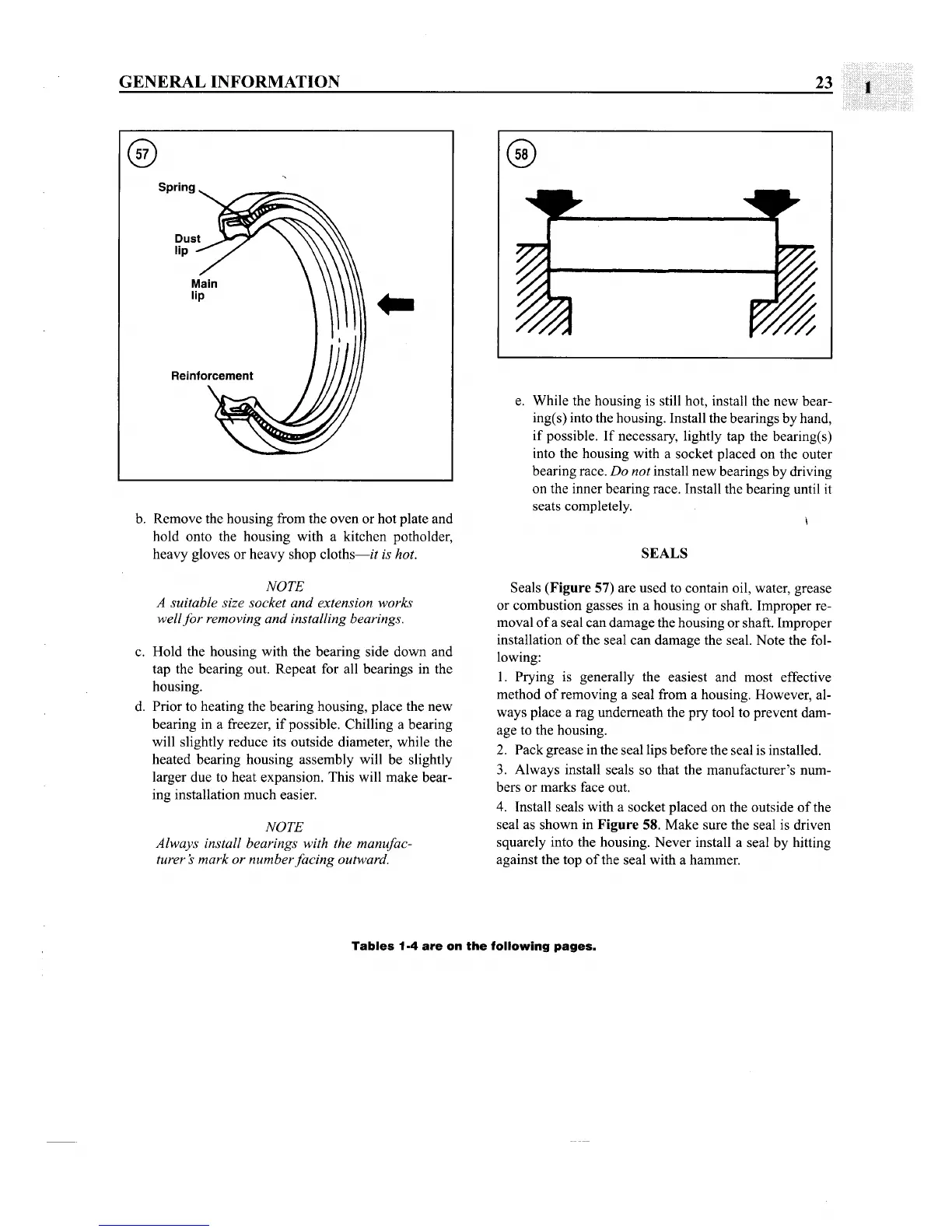
Seals (Figure 57) are used to contain oil, water, grease
or combustion gasses in a housing or shaft. Improper re-
moval
of
a seal can damage the housing or shaft. Improper
installation
of
the seal can damage the seal. Note the fol-
lowing:
1. Prying is generally the easiest and most effective
method
of
removing a seal from a housing. However, al-
ways place a rag underneath the pry tool to prevent dam-
age to the housing.
2. Pack grease in the seal lips before the seal is installed.
3. Always install seals so that the manufacturer's num-
bers or marks face out.
4. Install seals with a socket placed on the outside
of
the
seal as shown in
Figure 58. Make sure the seal is driven
squarely into the housing. Never install a seal by hitting
against the top
of
the seal with a hammer.
Tables
1·4
are
on
the
following
pages.



 To Next Page