LAY
-UP
AND
FITTING
OUT
Heat
-
-'l-
-T
~
'
exc
hanger
2. On 3GM, 3GM30, 3HM and 3HM35 engines, open the
drain on the underside
of
the exhaust manifold (Fi
!!:
ure 1,
typical).
3. Open the drain on the cylinder block (Fig
ur
e 2, typi-
cal).
4. Remove the lower end
of
all cooling system hoses
from the engine, pump and exhaust manifold. Lower the
hoses and allow them to completely drain. Reconnect the
hoses and clamp securely.
,VOTE
On
IGM
and IGMIOengines. access is re-
stricted to the upper water pump cover
sere",·:
If a suitable tool is not available, it
may be necessary to remove the cranksha
ft
pulley
jor
access to afl
of
the water pl/mp
cover screws.
65
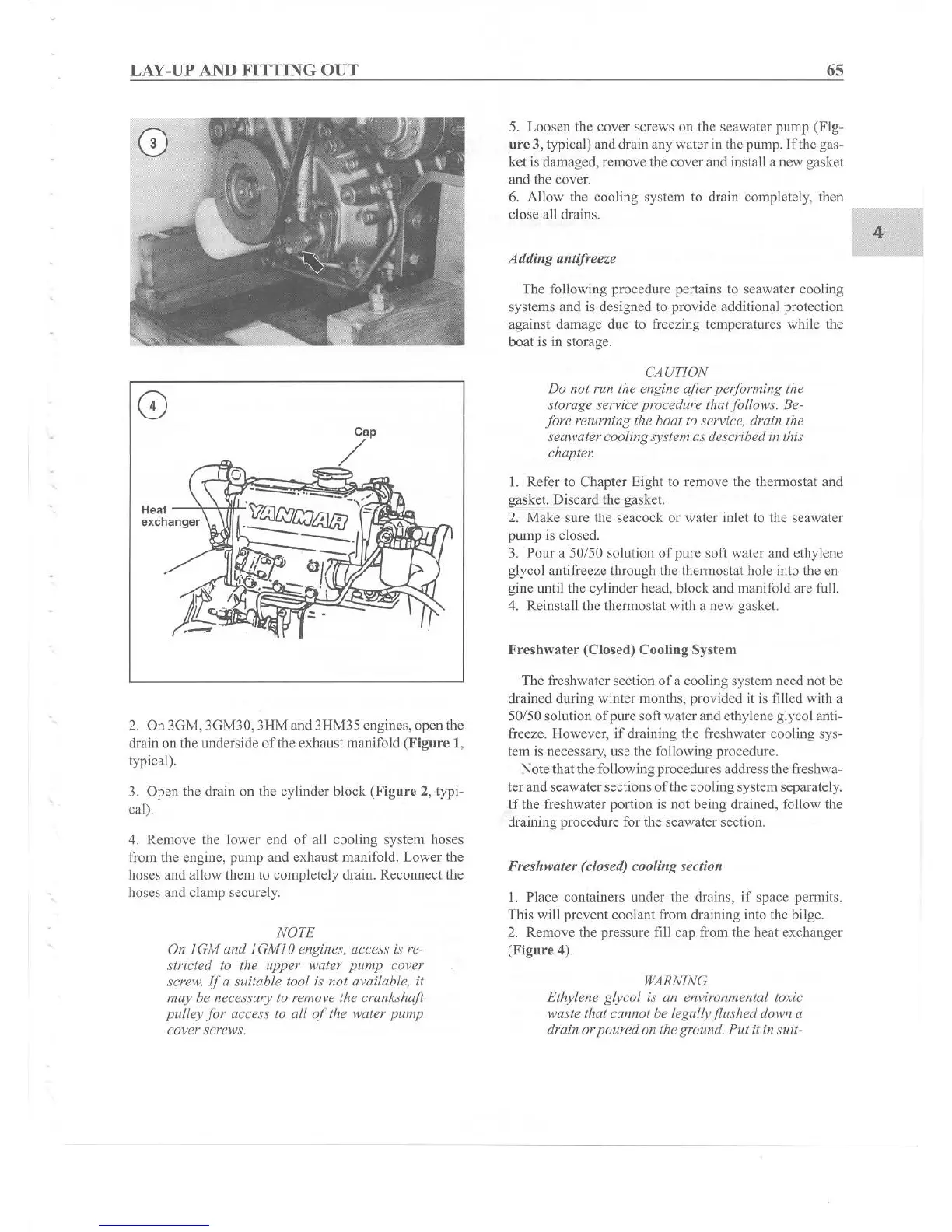
5. Loosen the cover screws on the seawater pump (Fig-
ure 3, typical) and drain any water in the pump. lf thc gas-
ket is damaged. remove the cover and install a new gasket
and the cover.
6. Allow the cooling system to drain completely, then
close all drains.
Adding
ant
if
reeze
The following procedure pertains to seawater cooling
systems and is designed to provide additional protection
against damage due to freezing temperatures
while the
boat
is in storage.
C.AUTION
Do not
nm
the engine after
perfo
rming the
storage service procedure tnat fotlows. Be-
fore returning the hoat
to
service, drain the
seawater
cooling system as described in this
chapter.
I. Refer to Chapter Eight to remove the thermostat and
gasket. Discard the gasket.
2. Make sure the scacock or water inlet to the seawater
pump is closed .
3. Pour a
50/50 solution
of
pure soft water and ethylene
glycol antifreeze through the thermostat hole into the en-
gine until the cylinder
head, block and manifold arc full,
4. Reinstall
the thermostat with a new gasket.
Fr
eshwater (Closed) Cooling Syste m
The freshwater section
ofa
cooling system need not be
drained during winter months, provided it is
filled with a
50/50solution
of
pure soft water and ethylene glycol anti-
freeze. However, if draining the freshwater cooling
sys·
tern is necessary, usc the following procedure.
Note that the following procedures address the freshwa-
ter and seawatersections
of
the cooling system separately.
If the freshwater portion is not being drained, follow the
draining procedure for the seawater section.
Freshwater (cl
oud)
cooli
ng
section
I. Place containers under the drains, if space permits.
This
will prevent coolant from draining into the bilge.
2. Remove the pressure fill cap from the heat exchanger
(Figure
4).
WARNING
Ethylene glycol
is
WI
environmental toxic
waste that cannot he legally
flushed
down a
drain
or
pouredon the ground. Put it in suit-
4



 To Next Page