Need help?
Do you have a question about the York YHE Series and is the answer not in the manual?
Explains DANGER, WARNING, and CAUTION signal words for safety.
Selecting and verifying a suitable installation location for the unit.
Steps for replacing an R-22 unit with an R-410A unit.
Installing the unit on a solid, level base at ground level.
Installing the unit on a roof, ensuring structural support.
Mounting the unit on a wall using a solid base.
Positioning the unit on its base and ensuring proper clearances.
Information on the liquid line filter-drier and replacement guidelines.
Guidelines for connecting refrigerant lines between units.
Care needed to avoid kinking, bending, or damaging refrigerant lines.
Best practices for brazing refrigerant line connections.
Methods to protect service valves during brazing.
Step-by-step guide for installing the TXV kit.
Procedures for charging the system with the correct refrigerant amount.
Using gauges to verify and adjust system charge.
Essential electrical connection and grounding requirements.
Instructions for connecting the main power supply to the unit.
Routing and connecting low voltage control wiring for operation.
Information on installing and using a dehumidification control.
Setting indoor fan speed for optimal airflow and comfort.
Procedure to ensure the crankcase heater is energized before startup.
Timer preventing rapid compressor cycling for protection.
Control's protection against low voltage conditions.
Using test terminals for installation and service functions.
Displaying status and fault codes via the LED indicator.
How the system manages frost buildup and defrost cycles.
How the control manages the unit's cooling cycle.
How the control manages the unit's heating cycle.
Control logic for emergency heat activation.
Handling of pressure switch faults and unit lockout.
Recommended maintenance tasks for unit longevity and performance.
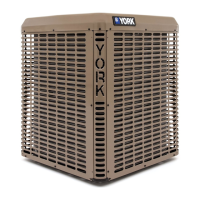
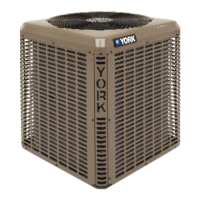
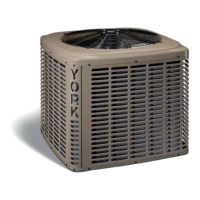
This document describes the installation and operation of R-410A Outdoor Split-System Heat Pumps, specifically the 14 SEER YHE, TH4, THE, and RHP14L series, ranging from 1.5 to 5 tons, and available in 1 & 3 phase configurations. The manual emphasizes safety, proper installation, and maintenance procedures to ensure optimal performance and longevity of the unit.
The R-410A Outdoor Split-System Heat Pump is designed to provide both cooling and heating for residential or commercial spaces. It connects to a matching indoor coil with sweat connect lines and uses R-410A refrigerant. The unit's operation involves a compressor, outdoor fan, and a reversing valve to switch between cooling and heating modes. A demand defrost control module manages frost and ice accumulation on the outdoor coil during heating operation, ensuring efficient airflow. The system is designed to work with a thermostatic expansion valve (TXV) for refrigerant metering.

 To Next Page
 General