Need help?
Do you have a question about the Yost Vise 7WW-DI and is the answer not in the manual?
Buyer has seven days to inspect products for defects and notify Seller.
Lists model, jaw width, opening, pipe capacity, throat depth, and weight.
Jaws withstand 1600 inch pounds without distortion.
Hardened steel serrated jaws have Rockwell C hardness of RC 52-58.
Essential precautions for safe setup and operation to prevent injury or damage.
Detailed steps for properly securing the vise to a workbench using bolts and washers.
Instructions for opening, closing, and releasing workpieces using the vise handle.
Steps to loosen, swivel, and re-tighten the vise for better access.
Lists all parts for the 7WW-DI Heavy Duty Ductile Iron Woodworker's Vise with quantities.
This document provides comprehensive instructions and safety guidelines for the Yost 7WW-DI Heavy Duty Ductile Iron Woodworker's Vise. It emphasizes the importance of proper setup, operation, and maintenance to ensure user safety and the longevity of the tool.
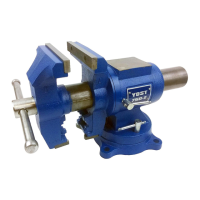
The Yost 7WW-DI Vise is a robust clamping tool designed for woodworking and general workshop applications. Its primary function is to securely hold workpieces, allowing users to perform various tasks such as cutting, drilling, shaping, and assembly with stability and precision. The vise features serrated jaws for a firm grip and a swivel base that enables rotation for optimal workpiece positioning.
The manual outlines a detailed process for mounting and operating the vise, ensuring both safety and efficiency.
Before use, the vise must be securely mounted to a workbench. The document recommends placing an 18" x 18" x 2" piece of wood or an 18" x 18" x ¼" metal plate underneath the workbench for added strength. Mounting holes should be marked and drilled through the workbench and the reinforcing plate, using the swivel base as a template. Proper length and diameter bolts, along with flat washers, lock washers, and locking nuts, are essential for a secure installation. The bolts should protrude at least 1" beyond the underside of the workbench and reinforcing plate. It is crucial to periodically recheck and re-tighten the nuts to maintain stability. The workbench itself must be properly secured to the floor or wall and designed to handle the vise and the expected workload. The work area should be dry, well-lit, clean, and unobstructed to prevent slips and other hazards.
Operating the vise involves several steps to ensure the workpiece is held securely. First, ensure the vise is securely mounted to the workbench and that the swivel base lockdowns are tight. To open the vise, turn the handle counterclockwise, being careful not to exceed the maximum rated jaw opening. Once open, place the item between the serrated jaws. Turn the handle clockwise to close the vise until the item is snug. Continue tightening until the clamped item can no longer move, but avoid over-tightening, which could damage the item or the vise. When finished, slowly turn the handle counterclockwise to release the item.
The swivel base allows the vise to be rotated, providing better and safer access to the workpiece from different angles. To adjust the vise's position, first ensure the item is securely mounted in the vise. Then, slowly loosen each lockdown located on both sides of the vise by about ¼ of a turn counterclockwise. Exercise caution not to over-loosen or remove the lockdowns, as this could cause the vise to tip over. Once loosened, swivel the vise to the desired position. Finally, tighten each lockdown clockwise to secure the vise firmly to its base.
The manual emphasizes numerous safety precautions to prevent serious injury. Users should always wear eye, face, and ear protection when striking or using power tools with the vise. A dust mask or respirator is recommended when working with wood, metal, chemical dusts, or mists. Restrictive hair covering and anti-slip footwear should be worn. Loose clothing or jewelry should be avoided. Bench tops must be properly secured. Proper nuts, bolts, and lock washers must be used in all mounting holes. The vise selected should be of appropriate size and capacity for the work object. Hand-tighten the handles of the lockdowns for the swivel base. Inspect the vise for stress fatigue or damage before each use.
Several actions are strictly prohibited to prevent damage to the vise or injury to the user. Never use a hammer, extension pipe, or cheater bar on the spindle handle. Do not unscrew the movable jaw beyond its maximum specified opening. Welding the vise base to any metal object is forbidden. The vise should not be used to press an object into or out of another object. Extension pipes should not be used to tighten lockdown handles. Pressurized containers or combustible materials should never be placed in the vise. Extreme or prolonged heat should not be applied to the vise, as it can alter structural properties. If there is any doubt about a condition being safe or unsafe, the vise should not be operated.
Regular maintenance is crucial for the vise's performance and longevity. The manual specifically advises users to grease the main screw regularly. This simple maintenance step helps ensure smooth operation of the vise and prevents wear and tear on its moving parts. The document also implicitly suggests regular inspection for damage or stress fatigue, which can be considered a form of preventative maintenance. Addressing any issues promptly can extend the life of the vise and maintain its safe operation.
 General
| Jaw Width | 7 inches |
|---|---|
| Throat Depth | 4 inches |
| Material | Ductile Iron |
| Mounting Type | Bench Mount |
| Pipe Jaw Capacity | 4 inches |
| Weight | 35 lbs |


 To Next Page