Page 1
09101-90(I)
MODEL 09101
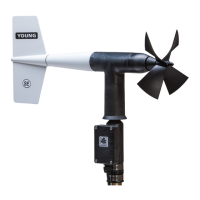
WIND MONITOR - SE
INTRODUCTION
The Wind Monitor-SE combines the performance and durability
of the standard Wind Monitor with an optically encoded direction
transducer and serial data output capability.
The wind speed sensor is a four blade helicoid propeller that turns
a multipole magnet. Propeller rotation induces a variable frequency
signal in a stationary coil. Slip rings and brushes are not used.
The w i n d direction s e n s o r is a durable m o l d e d vane. An
optical encoder measures vane angle, thereby eliminating the
characteristic deadband and wear of potentiometer transducers.
The encoder is an absolute type so direction output remains
accurate even if power is interrupted.
Raw transducer signals are processed by onboard electronics.
A variety of serial protocols or a conventional calibrated voltage
output may be selected with simple internal jumpers.
The Wind Monitor-SE is designed for superior environmental
resistance. Housing parts are UV stabilized thermoplastic. Fittings
are stainless steel and anodized aluminum. Precision grade
stainless steel ball bearings are used throughout. The instrument
mounts on standard 1 inch pipe.
INITIAL CHECKOUT
Remove the sensor from its shipping carton. Remove the plastic
nut from the propeller shaft and install the propeller with the teeth
on the propeller hub engaging the slots on the shaft hub. Tighten
plastic propeller nut nger-tight only. Do not overtighten.
The instrument is fully balanced, aligned, and calibrated before
shipment. Some simple checks can be made to verify proper
function. Both vane and propeller should rotate easily without
friction. Check vane balance by holding sensor with vane surface
horizontal. The vane should have no tendency to rotate. A slight
imbalance will not degrade performance.
INITIAL SETUP
The 09101 has been calibrated at the factory and requires
no additional adjustments. Operation is configured by onboard
jumpers and software commands.
Unless otherwise specified, the sensor is supplied with the
following settings:
Continuous Serial Output
RMY Protocol
9600 Baud
Meters per Second
Other settings are easily selected by changing the jumper pattern.
Refer to the wiring diagram for jumper J1 and J3 locations. The
following table lists available features and position of each jumper.
Important Note:
Jumper settings are read at power-up only. If jumpers are
changed, remove and reapply power for the new settings to
be used.
At rst power-up the Wind Monitor-SE has a 3 second delay
before outputting the rst wind speed value.
WIND SPEED SPECIFICATION SUMMARY
Range 0 to 100 m/s (224 mph)
Resolution: 0.1 unit
Accuracy: ±0.3 m/s (0.6 mph) or 1% of reading
Threshold: 1.0 m/s (2.2 mph)
Distance constant: 2.7 m (8.9 ft)
Transducer: Rotating magnet and stationary coil.
WIND DIRECTION (AZIMUTH) SPECIFICATION SUMMARY
Range: 0-360 degrees
Accuracy: ± 2 degrees
Resolution: 1 degree
Threshold: 1.1 m/s (2.5 mph) @ 10° displacement
Delay distance: 1.3 m (4.3 ft)
Damping ratio: 0.3
Transducer: Absolute encoder
GENERAL
Power requirement: 11-24 VDC, 20 mA
Dimensions: Overall height 37 cm
Overall length 55 cm
Propeller 18 cm diameter
Mounting 34 mm (1.34 in) diameter
(standard 1 inch pipe)
Weight: Sensor weight 1.0 kg (2.2 lb)
Shipping weight 2.3 kg (5.0 lb)
Voltage Output: WS: 0-5 VDC for 0-100 m/s
WD: 0-5 VDC for 0-540°
Serial RS-485: 2 wire-half duplex, 1200-9600 Baud
RMY, NCAR, NMEA, or RMYT protocols
Polled or continuous
Operating Temperature: -50 to 50°C (-58 to 122°F)


 To Next Page
 Loading...