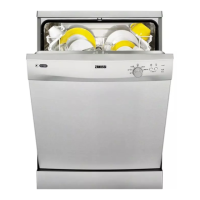
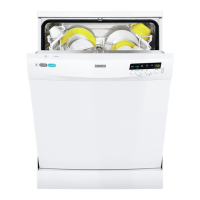
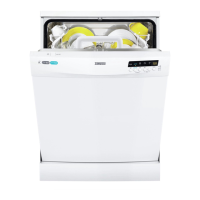
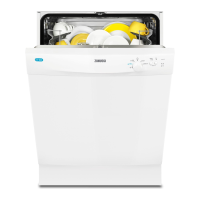
This document is a user manual for a Zanussi dishwasher, specifically models ZDF12001XA and ZDF12001WA. It provides instructions for installation, use, maintenance, and troubleshooting.
Function Description
The Zanussi dishwasher is designed for household and similar applications, including staff kitchens, farmhouses, hotels, motels, and bed and breakfast environments. Its primary function is to wash dishes, cutlery, and cookware efficiently. The appliance uses water, detergent, and rinse aid to clean and dry items. It features a water softener system to neutralize minerals in hard water, ensuring better washing results and preventing damage to the appliance.
Important Technical Specifications
- Dimensions (Width / Height / Depth): 600 / 850 / 625 mm
- Electrical Connection:
- Voltage: 220-240 V
- Frequency: 50 Hz
- Water Supply Pressure (Min. / Max.): (0.5 / 0.05) / (8 / 0.8) bar / MPa
- Water Supply Temperature: Cold water or hot water (max. 60 °C). The manual notes that using hot water from alternative energy sources (e.g., solar panels) can decrease energy consumption.
- Capacity: 12 place settings
- Power Consumption:
- Left-on mode: 0.50 W
- Off-mode: 0.50 W
- Water Softener: Adjustable to various water hardness levels (German, French, mmol/l, Clarke degrees) from level 1 (softest, < 7 French degrees) to level 10 (hardest, 84-90 French degrees). Salt is not required for levels below 7 French degrees.
- Programmes:
- ECO 50°: Normal soil, crockery and cutlery. Duration: 195 min, Energy: 1.02 kWh, Water: 11 l. (Standard programme for test institutes, most efficient use of water and energy).
- Normal Soil 65°C: Crockery and cutlery. Duration: 100-110 min, Energy: 1.2-1.6 kWh, Water: 15-16 l.
- Heavy Soil 70°C: Crockery, cutlery, pots and pans. Duration: 130-150 min, Energy: 1.4 kWh, Water: 13-15 l.
- 30' 65°C: Fresh soil, crockery and cutlery. Duration: 30 min, Energy: 0.8 kWh, Water: 9 l. (Good washing results in a short time for fresh soil).
- Prewash: All types of load. Duration: 14 min, Energy: 0.1 kWh, Water: 4 l. (Quickly rinses dishes to prevent food bonding and bad odours; no detergent needed).
Usage Features
- Control Panel: Features an On/off indicator, Programme marker, Indicators (End, Salt, Rinse aid), Start button, Half load button, and Programme knob.
- Programme Selection: Users turn the programme knob to align the marker with the desired programme symbol.
- Starting a Programme: After selecting a programme, the Start button is pressed. The appliance enters setting mode when the On/off indicator and End indicator flash.
- Cancelling a Programme: Press and hold the Half load button and Start button until the End indicator flashes.
- Half-load Option: Reduces programme duration, energy, and water consumption for smaller loads. This option is not applicable to the 30' and Prewash programmes. It can be activated/deactivated before a programme starts.
- Detergent Use:
- Detergent or tablets are placed in compartment (A), with a small quantity in compartment (B) for prewash phases.
- When using combi detergent tablets (containing salt and rinse aid), the salt container and rinse aid dispenser should not be filled. The water softener and rinse aid dispenser should be set to their lowest positions.
- If switching from combi tablets to separate detergent, salt, and rinse aid, the water softener must be set to the highest level, salt and rinse aid dispensers filled, and a short rinsing programme run without detergent or dishes before adjusting settings to local water hardness.
- Loading Baskets: Items should be loaded according to the provided leaflet, ensuring hollow items face down, cutlery and dishes do not bond, glasses do not touch, and spray arms can move freely. Knives and sharp cutlery should be placed points down or horizontally.
- Opening Door During Operation: Opening the door pauses the programme; closing it resumes the programme from the point of interruption.
- End of Programme: The End indicator illuminates. If not deactivated within 5 minutes, all indicators turn off to save energy. To deactivate, turn the programme knob to the off position.
Maintenance Features
- Filter Cleaning:
- Filters (B) and (C) are removed by turning the handle counterclockwise, then pulled apart and washed.
- Filter (A) is removed and washed, ensuring no food residues remain in the sump area.
- Filters are reassembled and placed back, ensuring filter (A) is correctly positioned under guides (D), and the handle is turned clockwise to lock. Incorrect filter positioning can lead to poor washing results and appliance damage.
- Spray Arm Cleaning: If spray arm holes are clogged, remaining soil parts should be removed with a thin pointed object. Spray arms should not be removed.
- External Cleaning: Clean the appliance with a moist, soft cloth and neutral detergents. Abrasive products, pads, or solvents should not be used.
- Internal Cleaning: To prevent grease and limescale deposits from short duration programmes, it is recommended to run long duration programmes at least twice a month.
- Salt Container: Fill with 1 litre of water (first time only) and then with dishwasher salt. After filling, a programme should be started to prevent corrosion from any spilled salt.
- Rinse Aid Dispenser: Fill with rinse aid. The released quantity can be adjusted using a selector between position 1 (lowest) and 4 (highest).
- Troubleshooting: The manual provides a table of alarm codes (flashing indicators) and common problems with possible solutions, such as checking mains plug, fuse, door, water tap, water pressure, inlet/drain hoses, and filters. If problems persist or other alarm codes appear, contact Service.
- Washing and Drying Results: Advice is given for issues like whitish streaks (adjust rinse aid, check detergent quantity) and wet dishes (programme without drying phase or low temperature drying).
- Environmental Concerns: The manual encourages recycling packaging materials and disposing of the appliance at local recycling facilities, not with household waste.

 Need help?
 General

 To Next Page