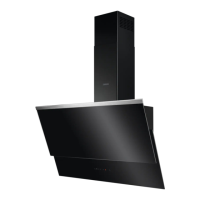
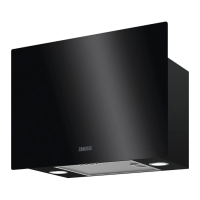
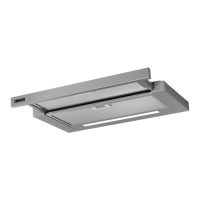
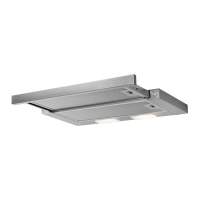
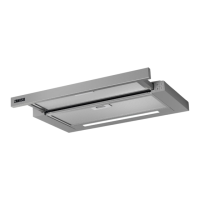
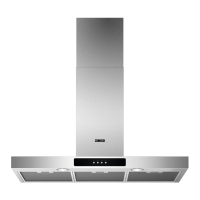
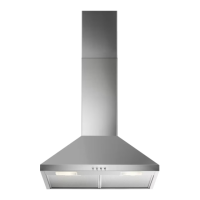
This document is a user manual for a Zanussi Cooker Hood, specifically models ZFV919Y and ZFV916Y. It provides comprehensive information on safety, installation, product description, daily use, care and cleaning, troubleshooting, and environmental concerns.
Function Description
The Zanussi Cooker Hood is designed for domestic use above hobs, cookers, and similar cooking devices to extract smoke, steam, and odors from the kitchen environment. It operates with multiple speed settings, including a "Breeze" function for low-noise air refreshment and a "Maximum Speed" for intensive extraction. The appliance can be controlled manually via its touch-sensitive control panel or automatically through the Hob²Hood function, which connects the hood to a compatible hob via infrared signals. The Hob²Hood function adjusts the fan speed based on the hob's mode setting and the temperature of the cookware.
Important Technical Specifications
The manual highlights several important technical specifications and safety requirements:
- Minimum Distance from Hob: The minimum distance between the hob surface (where pans stand) and the lower part of the appliance must be at least 65 cm, unless otherwise specified in the installation instructions for the appliance or hob.
- Electrical Connection: All electrical connections must be made by a qualified electrician, ensuring compatibility with the mains power supply parameters on the rating plate. The appliance must be earthed if the symbol (earth symbol) is not printed on the rating plate. An isolating device must be incorporated into the fixed wiring to disconnect the appliance from the mains at all poles, complying with overvoltage category III conditions.
- Air Discharge: The discharge of air must comply with local authority regulations. The ventilation openings must not be blocked, and the extracted air should not be conveyed into a duct used to exhaust smoke and steam from other appliances (e.g., central heating systems, water heaters).
- Room Ventilation: Good air ventilation is crucial in the room where the appliance is installed to prevent the backflow of gases from other fuel-burning appliances, including open fires. When the hood operates with other appliances, the maximum vacuum generated in the room should not exceed 0.04 mbar.
- Lamp Type: The appliance is supplied with an LED lamp and a separate control gear (LED driver). These parts are replaceable by a technician only.
Usage Features
The cooker hood offers several user-friendly features:
- Control Panel: A touch-sensitive control panel with symbols for On/Off, First speed, Second speed, Third speed, Maximum speed, Breeze, Filter notification, Hob²Hood indicator, and Lamp.
- Speed Settings:
- First Speed: Recommended for heating up food and cooking with covered pots.
- Second Speed: Suitable for cooking with covered pots on multiple cooking zones or burners, and gentle frying.
- Third Speed: For boiling and frying large quantities of food without a lid, or cooking on multiple zones/burners.
- Maximum Speed: For boiling and frying large quantities of food without a lid, with high humidity. This mode operates for 8 minutes before returning to the previous speed setting.
- Breeze Function: Operates at the lowest speed for 60 minutes to refresh kitchen air at a very low noise level, turning off automatically. It is recommended for use after cooking.
- Hob²Hood Function: An automatic function that connects the hood to a compatible hob via infrared signals. The hood's fan speed adjusts automatically based on the hob's activity (mode setting and cookware temperature). This function can also be activated manually from the hob's panel.
- Lamp Control: The lights can be turned on and off independently of the hood's extraction functions to illuminate the cooking surface.
- Filter Notification: An indicator (red light) reminds the user to clean the grease filter (flashes for 30 seconds) or change/clean the charcoal filter (turns on for 30 seconds). This notification can be activated or deactivated by touching the filter icon for 3 seconds.
- Recommended Usage: It is recommended to leave the hood operating for approximately 15 minutes after cooking to ensure optimal air purification.
Maintenance Features
Regular maintenance is essential for the appliance's performance and safety:
- Cleaning Agents: Use a soft cloth with warm water and a mild detergent for cleaning the appliance surface. Avoid abrasive detergents, brushes, steam cleaners, water sprays, harsh abrasive cleaners, or sharp metal scrapers. Only neutral detergents should be used.
- Grease Filters:
- Cleaning Frequency: Clean grease filters regularly, at least every 2 months, to prevent grease accumulation and fire risk.
- Cleaning Method: Grease filters can be washed in a dishwasher on a low temperature and short cycle. Discoloration may occur but does not affect performance.
- Removal/Installation: Filters are mounted with clips and pins. To remove, pull the cover, press the mounting clip, and slightly tilt the front of the filter downwards before pulling it out. Reinstall by reversing these steps.
- Charcoal Filters:
- Replacement Frequency: Activated charcoal filters are not washable or regenerable and must be replaced approximately every 4-6 months, or more frequently with heavy usage. The saturation time varies depending on cooking type and grease filter cleaning regularity.
- Replacement Procedure: Remove the grease filters first, then turn the charcoal filter counterclockwise and pull it out. Reinstall by reversing these steps.
- Non-washable: A warning explicitly states that charcoal filters are NON-washable and cannot be regenerated.
- Interior Cleaning: Use a cloth to clean the interior of the appliance.
- Lamp Replacement: The LED lamp and its control gear can only be replaced by a qualified technician.
The manual also includes troubleshooting tips for common issues like the appliance not activating (check power supply/fuse), the lamp not operating (replace lamp), or insufficient vapor absorption (change motor speed). It emphasizes the importance of recycling the appliance and its packaging at appropriate facilities.

 Need help?
 General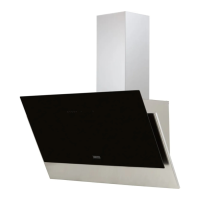

 To Next Page