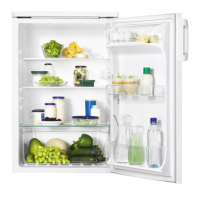
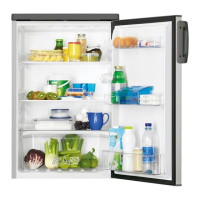
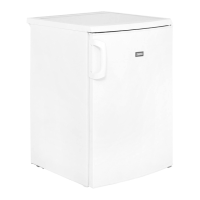
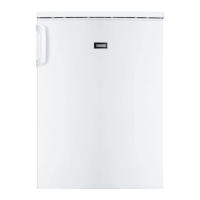
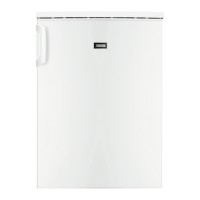
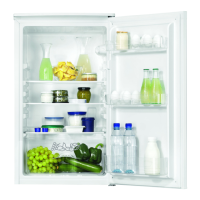
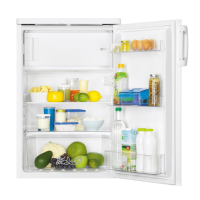
This document is a user manual for a Zanussi refrigerator, model ZRG16605XV, providing comprehensive instructions for its safe installation, operation, and maintenance.
Function Description
The Zanussi refrigerator is designed for household and similar applications, serving as a cooling appliance for storing food products. It operates by automatically regulating its internal temperature to preserve food freshness. The appliance uses a refrigerant circuit containing isobutane (R600a), a natural gas with high environmental compatibility, for its cooling function. Frost is automatically eliminated from the refrigerator compartment's evaporator during normal use, with defrost water draining into a special container at the back of the appliance where it evaporates.
Usage Features
The refrigerator offers several user-friendly features to optimize food storage and convenience:
- Temperature Regulation: The appliance's temperature is automatically regulated. Users can adjust the temperature by turning a regulator towards lower settings for minimum coldness or higher settings for maximum coldness. A medium setting is generally recommended for optimal performance. The ideal setting can vary based on room temperature, door opening frequency, and the quantity of food stored. If the ambient temperature is high or the appliance is fully loaded and set to the lowest temperature, continuous operation may lead to frost formation on the rear wall. In such cases, adjusting the dial to a higher temperature allows for automatic defrosting and reduced energy consumption.
- Movable Shelves: The interior walls are equipped with runners, allowing users to position the shelves as desired to accommodate different food items. It is important not to move the glass shelf above the vegetable drawer to ensure proper air circulation.
- Positioning Door Shelves: The door shelves can be adjusted to different heights to store various sizes of food packages. To reposition, users gradually pull the shelf until it comes free and then re-engage it at the desired height.
- Internal Lighting: The appliance is equipped with a long-life LED interior light, which is designed specifically for household appliances. In case of a defective lamp, it is recommended to use original spare parts and LED bulbs (E14 base) only, with the maximum power indicated on the lamp unit.
- Door Reversibility: The door can be reversed to open from either the left or right side, offering flexibility in appliance placement. This operation involves unscrewing and repositioning various screws, hinges, and the door's top and bottom components.
- Food Storage Recommendations:
- Warm food or evaporating liquids should not be stored in the refrigerator.
- Food should be covered or wrapped, especially if it has a strong flavor, to prevent odor transfer.
- Food should be positioned to allow free air circulation.
- Meat should be wrapped in suitable packaging and stored on the glass shelf above the vegetable drawer for at most 1-2 days.
- Cooked foods and cold dishes should be covered and placed on any shelf.
- Fruits and vegetables should be cleaned thoroughly and placed in a special drawer. Bananas, potatoes, onions, and garlic should not be kept in the refrigerator unless packed.
- Butter and cheese should be placed in an airtight container or wrapped in aluminum foil or a polythene bag to exclude air.
- Bottles should be closed with a cap and placed on the door bottle shelf or bottle rack.
Maintenance Features
Regular maintenance is crucial for the appliance's longevity and efficient operation:
- Cleaning the Interior: Before first use, the interior and all internal accessories should be washed with lukewarm water and a neutral soap to remove any new product smell, then dried thoroughly. For subsequent cleaning, avoid detergents, abrasive powders, chlorine, or oil-based cleaners as they can damage the finish.
- Periodic Cleaning:
- The inside and accessories should be cleaned regularly with lukewarm water and neutral soap.
- Door seals should be checked and wiped clean regularly to ensure they are free from debris.
- The condenser and compressor at the back of the appliance should be cleaned with a brush if accessible, as this improves performance and saves electricity.
- The defrost water drain hole in the middle of the refrigerator compartment channel must be periodically cleaned to prevent water overflow and dripping onto food.
- Defrosting: The refrigerator features automatic defrosting.
- Periods of Non-Operation: If the appliance will not be used for long periods, users should disconnect it from the electricity supply, remove all food, clean the appliance and accessories, and leave the door(s) open to prevent unpleasant smells. If the appliance is to remain switched on, it should be checked periodically to prevent food spoilage in case of a power failure.
- Troubleshooting: The manual provides a comprehensive troubleshooting guide for common issues such as the appliance not operating, unusual noise, lamp malfunction, continuous compressor operation, and water flow problems. Solutions range from simple checks like ensuring the plug is connected correctly or adjusting the temperature setting, to more involved steps like cleaning the water outlet or contacting an Authorized Service Centre for complex issues.
- Door Gasket Maintenance: To ensure proper door closure, users should clean the door gaskets and, if necessary, adjust the door or replace defective gaskets by contacting an Authorized Service Centre.
- Electrical Connection: The appliance must be earthed, and any electrical work should be carried out by a qualified electrician. The manual provides detailed instructions for connecting the mains plug, ensuring correct wiring based on color codes (green and yellow for earth, blue for neutral, brown for live). It also specifies the use of a 13 amp fuse and warns against the hazards of a cut-off plug.


 To Next Page
 General