
 Need help?
Do you have a question about the Zanussi ZRG16600XA and is the answer not in the manual?
This document is a user manual for a Zanussi refrigerator, model ZRG16600XA. It provides comprehensive instructions for the safe operation, maintenance, and installation of the appliance.
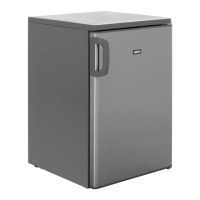
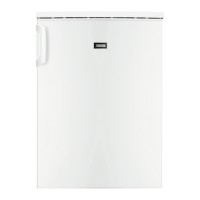
The Zanussi ZRG16600XA is a refrigerator designed for keeping foodstuffs and beverages cool in a normal household setting. It is suitable for various applications, including staff kitchen areas, farmhouses, hotels, motels, bed and breakfast environments, and catering. The appliance utilizes isobutane (R600a) as a refrigerant, a natural gas known for its environmental compatibility. The refrigerator features an automatic defrosting system for the evaporator in the refrigerator compartment, which eliminates frost during normal use. Defrost water drains into a special container at the back of the appliance, where it evaporates.
The refrigerator's operation is straightforward. To switch on the appliance, the user inserts the plug into a wall socket and turns the temperature regulator clockwise to a medium setting. To switch off, the temperature regulator is turned to the "O" position. The temperature is automatically regulated, but users can adjust it by turning the regulator towards lower settings for minimum coldness or higher settings for maximum coldness. A medium setting is generally recommended. The manual advises that if the ambient temperature is high or the appliance is fully loaded and set to the lowest temperatures, continuous running may cause frost on the rear wall. In such cases, the dial should be set to a higher temperature to allow automatic defrosting and reduce energy consumption.
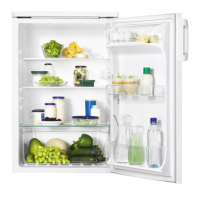
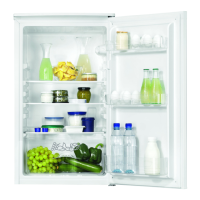
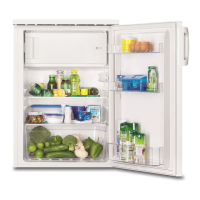
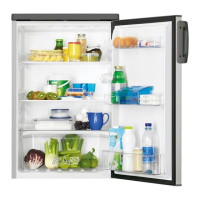
The interior of the refrigerator is designed for flexible storage. The walls are equipped with runners, allowing shelves to be positioned as desired to accommodate various food packages. The door shelves can also be adjusted in height by gradually pulling them free and repositioning them.
For optimal food preservation, the manual provides several tips:
The manual also addresses normal operating sounds, such as gurgling and bubbling from the refrigerant, a whirring and pulsating noise from the compressor, and a "click" from the temperature regulator when it switches on or off. These sounds are normal and not indicative of a fault.
Regular maintenance is crucial for the appliance's longevity and performance. Before any maintenance, the appliance must be switched off and disconnected from the mains supply.
For long periods when the appliance is not in use, the following precautions should be taken:
The manual includes a troubleshooting guide for common issues, such as the appliance being noisy, not operating, the lamp not working, the compressor running continually, water flows on the rear plate or into the refrigerator, and incorrect temperatures. Solutions range from checking stability and connections to adjusting temperature settings, cleaning the drain, or contacting a qualified electrician.
Instructions are provided for replacing the internal light bulb, which involves breaking the circuit, unscrewing the lamp cover, unhooking the moving part, replacing the bulb with one of the same power (specified on the bulb cover), fixing the cover, and reconnecting the appliance.
The manual details the steps to change the door's opening direction, a process that may require assistance from another person to hold the doors. This involves removing the plug, tilting the appliance, unscrewing feet and hinges, repositioning pins, and reassembling the components on the opposite side. A final check ensures all screws are tightened and the door opens and closes correctly. If the ambient temperature is cold, the gasket may not fit perfectly initially but will adjust naturally.
The manual emphasizes safety throughout, including warnings about keeping ventilation openings clear, not using mechanical devices or artificial means to speed up thawing, not using other electrical appliances inside unless approved, and not damaging the refrigerant circuit. It also warns against altering specifications or modifying the product, as this can cause short-circuits, fire, or electric shock. Any electrical component replacement must be done by a certified service agent. It stresses the importance of proper disposal of the appliance due to flammable gases in the insulation foam and recyclable materials. The appliance must be earthed, and the manufacturer declines liability if safety measures are not observed.
 General
| Appliance placement | Freestanding |
|---|---|
| Product colour | Stainless Steel |
| Door hinge | Right |
| Reversible doors | Yes |
| Number of compressors | 1 |
| Climate class | SN, N, ST, T |
| Noise level | 39 dB |
| Fridge interior light | Yes |
| Number of shelves/baskets in fridge | 3 |
| Number of vegetable drawers | 1 |
| Egg balcony | Yes |
| Bottle rack | Yes |
| Freezing capacity | 3 kg/24h |
| Star rating | 4 |
| Energy efficiency class | A+ |
| Cooling System | Static |
| Number of Door Bins | 2 |
| Defrost System | Manual |
| Freezer Defrost System | Manual |
| Storage time during power failure | 12 hours |
| Width | 55 cm |
| Height | 85 cm |



 To Next Page