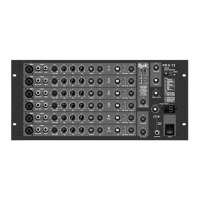
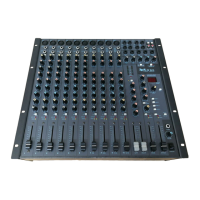
Die Aufgabe des Mischpultes
Das Mischpult ist die zentrale Stelle in
der PA, es ist für folgende Aufgaben zu-
ständig: es sammelt sämtliche Signale,
verstärkt sie auf ein gemeinsames Ni-
veau, erkennt dabei Verzerrungen und
zeigt sie an, optimiert die Signale im
Klang, mischt sie zusammen, verteilt sie
gleichzeitig auf verschiedene We g e ,
mischt Effekte dazu, versorgt Kondensa-
tormikrofone mit Spannung, paßt das ge-
samte Klangbild an die Hallenakustik an,
verhindert Erdschleifen durch symmetri-
sche Anschlüsse, verhindert Rückkopp-
lungen durch entsprechende klangrege-
lung und verwirrt nicht selten den Mann
(oder die Frau), der (oder die) es ver-
sucht zu bedienen. Dieser möglichen
Verwirrung wollen wir entgegenwirken
indem wir im Folgenden zunächst die
Grundzusammenhänge erklären, die
wichtigsten Qualitätskriterien erläutern
und dann zur detaillierten Beschreibung
unserer Zeck-Mischpulte übergehen.
Der prinzipielle Aufbau eines Misch-
p u l t e s
Betrachten wir es zunächst einmal ganz
einfach: in ein Mischpult geht viel rein
und wenig kommt raus. Das ist allerdings
nicht qualitativ, sondern rein quantitativ
gemeint. Im Klartext: das Mischpult faßt
viele Eingangssignale zu einem Stereo-
Summensignal (=Master) zusammen. Al-
lerdings erzeugt das Mischpult keine Lei-
stung, für Leistung ist die Endstufe zu-
ständig. Das Mischpult macht die Vo r v e r-
stärkung, die zur Aussteuerung der End-
stufe notwendig ist.
Das Master-Signal ist das Endprodukt,
das anschließend auf die Endstufen und
damit auf die Boxen gegeben wird. Die
Zumischung von Effekten geschieht im
Mischpult durch Einschleifen von Eff e k t-
geräten. Neben dem Mastersignal er-
zeugt das Mischpult ein Monitorsignal,
das unabhängig vom Mastersignal ist.
Das Monitorsignal gelangt über die Moni-
torendstufe auf die Bühnenmonitore und
ermöglicht es Sängern, Bläsern, Keybo-
ardern usw. sich selbst besser zu hören.
Die Bühnenlautstärke (Monitor) ist unab-
hängig von der Saallautstärke (Master)
r e g e l b a r.
Auf das Thema Untergruppen gehen wir
später ein. Das stark vereinfachte Block-
schaltbild erklärt den prinzipiellen Aufbau
eines einfachen Mischpultes. Die Anord-
nung der verschiedenen Regler wurde
aus Gründen der Übersichtlichkeit leicht
g e ä n d e r t .
The mixing desk´s job
The mixing desk is the central point of
the PA system and is responsible for the
following tasks: it collects all given sig-
nals, amplifies them to a collective level,
recognises and indicates distortion, im-
proves on the signal sounds and mixes
them together, simultaneously transmits
them on different routes and mixes effec-
ts into them, provides condenser mikes
with voltage, adapts the whole sound to
local acoustics, avoids earthing problems
(loops) by means of balanced connec-
tions, avoids feedback by means of se-
parate monitor equalisation and quite
often puzzles the person who is trying to
work it.
We´d like to do something about such
puzzlement by explaining the basic prin-
ciples, mentioning which quality criteria
were considered and by subsequent de-
tailed descriptions of the Zeck mixing
d e s k s .
Basic principles of the mixing desks
Let´s first of all take a simplified look at
it: a lot goes into a mixer and only a little
comes out. That is, of course, only
meant quantatively and not qualitatively.
In a nut- shell: the mixer combines a
large number of in-going signals in a ste-
reo master signal. It does not produce
any actual power which is provided by
the amplifier. The mixer provides pre-
amplification which is necessary for re-
gulating the main amp performance.
The master signal is the end-product
which subsequently is fed through the
amp to the speakers. Mixing-in of effects
takes place in the mixer by cutting in sig-
nals provided by the effects equipment.
Apart from the master signal the mixer
also produces the completely separate
and independant monitor signal which is
transmitted through the monitor amp to
the monitor speakers on stage and ena-
bles singers and musicians to hear
themselves better. The volume of the
stage monitors is separately controlled,
independant of the main amp volume.
The subject "subgroups" will be dealt
with later.
The following, highly simplified diagram
explains the basic
structure of a simple mixing desk. The
order of the various controls has been
slightly altered to afford better compre-
h e n s i o n .
3


 To Next Page
 Loading...