focusing ring until a sharp image appears on the ground glass. After focusing, the lens is instantly
stopped down by turning the diaphragm ring clockwise to its full extent, i.e. to its preset figure.4www.butkus.org
50mm INDUSTAR: When photographing with the 50mm Industar lens (which has no pre-set
diaphragm), the aperture setting ring of the lens is set after the focusing is done. In situations where you
want to photograph a number of objects disposed at different distances: use the depth-of-field scale. The
depth-of-field scale is symmetrically arranged on both sides of the index and corresponds to diaphragm
values After the camera is focused you Can read off the depth of field for a chosen aperture by noting
the limits of the depth-in-field scale on both sides of the index on the distance scale for the aperture
setting selected. For example: when the lens is focused at 10 ft and f:11 aperture is selected. the image
will be sharp in limits from 8ft to 40ft.
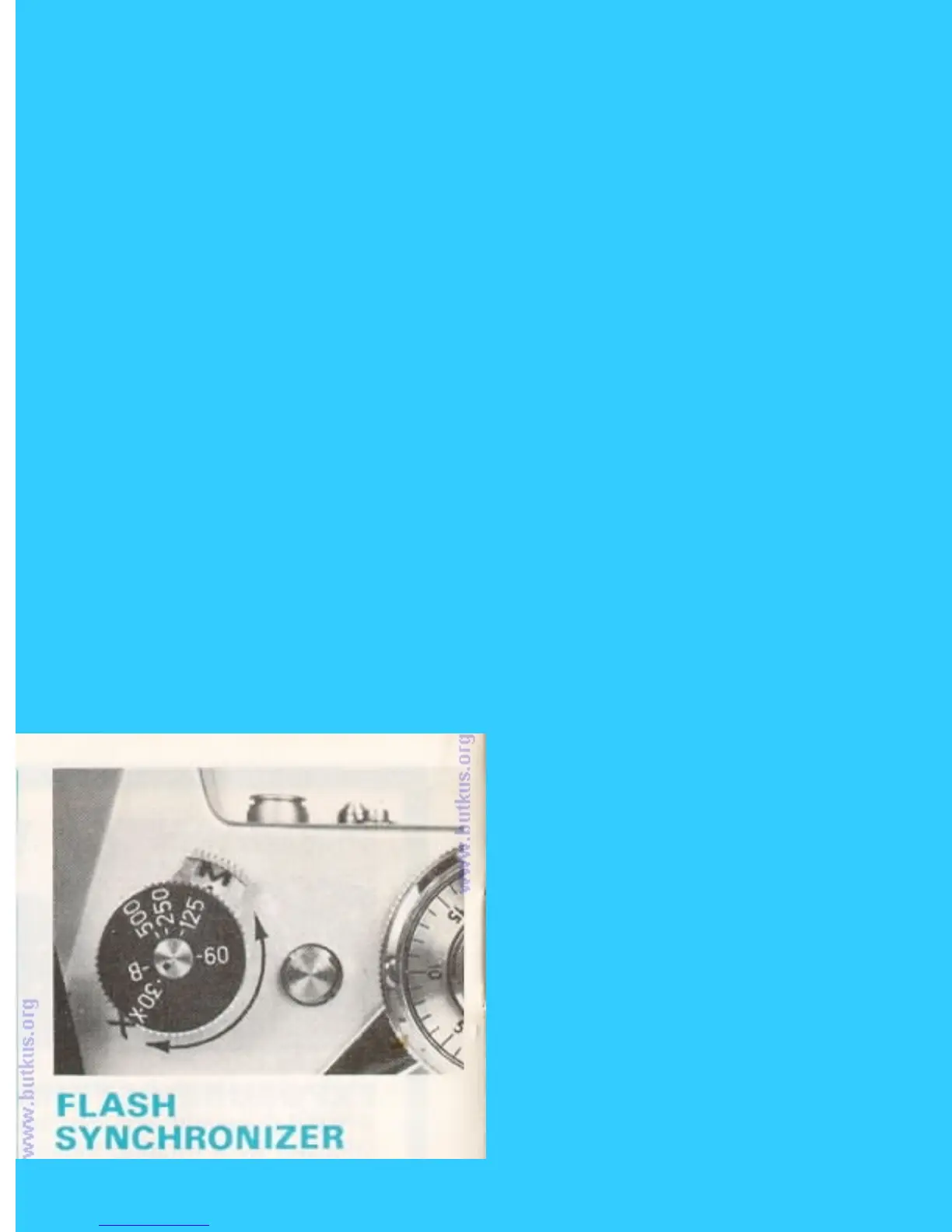
FLASH SYNCHRONIZER
For photographing in conditions with poor illumination, you should use a flash gun. For this- purpose
the Zenith B camera is fitted with a special device which synchronizes flash to coincide with the shutter
operating time. To switch on a single action flash bulb: set the synchronization setting lever against
index "M". When operating with an electronic flash gun, the synchronization setting lever should be set
against index "X". Only one exposure time of 1 /30th sec. may be used in the Zenith B camera: when
photographing with either flash bulbs or electronic flash. Hand exposure ''B' is not recommended when
using flash bulbs: a considerable amount of stray light (after flash) enters the camera with resulting over
exposure.



 To Next Page