TUNING
STANDARD BROADCAST
BAND:
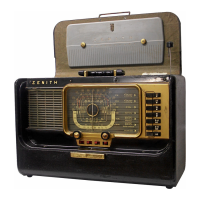
I:igure
2 sho*'s
the position
of
Tr,rning antl
Volume Control
knobs.
To
place
the
instrument
in
operation,
tr,rrn thc
Volume Control
knob to the right.
This
will turn
on the set.
Allo*'about
l0
scconds
for
thc tubes
to reach operating
temperature.
Set
thc
[Jlnri
Srlitch
to
thc AM position.
To tr-rne the
rcceiver,
turn the Tuning Control
knob slowly to
the de-
sirccl station
and rcacljust
the
Volume
Control
knob to the right or
left to
the clcsircd
volumc. To turn
thc receiver
OFF,
rotate the
Volume
Control
knob as far
as it
will
go
to the left, until
a
"click"
is heard.
Figure
2
-
Fronf Ponel
View
F'REQUENCY
MODULATION BAND: The receiver is turned
ON
and
OFF
in the same
manner as in standard
broadcast
operation. The Band
S*'itch nrrst bc sct to
l"M
rrosition.
TUNING THE RECEIVER ON
THE FREQUENCY MODULATION BAND !yILL REQUIRE MORE
CARE
THAN
ON
THE BROADCAST BAND. A hissinq sound may be
noted when
tuning between
Frequency
Modulation stations. This
is
normal,
and
will
disappear as the station
is
tuned
in.
After
a
station
is located, the
pointer should be
moved back and forth
over
it until the
point
of
quietest
reception and best tone
quality
is found.
Correct
tuning is indicated by
the disappearance of background noise.
Although Frequency
Modulation
stations are heard over great
distances
on
rare occasions, do not expect to
tune in
other
than
your
Iocal
stations.
The nature of Frequency Modulation
transmission
limits
reception
to areas
within the
approximate horizon.



 To Next Page