Need help?
Do you have a question about the Zimmer A.T.S. 3000 and is the answer not in the manual?
Details the limited one-year warranty for the A.T.S. 3000 system in the USA, including scope, disclaimers, and claim procedures.
Covers UL60601-1 classification and guidance/declarations for electromagnetic compatibility (EMC) of the A.T.S. 3000.
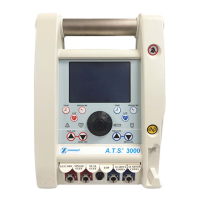
Provides detailed technical specifications for the A.T.S. 3000, including voltage, current, power, battery, cords, and controls.
Details the intended medical applications, contraindications, and crucial safety precautions for operating the A.T.S. 3000.
Describes potential adverse effects associated with tourniquet use, such as pain, tissue damage, and bleeding.
Details the physical dimensions of the A.T.S. 3000 and describes its LCD display capabilities for pressure and time.
Guides users through initial unit inspection, charging, and functional/calibration checks before operation.
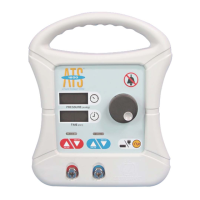
Identifies and explains the function of all front panel controls, indicator lights, and connection ports on the A.T.S. 3000.
Details pre-operation setup steps, including fuse checks and initial charging procedures.
Describes procedures to verify unit functionality and calibration status, including self-tests and set point checks.
Explains how to set and modify default pressure and time limits for the tourniquet cuffs.
Details the process for determining the patient's LOP to set optimal tourniquet pressure.
Guides the user through operating the A.T.S. 3000 with a single tourniquet cuff.
Explains the operation of the A.T.S. 3000 when using two tourniquet cuffs simultaneously.
Provides instructions for using the A.T.S. 3000 for Bier Block Cuff Operation (Intravenous Regional Anesthesia).
Details how to adjust the speaker volume for alarms and feedback.
Explains how to customize the contrast of the unit's display screen.
Lists all possible alarm conditions, their indications, and recommended actions for troubleshooting.
Provides an overview of recommended maintenance practices for the A.T.S. 3000 to ensure safe and effective operation.
Details the steps required to access internal components and parts of the A.T.S. 3000 for servicing.
Outlines procedures for cleaning and disinfecting the LOP sensor before patient use.
Specifies the schedule and inspection points for routine maintenance testing and visual checks of the A.T.S. 3000.
Provides a detailed step-by-step guide for calibrating the cuff and reservoir transducers of the A.T.S. 3000.
Explains how to perform leak testing on the A.T.S. 3000 system to ensure pneumatic integrity.
Covers checking battery voltage, service requirements, and proper battery disposal procedures.
Details the procedure for replacing fuses and fuse drawers, including correct fuse types and drawer usage.
Addresses unscheduled maintenance and how the unit's self-test features assist in fault isolation.
Provides a guide to resolve common malfunctions by listing symptoms and their probable causes.
Lists expected voltage readings at various test points for troubleshooting.
Lists field-replaceable parts orderable from Zimmer, with contact information for ordering.
Specifies the recommended environmental conditions for storing and transporting the A.T.S. 3000.
Identifies and labels all controls, indicators, and ports on the front panel of the A.T.S. 3000.
Identifies and labels the power cord, fuse block, and other features on the rear panel of the A.T.S. 3000.
Illustrates the calibration kit setup, battery removal, and replacement procedures.
Details procedures for accessing internal components and provides a layout of the A.T.S. 3000 control board.
Explains important warnings, cautions, and standard symbols used on the A.T.S. 3000 and its packaging.
 General
| Brand | Zimmer |
|---|---|
| Model | A.T.S. 3000 |
| Category | Medical Equipment |
| Language | English |

 To Next Page