
 Need help?
Do you have a question about the Zodiac PRO 550 and is the answer not in the manual?
Detailed specifications of the boat, including dimensions, capacity, and engine configuration.
Lists all components included with the boat, categorized into Hull, Buoyancy Chamber, Standard, and Optional Equipment.
Diagrams illustrating the placement of various components and fittings on the boat's deck.
Instructions and recommendations for transporting, storing, and lifting the boat safely.
Guidance on positioning optional accessories like consoles, seats, roll bars, and boarding ladders.
Details on the fuel tank, filling procedures, circuit locking, and maintenance of the water/fuel separator filter.
Recommendations for battery usage, maintenance, and safety precautions related to the boat's electrical system.
Identifies and explains the purpose of various safety labels placed on the boat for user awareness.
Step-by-step instructions for correctly fitting the buoyancy chamber onto the boat's hull, including flap fixing.
Outlines the main steps for assembling the boat, including component inventory and initial inflation.
Explains the use of the inflation pump, easy push valves, and pressure indicator for inflating the boat.
Details the correct pressure for buoyancy chambers, factors affecting it, and how to manage pressure loss or overpressure.
General recommendations and advice regarding the boat's propulsion system and engine compatibility.
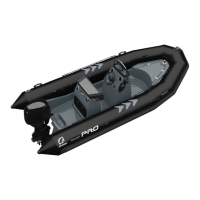
This manual describes the Zodiac PRO 550, a versatile inflatable boat designed for various marine activities. It focuses on the buoyancy chamber, propulsion system, installation, and associated circuits, providing essential information for safe and optimal operation.
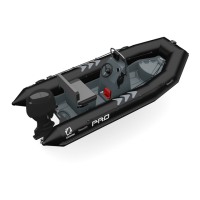
The Zodiac PRO 550 serves as a robust and adaptable marine vessel. Its primary function is to provide a stable and reliable platform for transportation and recreational activities on water. The boat is equipped with a polyester hull and a removable buoyancy chamber, which together ensure buoyancy and stability. The design incorporates features for easy handling, storage, and maintenance, making it suitable for both experienced users and those new to boating. The boat's structure allows for the installation of various optional accessories, enhancing its functionality and catering to diverse user needs.
The Zodiac PRO 550 offers several usage features that contribute to its practicality and ease of operation.
Handling and Transportation: The manual provides detailed instructions for handling and transporting the boat. For lifting, a 4-wire sling, available from a Zodiac dealer, is recommended. Specific steps are outlined for preparing the boat for lifting, including reversing the aft chain plates and fitting additional chain plates at the bow. All fittings must be made watertight using Sikaflex to ensure safety and prevent water ingress. For storage, precise recommendations are given for positioning the boat, emphasizing that it must rest on the bow line. These guidelines are crucial for preventing damage during storage and transport.
Optional Accessories: The boat is designed to accommodate various optional accessories such as a console, seat, and bolster. The manual specifies optimal positioning for these accessories to maximize usability and facilitate the routing of wires under the deck. It highlights areas, particularly above the fuel tank, where precautions must be taken during installation to avoid damaging the boat's structure. A cable guide, supplied with the boat, should be located in the grey-shaded area (axis of non-slip area) to allow wires to pass under the deck without compromising the boat's integrity. The tank hatch must remain accessible for safety reasons, even if covered by a console, ensuring it can be accessed through the console chest.
Fuel System: The boat features a 75-liter fuel tank located under the deck, accessible through a hatch under the anchor locker lid at the front. The fuel circuit includes a cutoff valve, a level probe, and a filling port. The manual details the procedure for filling the tank, which involves opening the bow anchor locker lid, removing a small cover, and lifting the filler plug. A critical safety feature is the petrol circuit closing valve, located under the deck. This valve must be closed when the boat is not in use and opened before operation. In case of a petrol leak or fire, this valve allows the tank to be isolated from the fuel circuit and must remain closed.
Water/Fuel Separator Filter: To protect the engine, a water/fuel separating filter is integrated into the engine's fuel supply circuit. The manual illustrates the filter head and replaceable filter cartridge, emphasizing the importance of regular cartridge replacement after every 50 hours of use. Instructions for changing the filter cartridge include placing a draining funnel, releasing pressure in the fuel feed system, and following the manufacturer's guidelines. Safety warnings highlight the flammability of fuel, advising users to switch off the engine, disconnect the battery, and avoid smoking or open flames when working on the fuel system.
Electrical System: The boat's electrical system includes a battery (not supplied), for which recommendations on location and usage are provided. Standard maintenance involves keeping the battery clean and dry, tightening and greasing terminal lugs regularly with vaseline. Users are advised to top up with distilled water, as mineral water can damage batteries. Safety precautions emphasize keeping batteries and electrolyte out of reach of children, maintaining an upright position, and removing the battery from the engine compartment when adding electrolyte or recharging. The manual warns that battery electrolyte is toxic and corrosive, and batteries can emit explosive gases, necessitating work in well-ventilated areas with eye protection. For long-term storage, the battery should be removed, stored in a cool, dry place, and fully recharged before reuse.
Buoyancy Chamber Inflation: The manual provides a step-by-step procedure for inflating the buoyancy chamber. It advises applying liquid soap to the hull rails to facilitate positioning. The bolt rope of the buoyancy chamber should be positioned in the hull rail at the front of the boat. The process involves pulling the buoyancy chamber's tabs towards the aft end, ensuring protective flaps pass over the hull's nose, and fixing the sealing protective flap with screws and fabric washers. The buoyancy chamber's nose should be brought forward to pull the exterior protective flap under the hull's nose. Slight inflation helps check for correct centering. The external protective flap should be fixed only after the buoyancy chamber has been inflated. The inflation system includes an inflation pump with an adaptor, tube nozzle, tube connector, and inflation port. Easy push valves are designed for screwing in and unscrewing without forcing, with a warning against forcing the caps to avoid damaging the internal inflation system.
Pressure Management: The correct pressure for the buoyancy chamber is 240 mb/3.4 PSI, indicated by the middle of the green sector on the pressure gauge. The boat is fitted with an ACCESS pressure indicator for quick readings during inflation. The manual explains how ambient temperature and water temperature influence internal pressure, advising users to anticipate these variations. For example, a drop in temperature will cause a pressure drop, requiring reinflation, while exposure to direct sunlight can cause overpressure, necessitating deflation. Overinflation can damage the inflatable structure. The easy push valve allows air release by depressing the valve plunger to manage overpressure.
The Zodiac PRO 550 incorporates several features and recommendations for maintenance to ensure its longevity and safe operation.
Fuel Tank Replacement: If the fuel tank needs replacement, a cavity on the deck can be cut out, and an access hatch installed. This work must be performed by a qualified ZODIAC agent or dealer for safety reasons.
Water/Fuel Separator Filter Replacement: The replaceable filter cartridge for the water/fuel separator should be changed after every 50 hours of use. This regular maintenance is crucial for protecting the engine from contaminants.
Battery Maintenance: Regular battery maintenance includes keeping it clean and dry, tightening and greasing terminal lugs, and topping up with distilled water. For storage, the battery should be removed and recharged before reuse.
Safety Labels: The boat is equipped with safety labels that provide essential recommendations for safe use. These labels cover various aspects, including the requirement for a fire extinguisher, warnings about highly flammable and explosive gasoline, proper refueling procedures, and precautions when working on the fuel system. They also advise against improper towing and warn about the risks associated with battery terminals. Adhering to these labels is vital for ensuring total safety during operation and maintenance.
 General
| Maximum engine power | 90 HP |
|---|---|
| Passenger capacity | 12 |
| Type | Rigid Inflatable Boat |
| Shaft length | Long |
| Number of air chambers | 5 |
| Length overall | 5.50 m |
| Fuel capacity | 90 L |
| Tube material | Hypalon |
| Inside length | 4.2 m |
| Inside width | 1.4 m |
| Recommended engine power | 90 HP |
| Material | Hypalon |

 To Next Page