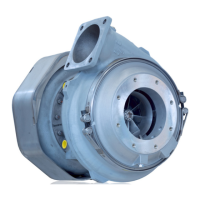
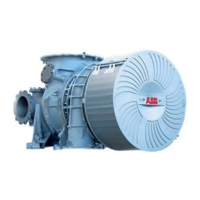
The provided document is an assembly instruction manual for the ABB A100-L series turbochargers, specifically covering models A165-L, A170-L, A175-L, A180-L, A185-L, and A190-L. These are described as high-efficiency turbochargers designed for two-stroke diesel engines.
Function Description
The ABB A100-L turbocharger series is designed to enhance the performance of two-stroke diesel engines by increasing the mass of air entering the engine cylinders. This process, known as forced induction, leads to more complete combustion, higher power output, and improved fuel efficiency. The turbocharger achieves this by utilizing the exhaust gases from the engine to drive a turbine, which in turn powers a compressor. The compressor then draws in ambient air, compresses it, and delivers it to the engine's intake manifold. The manual emphasizes that these turbochargers are state-of-the-art and comply with relevant health and safety standards, ensuring safe operation. They are considered "partly completed machinery" under the Machinery Directive 2006/42/EC, indicating they are intended to be integrated into a larger system (the engine).
Usage Features
The primary usage feature of the A100-L turbocharger is its integration into a two-stroke diesel engine system. The assembly instructions detail the process of correctly fitting the turbocharger to the engine, which is crucial for its proper function and to avoid health and safety risks. Key steps in the installation process include:
- Preparation: Removing covers from oil connections.
- Placement: Aligning the turbocharger and carefully placing it onto the engine bracket.
- Fastening: Tightening the fixing screws or nuts diagonally using either torque-controlled or angle-controlled tightening methods, depending on the specific requirements. The manual provides detailed tables for both tightening torques and angles based on the product model, thread size, and foot height.
- Connections: Connecting the cable to the speed sensor and all gas, air, and oil pipes.
- Pinning: If applicable, pinning the turbocharger feet with positioning pins, using one pin hole per foot.
The document also highlights that the turbocharger is designed for high efficiency, contributing to the overall performance of the two-stroke diesel engine. It is crucial that all persons involved in transportation and installation have read and understood these assembly instructions to ensure correct and safe usage.
Maintenance Features
While the manual primarily focuses on assembly, it provides critical information regarding the storage of new turbochargers and spare parts, which is a key aspect of maintenance and longevity.
- Short-term Storage (up to 6 months): New turbochargers and spare parts can be stored in their sealed packaging without additional mothballing measures for up to six months from the delivery date. The packaging includes a Volatile Corrosion Inhibitor (VCI) label. Storage must be in dry rooms with relative humidity between 40-70% to prevent condensation.
- Long-term Storage (more than 6 months): For storage exceeding six months, specific mothballing measures are required every six months. This involves opening the package, removing and replacing the VCI corrosion protection emitter with a new, identical one (available from www.branopac.com), and then resealing the package effectively to ensure permanent protection. The old VCI emitter must be disposed of in an environmentally compatible manner.
- Health and Safety during VCI Handling: When handling VCI products, it is essential to observe specifications in the safety data sheet, ensure good room ventilation, avoid eating or drinking at the workplace, clean hands and face after working, and wear safety gloves to protect against mechanical hazards.
- Hygrometer Check for Long-term Storage: Turbochargers prepared for prolonged storage by ABB Turbocharging are equipped with a hygrometer in a sight-glass (accessible through an opening in the wooden crate). Every six months, the hygrometer (02) must be checked. If the display field changes color at the 70% level, it indicates that the maximum permissible humidity has been exceeded, and the turbocharger must be inspected and repacked by an ABB Turbocharging Service Station.
- Package Inspection: The package must be inspected for damage. A damaged package also necessitates inspection and repacking by an ABB Turbocharging Service Station.
- Periodic Inspection (every 3 years): After every three years of storage, an ABB Turbocharging Service Station must perform specific work steps: inspect the components, replace the desiccant agent, and repackage the components.
- Unpacking: The corrosion protection effect ends once the material is unpacked from the VCI package. To prevent condensation, the surroundings and the package contents must be at the same temperature during unpacking.
- Operation Manual: The manual strongly advises consulting the Operation Manual for commissioning, operation, maintenance, and ordering spare parts. This manual, specific to the turbocharger's serial number, is available online on the ABB Turbocharging website.
The document emphasizes that only authorized personnel, who meet the target group definition, are versed in occupational safety regulations, are equipped with prescribed personal protective equipment, and have been instructed in the turbocharger's use, should perform work on the device. Regular checks of personnel's safety-conscious work and adherence to instructions are also recommended.

 Need help?
 General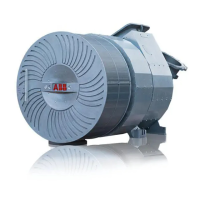

 To Next Page