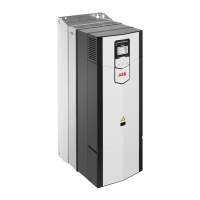
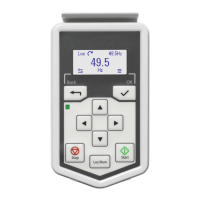
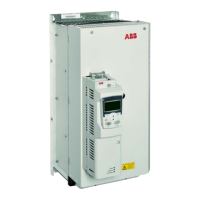
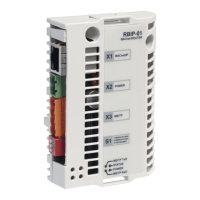
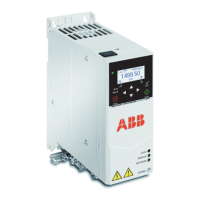
This document provides an installation notice for the ABB ACS 800 series of AC drives, specifically models ACS800-02-0080-2 to -0300-2, ACS800-02-0260-3 to -0490-3, and ACS800-02-0320-5 to -0610-5. It emphasizes a correct installation sequence to prevent damage and replaces page 49 in the standard Hardware Manual.
The ACS 800 is a high-performance AC drive designed for a wide range of industrial applications, offering precise control of electric motors. Its modular design allows for flexible configuration and integration into various systems. The installation process involves several key steps, starting with the mechanical mounting of the drive unit and its components, followed by electrical connections.
Function Description:
The ACS 800 drive is engineered to control the speed and torque of AC induction and permanent magnet motors. It achieves this through advanced motor control algorithms, such as Direct Torque Control (DTC), which provides highly accurate and dynamic motor control without the need for speed sensors in many applications. This capability makes it suitable for demanding processes where precise speed and torque regulation are critical, such as in cranes, extruders, winders, and test benches. The drive converts incoming AC power into a variable frequency and voltage output, which is then supplied to the motor, allowing for efficient and controlled operation across a wide speed range. It also incorporates features for energy efficiency, helping to reduce operational costs by optimizing motor performance.
Usage Features:
The ACS 800 is designed for ease of use and integration. The installation notice highlights the physical components and their arrangement, indicating a structured approach to setup.
- Modular Construction: The drive units are composed of distinct modules, as illustrated by the various sections (A, B, C, E, F, G, H, I, J) in the diagrams. This modularity simplifies installation, maintenance, and potential upgrades. For instance, section A likely represents the main drive enclosure, while sections B and C point to internal components or connection points.
- Clear Connection Points: The diagrams clearly label various connection terminals such as V1, V2, U1, U2, W1, W2 for motor phases, UDC+ and UDC- for DC bus connections, and PE for protective earth. There are also connections labeled R- and R+, which might refer to braking resistor connections or other auxiliary power inputs/outputs. This clear labeling facilitates accurate wiring and reduces the risk of errors during installation.
- Structured Installation Sequence: The notice explicitly states, "To avoid damage, follow the correct installation sequence below!" This underscores the importance of a step-by-step approach, which is crucial for complex electrical equipment. The numbered steps (1, 2, 3) within diagram A suggest a specific order for assembling or connecting parts of the drive.
- Robust Design: The physical appearance of the drive units suggests a robust construction suitable for industrial environments. The enclosures are designed to protect internal components from dust, moisture, and mechanical impact, ensuring reliable operation in harsh conditions.
- Integration with Control Systems: While not explicitly detailed in this notice, the ACS 800 series is typically designed for seamless integration with various industrial control systems, including PLCs and DCSs, through standard communication protocols. This allows for remote monitoring, control, and diagnostics, enhancing overall system automation.
Maintenance Features:
The modular design and accessible components of the ACS 800 contribute significantly to its maintainability.
- Component Accessibility: The exploded views and internal diagrams (e.g., sections C, E, I, J) show that key components are accessible, which is vital for inspection, troubleshooting, and replacement. For example, section E appears to show a removable module or component tray, simplifying service tasks.
- Clear Wiring Layout: The organized internal wiring and labeled terminals (V1, V2, U1, U2, W1, W2, UDC+, UDC-, PE) not only aid in initial installation but also make it easier for technicians to trace circuits and diagnose issues during maintenance.
- Replacement of Modules: The modular nature implies that if a specific component or module fails, it can often be replaced independently without needing to replace the entire drive unit. This reduces downtime and repair costs.
- Preventive Maintenance: The design likely supports routine inspections of connections, cooling systems, and other wear-and-tear components. For instance, the presence of cooling fins or fans (though not explicitly detailed, implied by industrial drive design) would necessitate periodic cleaning to maintain optimal thermal performance.
- Diagnostic Capabilities: Modern industrial drives like the ACS 800 typically include advanced diagnostic features that provide fault codes and operational data. While not shown in this installation notice, these features are crucial for quick identification and resolution of operational problems, minimizing production interruptions.
In summary, the ABB ACS 800 is a sophisticated and robust AC drive system designed for high-performance motor control in industrial settings. Its modular construction, clear installation guidelines, and accessible components contribute to its ease of installation, reliable operation, and straightforward maintenance, making it a valuable asset for demanding applications. The emphasis on a correct installation sequence in this notice highlights the critical first step in ensuring the long-term performance and safety of the drive.

 Need help?
 General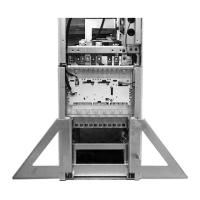

 To Next Page