To Next PageTo Next Page
 Need help?
Do you have a question about the ABB Circuit Shield 87B and is the answer not in the manual?
Identifies the specific model of the high impedance differential relay.
Specifies the catalog series for product identification and ordering.
Essential safety guidelines and warnings for handling and applying the relay.
Guidelines for proper receipt, care, and storage of the relay.
Detailed steps and considerations for installing the relay.
Information on wiring and interconnecting the relay.
How to configure voltage pickup and test/reset functions.
Details on fine-tuning settings using the vernier trimmer.
Procedures for verifying wiring, power, and basic operation after installation.
Details on the relay's input impedance and sensitivity characteristics.
Specifies the acceptable tolerance for voltage pickup settings.
Information on the relay's total trip time and component timings.
Ratings for continuous and short-term voltage withstand.
Permissible operating frequencies for the relay.
How the relay limits input voltage during faults.
Specifies the input-to-output isolation rating.
Available control power voltages and their catalog numbers.
Guidance on setting voltage pickup above external fault voltages.
Information on the relay's thermal withstand and energy limits during internal faults.
How to determine minimum fault current for tripping based on relay burden and CTs.
Guidelines for selecting and wiring current transformers for optimal performance.
Guidance on maintenance, parts, and component replacement.
Warnings and procedures regarding high voltage insulation tests.
Factory tests and on-site checks to verify relay functionality.
Procedure for a basic operational test using the front panel button.
Detailed procedures for bench testing and calibrating the relay.
Information on obsoleted 419B series units and their replacements.
Details on obsolete 219B series units and replacement with 419B series.
Diagram for ground fault protection of transformer/generator windings.
The ABB Type 87B High-Impedance Differential Relay, Catalog Series 419B, is a high-speed or instantaneous differential voltage device primarily designed for bus differential protection. Its high current sensitivity also allows for its use in differential protection of resistance-grounded systems, machines, or reactors.
The Type 87B relay utilizes solid-state circuits to provide high-speed and sensitive protection against faults within the protected zone of substations or equipment. It presents a high impedance burden to current transformers (CTs) for secondary differential currents below 0.5 amperes and corresponding burden voltages below 1000 volts peak, ensuring negligible leakage current through its varistors at these levels.
The relay's voltage pickup setting is adjustable via a switch and trimmer potentiometer in a voltage divider circuit. It responds to a modified instantaneous voltage increase across its terminals above the set point during internal faults. The pickup voltage should be set above moderate voltages that may occur under external or through-fault conditions due to unequal performance or saturation of CTs. Filter and delay circuits are incorporated to provide protection against system transients, RFI, and flux exchange between current transformers.
Equipped with voltage-limiting power resistors (metal oxide varistors), the relay limits input voltage to safe values during internal system faults. During heavy faults, the input burden essentially acts as a relatively high DC voltage in series with a low resistance, which minimally impedes the build-up of CT summation currents. This allows the relay to absorb instantaneous power in the order of kilowatts while responding to high currents, within its assigned wattsecond limits. The energy delivered by CTs depends on their saturation voltage (or VA rating), ratio, and fault current magnitude.
The Type 87B relay is primarily designed to operate a fast lockout relay, which then short-circuits the relay inputs and trips associated circuit breakers. The input side of the relay is isolated from the output circuits by an optocoupler. The output side comprises a dry contact and associated clamping, delay, polarity, and power supply circuits. When a differential trip occurs, the output contact is driven closed for a minimum of 200 milliseconds (400 typical) before automatically resetting. If the trip level input is maintained, the relay will continue to cycle through its trip and reset functions.
The relay is designed for use with dedicated CTs, preferably toroidal or bushing type with low leakage impedance. All CTs must have the same ratio and, ideally, the same relaying class rating (saturation voltage). The highest available CT tap is recommended to ensure the secondary winding is fully distributed around the core. Optimal sensitivity is achieved when CT lead resistances to the junction point are minimized and the junction is equidistant in lead length from all CTs. Only one ground connection should be present in the secondary circuit. CT polarity and recommended connections must be observed, and a lockout relay should always be used. The user should select CTs, wiring, and terminations capable of withstanding circuit voltages encountered during faults. If CT secondaries are additionally protected by gaps or varistors, their trigger or threshold voltage should be between 1600 and 2000 volts.
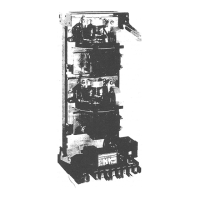
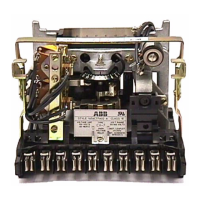
The Type 87B relay is housed in a case suitable for conventional semi-flush panel mounting, offering totally drawout construction with integral test facilities. Current transformer shorting is achieved by a direct-acting spring and blade assembly upon removal of the relay from its case. Sequenced disconnects prevent nuisance tripping during withdrawal or insertion.
A target indicator on the front panel provides a permanent indication of relay system operation. This target can be reset via a pushbutton extending through the relay cover, provided control voltage is present. The relay itself does not require manual reset; it restores to functional status upon clearing of faults and resetting of the lockout relay.
The voltage pickup is settable via a front panel switch at 75, 100, 150, 200, 250, 300, 350, or 400 volts AC RMS. A vernier marked pickup trimmer inside the relay on the upper printed circuit board allows for fine calibration of pickup settings at selected switch positions.
A built-in test pushbutton, located behind the removable front cover, facilitates operational trip tests. When using this test switch, the button should be released as soon as the 87B operates; holding it in will cause the relay to rapidly repeat its trip and reset functions, appearing to chatter.
No routine maintenance is required for these relays. However, following test instructions to verify proper working order is recommended. If a relay is found inoperative, it should be returned to the factory for repair. Immediate replacements are available from the factory by catalog and serial numbers. It is suggested to order a complete spare relay as a replacement and retain the repaired unit as a spare.
Metal handles provide leverage for withdrawing the relay assembly from its case. Removing or installing a drawout unit while the relay is in service will not cause an undesired operation. The assembly is identified by its catalog number on the front panel and a serial number stamped on the bottom of the board.
For situations requiring separation of the upper and lower circuit boards, two screws attaching the left and right handle assemblies to the upper printed circuit board, and two screws attaching the bottom circuit board to the bracket on the back plane board, must be removed. The lower board can then be withdrawn forward from the printed circuit connector. An 18-point extender board is available from the factory for access to the lower circuit board during testing or troubleshooting.
A test plug assembly (Catalog Number 400X0001) is available for use with the 419B series units. This device plugs into the relay case on the switchboard, providing access to all external circuits wired to the case. When using the test plug, access to the external CT circuit is obtained at any of the three current circuit shorting switches, as these switches are in series in the CT secondary circuit.
High voltage insulation tests are not recommended for the relay circuits. If a control wiring insulation test is required, the drawout assembly should be removed from the case before applying test voltage (partial withdrawal to break all connectors is sufficient). Bench tests with high voltage and high current from a high power voltage source are not recommended due to uncontrolled energy output. If such tests are contemplated, the test circuit should include properly selected current transformers of allowable ratio and saturation voltage, and a lockout relay interconnected as in the differential scheme.


 General