26
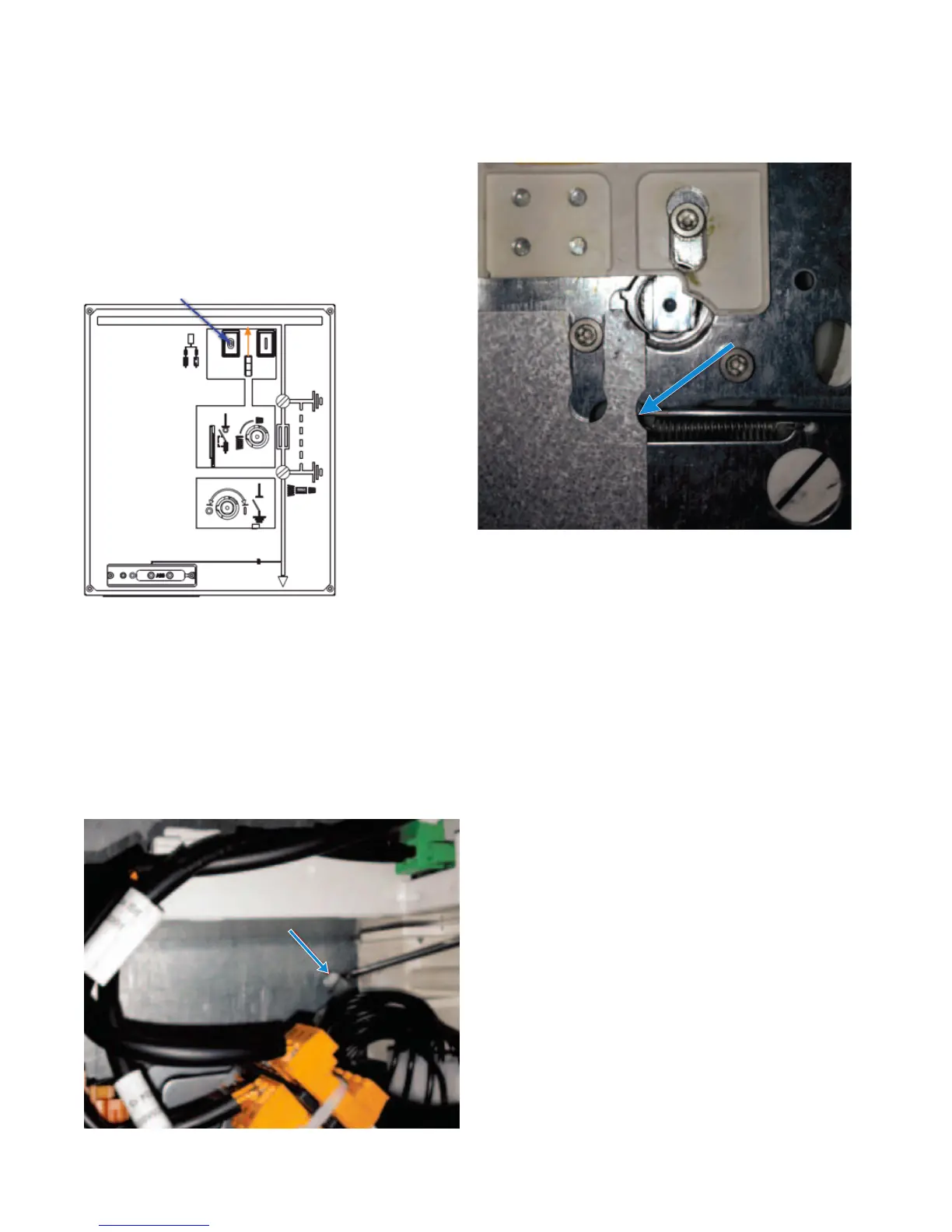
Fig. 48
Fig. 49
Fig. 47
5.12.3. No-load spring release procedure
NOTE
The no-load spring releasing operation is guaranteed for a
limited number of times < 25.
If the springs are loaded and the disconnector is open,
the operator can release the springs without changing the
condition of the disconnector.
Operating sequence
In the case of a non-motor operated double-spring operating
mechanism:
1. Release the springs by means of the opening button.
In the case of a motor operated double-spring operating
mechanism with GSec CAD (printed circuit board):
1. Remove the protective enclosure from the operating
mechanism.
2. Insert a screwdriver and push the lever downwards.
3. Release the springs.
4. Fit the protective enclosure back in place.
Motor operated with remote control switches:
1. Remove the protective enclosure from the operating
mechanism.
2. Insert the tool (screwdriver) as indicated in the photo and
inhibit the interlock.
3. Fit the operating lever into the seat.
4. Turn the operating lever clockwise to release the motor.
5. Remove the operating lever from the seat.
6. Release the springs by means of the opening button.
5.12.4. Operating units fitted with key interlocks
The units can be fitted with key interlocks. The key interlocks
are available separately for both the line switch and earthing
switch. Key locks can only be used in the following cases:
– The line circuit-breaker can set to the following 3 positions
when the operating mechanism is the single-spring type:
- “open-free” (1 key that locks the circuit-breaker in the
“open” position)
- “closed-free” (1 key that locks the circuit-breaker in the
“closed” position)
- combination of “open-free” and “closed-free” (2 keys).
– The line circuit-breaker can only set to the following
position if the operating mechanism is the double-spring
type:
- “open-free” (1 key that only turns when the circuit-
breaker is in the “open” position, with springs discharged).
– The earthing switch can set to the following 3 positions
with both single- and double-spring operating
mechanisms:
- “open-free” (1 key that locks the circuit-breaker in the
“open” position)
- “earthed-free” (1 key that locks the circuit-breaker in the
“earthed” position)
- combination of “open-free” and “earthed-free” (2 keys).


 To Next Page