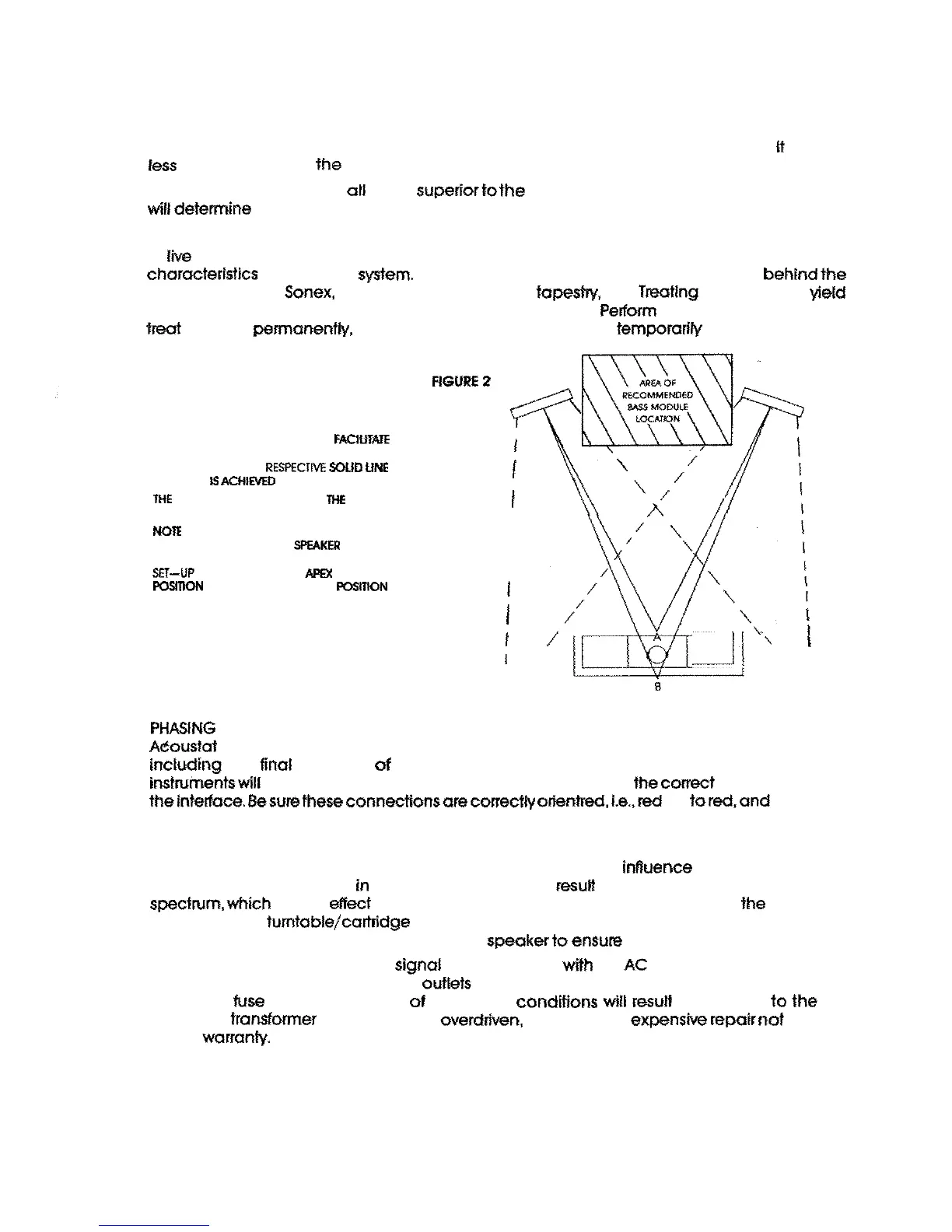
arrangement reduces the
"
Listening window,
"
but provides a more focused sound.
requires
angling, therefore. speakers are angled outward slightly
to
achieve this
"
apex
"
position.
NOTE
Neither position
is
in cases other. Personaf taste and room placement
which
is
the best
for
you. Experiment!
ACOUSTICAL
PROPERTIES
OF
THE
WALLS
A
end
-
dead end sef
-
up in the listening room can sometimes improve the sonic
of
a
speaker This can
be
accomplished by using materials
speakers such
as
fiberglass panels, carpet. etc. the walls can
more
precise imaging and superior focus
from
your
speakers. a listening test before you
fhe walls using a
heavy
blanket suspended while
you
listen.
THE
SOLID LINES
ARE
SHOWN
TO
ANGLING ONLV WHEN THE PANELS
ARE
PER-
PENDICULAR TO THE
THAT
APEX
DASHED LINES REPRESENT
SONIC
RADIATION
OF
THE
SPEAKERS
SPEAKERS
SHOWN
ARE
DRAWN WITH
THE
FRONT
PLANE
OF
ME
PERPEN
-
DICULAR
TO
THE LISTENER IN
A
ROOM
THIS
WOULD MELD
THE
IN
THE
B
TO
ACHIEVE
THE APEX
IN
A
THE
SPEAKERS
WOULD
HAVE
TO
BE
ANGLED
IN SLIGHTLY
I
I
I
I
speakers are designed
to
preserve the correct absolute phase throughouf the system,
the coupling
the signal to the air. The ensures that both vocalists and
sound as natural as possible. Phasing depends on connecflonsh
-
om
(+)
black(
-
-
)
to
black.
ELECTRIC
FEEDBACK
Electrostatic speakers produce a strong electric Reld which can the operation
of
any
low
level
electronic circuitry
close
proximity. This can in feedback well above the audio
has the
of
power dissipation and decreased headroom in system.
For
this reason, the leads and the phono inputs
of
the preamplifier should be
kept at Least
six
to
eight
feef
from
the nearest
that no feedback can occur.
WARNING! DO
NOT
apply audio
to
the intelface the
Power removed, hence
no
panel bias! Connection
to
switched
is
not
recommended.
DO
NOT
exceed
fuse
ratings
or bypass
receptacle. Either the above
in damage
low
frequency
if
the interface
is
requiring and
covered
by the
6



 To Next Page