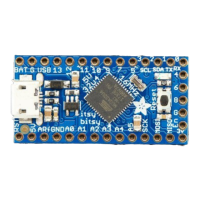
Trinket does not have a Serial port connection for debugging so the serial port monitor
will not be able to send/receive data
Some computers' USB v3 ports don't recognize the Trinket's bootloader. Simply use a
USB v2 port or a USB hub in between
There are two versions of the Trinket. One is 3V and one is 5V. Both work the same, but
have different operating logic voltages. Use the 3V one to interface with sensors and
devices that need 3V logic, or when you want to power it off of a LiPo battery. The 3V
version should only run at 8 MHz. Use the 5V one for sensors and components that can use
or require 5V logic. The 5V version can run at 8 MHz or at 16MHz by setting the software-set
clock frequency.
Here are some useful specifications!
ATtiny85 on-board, 8K of flash, 512 byte of SRAM, 512 bytes of EEPROM
Internal oscillator runs at 8MHz, but can be doubled in software for 16MHz
USB bootloader with a nice LED indicator looks just like a USBtinyISP
so you can program it with AVRdude (with a simple config modification) and/or
the Arduino IDE (with a few simple config modifications)
Mini-USB jack for power and/or USB uploading, you can put it in a box or tape it up and
use any USB cable for when you want to reprogram.
We really worked hard on the bootloader process to make it rugged and foolproof,
this board wont up and die on you in the middle of a project!
~5.25K bytes available for use (2.75K taken for the bootloader)
Available in both 3V and 5V flavors
On-board 3.3V or 5.0V power regulator with 150mA output capability and ultra-low
dropout. Up to 16V input, reverse-polarity protection, thermal and current-limit
protection.
Power with either USB or external output (such as a battery) - it'll automatically switch
over
On-board green power LED and red pin #1 LED
Reset button for entering the bootloader or restarting the program. No
need to unplug/replug the board every time you want to reset or
update!
5 GPIO - 2 shared with the USB interface. The 3 independent IO pins have 1 analog
input and 2 PWM output as well. The 2 shared IO pins have 2 more analog inputs and
one more PWM output.
Hardware I2C / SPI capability for breakout & sensor interfacing.
Mounting holes! Yeah!



 To Next Page