2.
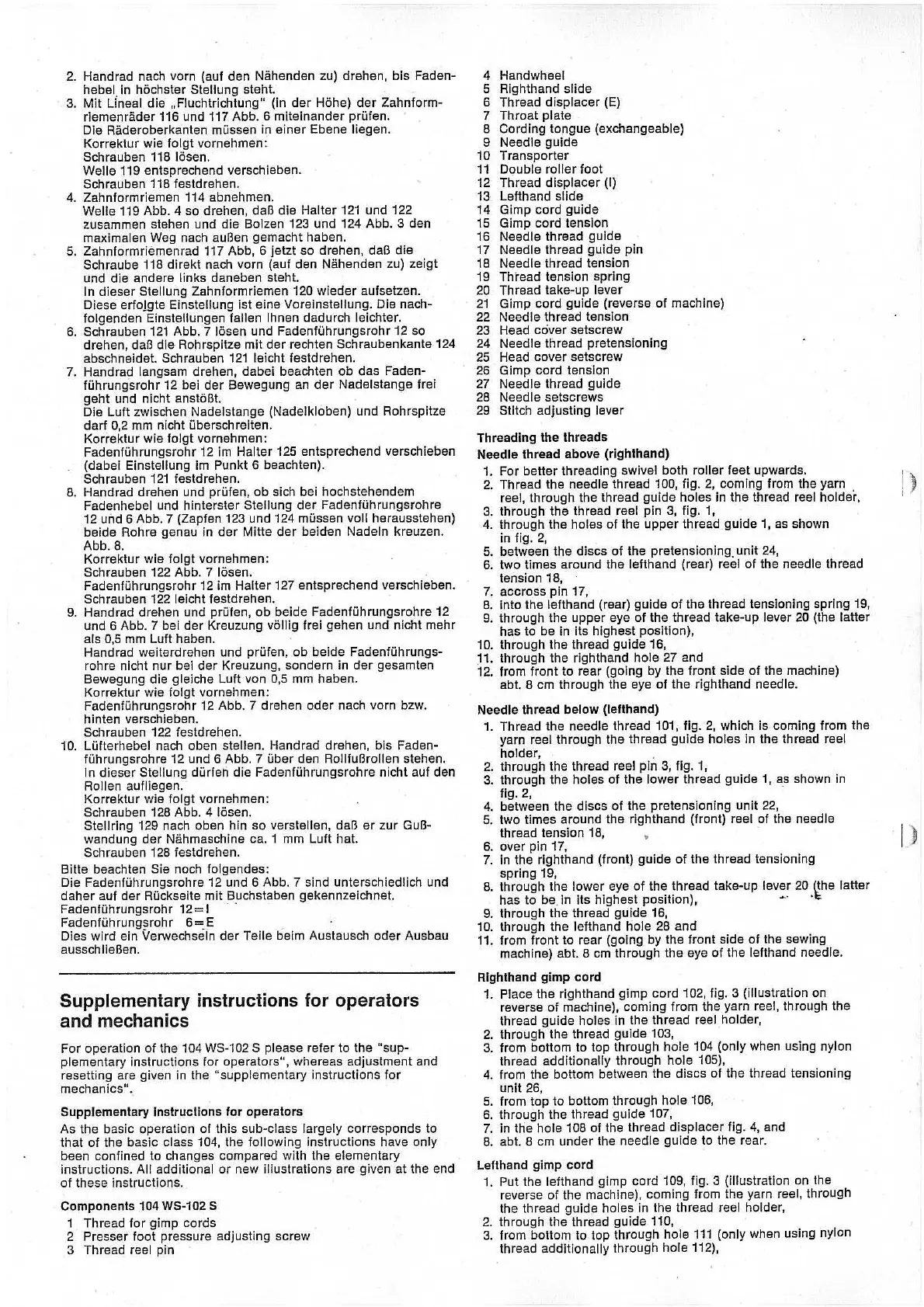
Handrad nach vorn (auf den Niihenden zu) drehen, bis Faden-
hebel_ in
hiichster Stellung steht.
3.
Mit
Lineal die ,,Fluchtrichtung" (in
der
Hiihe) der Zahnform-
riemenrader 116 und
117
Abb. 6 miteinander pri.ifen.
Die Raderoberkanten mi.issen in
einer
Ebene liegen.
Korrektur wie folgt vornehmen:
Schrauben
118
liisen.
Welle 119 entsprechend verschieben.
Schrauben
118 festdrehen.
4.
Zahnformriemen 114 abnehmen.
Welle 119 Abb. 4 so drehen,
dal3
die Halter
121
und 122
zusammen stehen und die Bolzen
123
und 124 Abb. 3 den
maximalen Weg nach
aul3en
gemacht haben.
5. Zahnformriemenrad
117
Abb, 6 jetzt so drehen,
dal3
die
Schraube
118 direkt nach vorn (auf den Nahenden zu) zeigt
und die andere links daneben steht.
In dieser Stellung Zahnformriemen 120 wieder aufsetzen.
Diese
erfoJgte Einstellung
isl
eine Voreinstellung. Die nach-
folgenden Einstellungen fallen Ihnen dadurch leichter.
6.
Schrauben
121
Abb. 7 liisen und Fadenfi.ihrungsrohr 12 so
drehen,
daB
die Rohrspitze mit der rechten Schraubenkante 124
abschneidet. Schrauben
121
leicht festdrehen.
7. Handrad langsam drehen, dabei beachten
ob
das Faden-
fi.ihrungsrohr
12
bei der Bewegung
an
der Nadelstange frei
geht und nicht
anstiiBt.
Die Luft zwischen Nadelstange (Nadelkloben) und Rohrspitze
dart
0,2
mm nicht i.iberschreiten.
Korrektur wie folgt vornehmen:
Fadenfi.ihrungsrohr
12
im
Halter 125 entsprechend verschieben
(dabei Einstellung
im
Punkt 6 beachten).
Schrauben
121
festdrehen.
8.
Handrad drehen und pri.ifen, ob sich bei hochstehendem
Fadenhebel und hinterster Stellung
der
Fadenfi.ihrungsrohre
12
und 6 Abb. 7 (Zapfen 123 und 124 mi.issen voll herausstehen)
beide Rohre genau in der Mitte
der
beid-en
Nadeln kreuzen.
Abb.
8.
Korrektur wie fol gt vornehmen:
Schrauben 122 Abb. 7
liisen.
Fadenfi.ihrungsrohr
12
im Halter
127
entsprechend verschieben.
Schrauben
122
leicht festdrehen.
9.
Handrad drehen und pri.ifen,
ob
beide Fadenfi.ihrungsrohre
12
und 6 Abb. 7 bei
der
Kreuzung viillig frei gehen und nicht mehr
als
0,5
mm
Luft haben.
Handrad weiterdrehen und
pri.ifen, ob beide Fadenfi.ihrungs-
rohre nicht
nur
bel der Kreuzung, sondern in
der
gesamlen
Bewegung die gleiche Luft von
0,5
mm haben.
Korrektur wie rolgt vornehmen:
Fadenfiihrungsrohr
12
Abb. 7 drehen
oder
nach vorn bzw.
hinten verschieben.
Schrauben 122 fesldrehen.
10.
Lurterhebel nach oben stellen. Handrad drehen, bis Faden-
fiihrungsrohre
12
und 6 Abb. 7 iiber den RollfuBrollen stehen.
In dieser Stellung
di.irren
die
Fadenfi.ihrungsrohre nicht auf den
Rollen
aurliegen.
Korrektur wie fol gt vornehmen:
Schrauben
128
Abb. 4 liisen.
Stellring
129
nach oben hin so verstellen,
dal3
er
zur
Gu13-
wandung der Niihmaschine ca. 1 mm Luft hat.
Schrauben
128
festdrehen.
Bitte beachten Sie noch folgendes:
Die Fadenfiihrungsrohre 12 und 6 Abb. 7 sind unterschiedlich und
daher auf der Riickseite mit Buchstaben gekennzeichnet.
Faden!Ohrungsrohr
12=
I · ·
Fadenfi.ihrungsrohr
6=E
Dies wird ein Verwechseln
der
Teile bairn Austausch
oder
Ausbau
aussch I
iel3en.
Supplementary instructions for operators
and mechanics
For operation
of
the 104
WS-102
S please refer to the "sup-
plementary instructions for operators", whereas adjustment and
resetting are given in the "supplementary instructions
for
mechanics".
Supplementary Instructions for operators
As the basic operation of this sub-class largely corresponds
to
that of the basic class
104,
the following instructions have only
been confined to changes compared with the elementary
Instructions. All additional
or
new illustrations are given at the end
of
these instructions.
Components 104 WS-102 S
1 Thread for gimp cords
2 Presser root pressure adjusting screw
3 Thread reel pin
4 Handwheel
5 Righthand slide
6 Thread displacer
(E)
7 Throat plate
8 Cording tongue (exchangeable)
9 Needle guide
10 Transporter
11
Double roller foot
12
Thread displacer (I)
13 Lefthand slide
14 Gimp cord guide
15
Gimp cord tension
16
Needle thread guide
17
Needle thread gui
de
pin
18
Needle thread tension
19
Thread tension spring
20
Thread take-up le
ve
r
21
Gimp cord guide (reverse
of
machine)
22
Needle thread tension
23
Head cciver setscrew
24
Needle thread pretensioning
25
Head cover setscrew
26
Gimp cord tension
27
Needle thread guide
28
Needle setscrews
29
Stitch adjusting lever
Threading the threads
Needle
thread above (righthand)
1.
For better threading swivel both roller feet upwards.
2.
Thread the needle thread 100, fig.
2,
coming from the yarn
reel, through the thread guide holes in the thread reel holder,
3.
through the thread reel pin
3,
fig. 1,
4.
through the holes
of
the upper thread guide 1,
as
shown
in fig.
2,
5.
between the discs
of
the pretensioning_ un
it
24,
6.
two times around the lefthand (rear) reel of the need
le
thread
tension 18,
7.
accross pin 17,
8.
into the lefthand (rear) guide of the thread tensioning spring
19,
9.
through the upper eye
of
the thread take-up
le
ver
20
(the latter
has to be in its highest position
),
10.
through the thread guide
16,
~1.
through the righthand hole
27
and
12.
from front
to
rear (going by the front side
of
the machine)
abt. 8 cm through the eye
of
the righthand needle.
Needle thread below (lefthand)
1. Thread the needle thread
101,
fig.
2,
which is coming from the
yarn reel through the thread guide holes
In
the thread reel
h~de~
.
2.
through the thread reel pin 3, fig.
1,
3.
through the holes of the lo
wer
thread guide 1,
as
shown in
fig.
2,
.
4.
between the discs of the pretensioni
ng
unit
22,
5.
two times around the
ri
ghthand (front) reel
of
the needle
thread tension
18,
•
6.
over pin
17,
7.
in the righthand (front) guide of the thread tensioning
spring 19,
8.
through the lower eye
of
the thread take-up lever
20
(the latter
has to be. In its highest
pos
ition), ~-
·I::.
9.
through the thread gu ide 16,
10.
through the lefthand hole 28 and
11.
from front to rear (going by the front side of the sewing
machine) ab
t.
8
cm
through the eye
of
the lefthand needle.
Rlghthand gimp cord
1. Place the righthand gimp cord 102, fig. 3 (illustration
on
reverse
of
mac
hi
ne)
, coming from the yarn reel, through the
thread guide holes in the thread reel holder,
2.
through the thread guide
103,
3.
from bottom
to
top through hole
104
(only when
us
ing nylon
thread additionally through hole 105
),
4.
from the bottom between the discs
of
the thread tensioning
unit
26,
5. from top to bottom through
hole
106,
6.
through the thread guide
107,
7.
in ttie hole 108 of the thread displacer fig.
4,
and
8.
abt. 8 cm under t
he
n
ee
dle guide to the rear.
Lefthand gimp cord
1.
Put the lefthand gimp cord
109,
fig. 3 (illus
tr
ation on the
reverse
of
the machine), coming from the yarn reel, through
the thread guide holes in the thread reel holder,
2.
through the thread guide 110,
3.
from bottom
to
top through hole
111
(only when using nylon
thread additionally through hole
112),
I)
From the Library of Superior Sewing Machine & Supply LLC


 To Next Page
 Loading...