INSTALLATION
MECHANICAL INSTALLATION
The detector must be bolted securely in position, but do not twist or strain it in any way.
Nothing should rest on the search head or touch the sides of it.
If a conveyor is used, all feet must be firmly on the floor. The conveyor must not rock or move. Twisting of
the conveyor when product enters the search head may cause false triggers. An unbalanced conveyor motor
could also be a source for unwanted vibration.
All cover screws, bolts, etc., in the vicinity of the detector must be tight for correct operation. Two pieces of
metal making intermittent contact may cause false triggers.
Do not modify the metal detector or its wiring in any way.
Do not attach rollers, guide plates, markers, or electronic sensing devices to any part of the search head.
Product pipes with emulsions or gravity system product chutes should pass through the center of the detector
opening, without touching the walls of the aperture.
The product being inspected should pass through the center of the metal detector opening. The product must
not make contact with any part of the search head. Non-metallic guides should be used if necessary.
WARNING: Do Not Weld anywhere on the unit with the metal detector head attached.
Welding on the unit WILL DESTROY the electronics of the detector and void any and all
warranties.
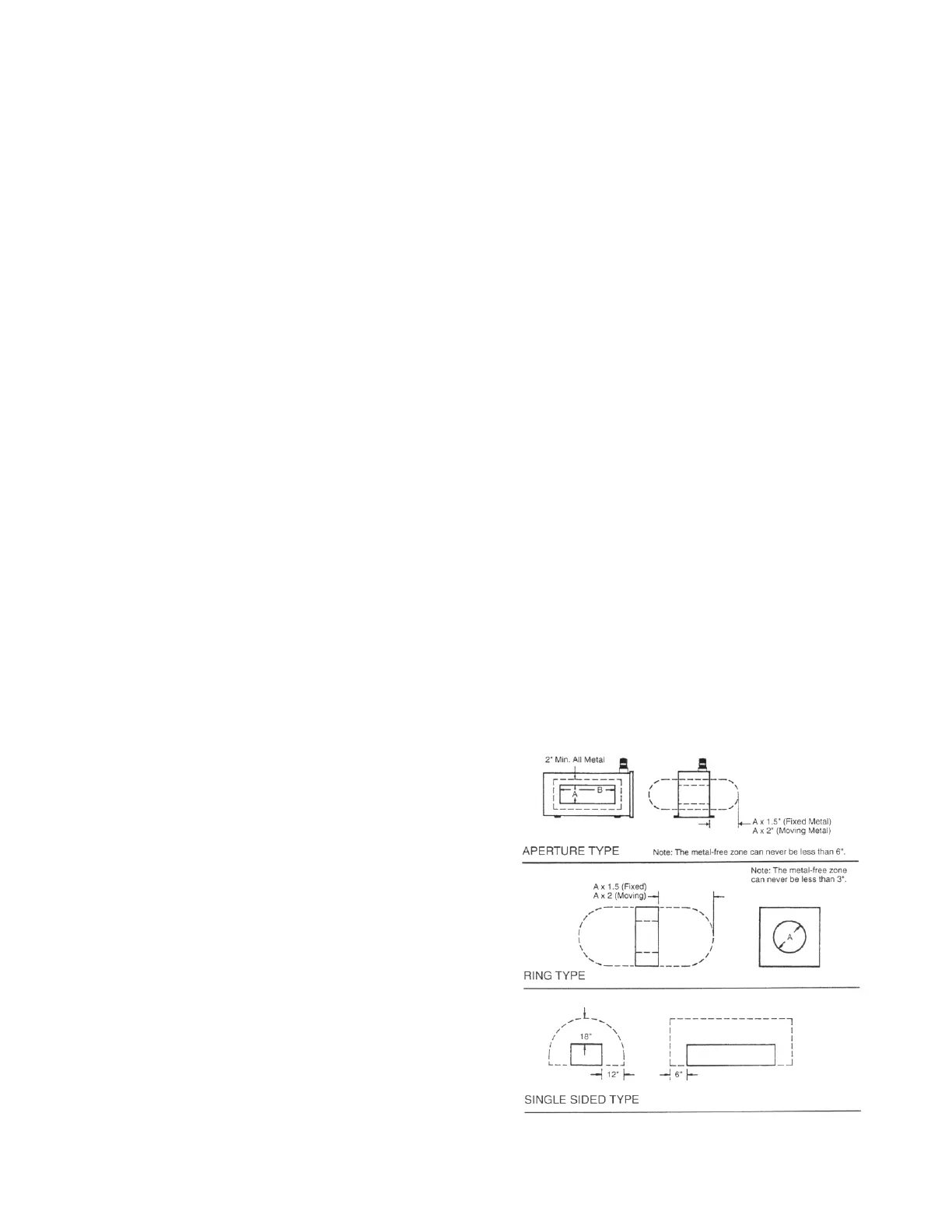
METAL FREE ZONE
The electro-magnetic field is created inside the
detector’s enclosure; however, some field emanates out
of the aperture on both sides and forms the metal free
zone (“MFZ”). Generally, the practical size of the
leakage is 1½ times the (smaller) aperture dimension,
and no metal should be allowed in this area. Large
moving metal should be kept 2 times away. Special
detectors are available for applications which demand a
substantially reduced MFZ.


 To Next Page