19
There is an Infant Mode button that the user must press
if the patient is an infant weighing less than 10 kg (22 lbs);
this is a manual action taken when the CellAED®
audio (voice) prompt invites them to “For infants, press
infant button.” The user must press the infant button
a second time to confirm and enable Infant Mode.
The CellAED® will issue audio prompt warnings prior
to shock delivery. Shock delivery is automated by
the CellAED®.
If the patient is transferred to emergency medical
personnel, the medical personnel can remove the
CellAED® electrode pads and replace with their own
defibrillation equipment, if available. The CellAED®
must be removed before any alternative defibrillator
is applied. To deactivate the CellAED®, stick the gel
sides of the electrode pads together for at least five
seconds. Audio (voice) prompts will acknowledge
when the CellAED® has been deactivated. Dispose
of the CellAED® safely and immediately according
to local council regulations.
5.2.4 CONTINUOUS BATTERY DIAGNOSTIC
The CellAED® is constantly aware of the battery status
and provides visual feedback to indicate the state of
readiness.
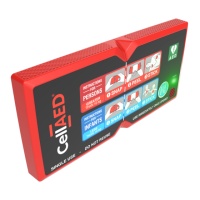
A blinking GREEN LED (every 30 seconds) indicates
the CellAED® is fully operational and ready to use.
A blinking AMBER LED (every 30 seconds) indicates
that the battery is low and the CellAED® should be
replaced immediately.
No LED indicates that the battery has expired and
the CellAED® should be replaced immediately.
5.2.5 HEART RHYTHM ANALYSIS
The CellAED® evaluates the patient’s heart rhythm.
Refer to Section 10.4, page 57 (ECG Interpretation
and Performance) for further information.
5.2.6 DEFIBRILLATION WAVEFORM
The defibrillation shock, using patented CellAED®
biphasic waveform technology, is a fully-discharging
capacitator method for delivering an energy-
efficient biphasic defibrillation waveform. The
waveform is automatically adjusted to compensate
for patient impedance. The CellAED® does not
detect patient motion.
5.2.7 SHELF LIFE
The CellAED® can be used up to 13 months from
the date of manufacture. This date is printed on the
CellAED® as a Date of Manufacture and indicates
the Use-by Date for the CellAED®.
Maintaining the CellAED® in an ideal storage condition
(15°C – 35°C (59°F – 95°F)) is required to maximise
the performance of the battery as well as the
CellAED® expected shelf life (refer to Section 6.4,
page 28).


 To Next Page