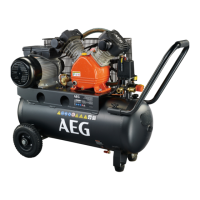
This document is the original instruction manual for the AEG AC3050V air compressor. It provides essential information for assembling, operating, and maintaining the product, and is subject to technical modifications.
The AEG AC3050V is an air compressor designed to supply pressurized air for operating air-powered tools. It is intended for indoor use only and must not be used to compress any other gas.
Key Technical Specifications:
- Rated motor power: 2100 W
- Rated current: 9.5 A
- Air outlets: 2 pcs, 6.35mm (1/4") NITTO style connector/coupler (suitable for NITTO fitments)
- Quick connector fitting size: 6.35 mm (1/4") BSP thread
- Weight: 43.2 kg
- Input: 220-240 V AC, 50 Hz
- Power cord length: 2 m
- Air tank capacity: 50 L
- Free air delivery: 200 L/min
- Maximum air delivery: 356 L/min at 0 bar tank pressure
- Maximum air pressure: 10 bar (145 psi, 1 MPa)
- Working pressure range: 7 - 10 bar (101.5 - 145 psi, 0.7 - 1 MPa)
- Pressure gauge: 2 pcs, 41 mm diameter
- Maximum rotational shaft speed: 2900 min⁻¹
- Short-circuit rating: 3 kA
- Operating temperature: 0-45°C
- Hazard level: Level D
- Measured sound pressure level (LpA): 86.55 dB(A), KpA = 3 dB
- Measured sound power level (LwA): 100.28 dB(A), KwA = 3 dB
- Air filter replacement part number: 039870001027
Assembly and Setup:
The compressor requires assembly before use. The manual details the installation of several components:
- Front Handle: Insert both ends of the front handle into the handle slots, align holes, and secure with locking bolts.
- Feet: Place a rubber foot under the left supporting frame, align screw holes, insert an M6 bolt and M6 flat washer from the bottom, insert another M6 flat washer at the other end, and secure with an M6 hex nut. Repeat for the right foot.
- Wheels: Insert an M10 step bolt into the wheel's center hole, place a 4 mm washer between the wheels and frame, and a 1.5 mm washer inside the frame. Insert a spring washer and secure with an M10 hex nut. Repeat for the other wheel.
- Air Filters: Attach one air filter to the cylinder cover on each side by screwing it in clockwise.
Usage Features:
- Oil Check and Addition: Before starting and before each use, the oil level must be checked. The sight glass has a red dot indicating the maximum oil level. If the oil level is at or below the bottom of the red dot, SAE-30 oil should be added using a funnel. Avoid overfilling.
- Transporting: The compressor can be moved by grasping the front handle firmly with two hands, lifting it, and pushing it to the desired location, ensuring it is balanced on its wheels. For stairs, grasp both front and rear handles firmly and carry the unit one step at a time, paying attention to the drain valve.
- Attaching/Disconnecting Air Hose: Ensure the compressor is off and unplugged, and the pressure regulator knob is fully counterclockwise with outlet pressure at zero. Attach the quick connect air fitting to the 6.35 mm (1/4 in.) quick connect coupler on the compressor, pushing until the sleeve locks. To disconnect, turn the regulator knob fully counterclockwise, confirm zero pressure, pull back the release sleeve, and pull out the air fitting.
- Turning On/Off: Plug in the compressor, then pull the power switch to the ON position. To turn off, push the power switch to the OFF position. The compressor automatically turns on when tank pressure drops below a preset limit and shuts off when the desired pressure is reached.
- Using the Air Compressor: Ensure the power switch is OFF and the compressor is unplugged. Attach the hose and air fitting to the accessory or tool. Connect the power cord, turn the switch ON, and rotate the pressure regulator knob to set the desired line pressure (clockwise to increase, counterclockwise to reduce). Lock the pressure by rotating the locking ring fully counterclockwise.
- Pressure Relief Valve Check: The valve automatically releases air if tank pressure exceeds the maximum. To check, turn the compressor on, allow the tank to fill, then turn it off. Pull the ring on the safety valve for 3-5 seconds; air should rapidly escape.
- Reset Button: If the motor current exceeds the limit, the compressor automatically shuts off. To reset, unplug the compressor, turn it off, wait three minutes for the motor to cool, press the reset button, plug it into an approved outlet, and turn it on.
Maintenance Features:
- General Maintenance: Avoid using solvents on plastic parts. Use clean cloths to remove dirt, dust, oil, and grease. Do not modify the product or use unapproved accessories. Disconnect power supply before adjustments or maintenance. Routinely check oil levels.
- Draining the Tank: To prevent corrosion and remove moisture, the air tank should be drained daily. Turn the compressor off, pull the pressure relief valve ring until the gauge reads less than 1.4 bar, then release the ring. Turn the drain valve counterclockwise to open and drain the moisture. Condensate is a polluting material and must be disposed of according to local regulations.
- Replacing Oil: Replace the oil after the first 10 hours of operation and every 100 hours thereafter. Allow the compressor to cool for 15 minutes before removing the drain plug. Place a container underneath to collect used oil. Remove the drain plug with a wrench, drain the oil, then reinstall and tighten the plug. Unscrew the oil fill cap, use a funnel to pour SAE-30 oil (recommended amount is 350 ml), ensuring the level does not exceed the red dot on the sight glass. Tighten the cap securely.
- Replacing Air Filters:
- Normal environment: Check and clean filters once a month. Replace damaged or heavily clogged filters.
- Heavy-dust environment: Check and clean filters once a week. Replace damaged or heavily clogged filters.
- To replace: Remove the air filter cover by turning counterclockwise, remove the old filter, install a new air filter, and refit the cover by rotating clockwise to secure.
Safety Warnings:
The manual emphasizes several safety warnings:
- Read all instructions before use to prevent electric shock, fire, and serious injury.
- Do not exceed the pressure rating of any component or attachment.
- Protect material lines and air lines from damage.
- Check hoses for weak or worn conditions before each use.
- Release all pressures slowly.
- Store idle compressors out of reach of children.
- Maintain compressors with care, checking for misalignment or binding parts.
- Keep the exterior dry, clean, and free from oil and grease.
- Use only identical replacement parts for servicing.
- Never use in an explosive atmosphere.
- Guard against electrical shock by preventing body contact with grounded surfaces.
- Do not abuse the power cord.
- Shut off power switch and remove plug if electrical components fail.
- Do not expose power tools to rain or wet conditions.
- Stay alert, exercise control, and do not operate when tired.
- Dress properly, avoiding loose clothing and jewelry.
- Always wear safety glasses with side shields.
- Wear a face or dust mask if dusty.
- Wear hearing protection during extended operation.
- Do not overreach; maintain proper footing and balance.
- Remove adjusting keys and wrenches before turning on.
- Never leave a tool unattended with the air hose attached.
- Never point an air tool toward yourself or others.
- Do not operate if the warning label is not legible.
- Always disconnect air and power supply before making adjustments or servicing.
- Do not attempt to pull or carry the compressor by the hose.
- Follow all safety rules for air tools in addition to compressor rules.
- Never direct compressed air toward people or animals.
- Do not use to spray chemicals.
- Inspect product cords and hoses periodically.
- Never use an electrical adaptor with a grounded plug.
- Check for damaged parts before further use.
- Never store a tool with an air line connected.
- Protect lungs by wearing a face or dust mask if dusty.
- If the power supply cord is damaged, it must be replaced by the manufacturer or an authorized service center.
- The machine must be connected to a circuit protection device (fuse or circuit breaker).
- Operate the machine from the front of the control panel.
- Wear personal protection equipment (e.g., gloves) when operating due to high temperatures.
- When using an extension cord, use a 3 x 1.5mm² heavy-duty cord only.
- This machine is not intended for use by persons (including children) with reduced physical, sensory or mental capabilities, or lack of experience and knowledge. Children should be supervised.
- Do not disassemble check valve, tank drain valves or safety relief valve with air in tank.
- Always wear eye protection with side shields.
- Do not attach any tools to the open end of the hose until start-up is complete.
- Do not use in a dusty or contaminated environment.
- Do not attempt to tamper with the safety valve.
- Always disconnect the air hose from tools whenever not in use or while servicing.
- Failure to unplug the compressor before storage may result in continuous running, overheating, damage, or fire.
- Do not let brake fluids, gasoline, petroleum-based products, penetrating oils, etc., come in contact with plastic parts.
- Hot oil can scald or burn hands; allow compressor to cool 15 minutes before draining oil.
- For greater safety and reliability, all repairs should be performed by an authorized AEG service center.
- Use only AEG accessories and spare parts.
The manual also includes a troubleshooting guide for common issues like the compressor not running, motor humming, current limiting protector cutting out, air tank pressure drops, excessive moisture, continuous running, and low air output, along with possible causes and solutions.
Contact information for Techtronic Industries Australia Pty Ltd and Techtronic Industries N.Z. Limited is provided for support and service. The document also lists symbols used throughout the manual to convey safety alerts, instructions, and warnings.



 To Next Page
 General