Need help?
Do you have a question about the AEG AC3050B and is the answer not in the manual?
Essential to read manual before assembling, operating, and maintaining the product.
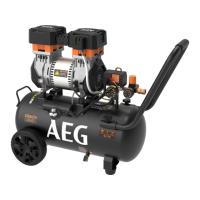
Key specifications including power, capacity, pressure, and dimensions.
Details for ordering replacement components for the air compressor.
Basic safety precautions to reduce risk of fire, electric shock, and personal injury.
Prevent body contact with grounded surfaces and avoid cord abuse to prevent electric shock.
Stay alert, dress properly, wear safety glasses, and protect hearing and lungs.
Follow maintenance, protect lines, release pressure, store safely, and use proper cleaning methods.
Use identical replacement parts and refer to instructions for service.
Read manual, drain tank daily, avoid flammable liquids, check for bursting risk, and store indoors.
Be aware of residual risks even when used as prescribed, such as fire, shock, and injury.
Defines intended operation, including use for pressurised air and indoor environments.
Carefully remove product and accessories, inspect for damage, and do not discard packing until satisfactory operation.
Insert handle ends into slots, align holes, and secure with locking bolts.
Attach rubber feet with M8 bolts, washers, and nuts to the supporting frame.
Mount wheels using M10 step bolts, washers, and nuts for stability.
Attach breather to the crankcase by screwing it in clockwise.
Attach air filters to cylinder cover and screw clockwise to fasten.
Check oil level using sight glass and add SAE-30 oil if below desired level.
Grasp handle, lift, and move on wheels or carry carefully on stairs.
Connect hose to quick coupler after ensuring pressure is zero, disconnect by pulling sleeve.
Use the power switch to turn the compressor on or off.
Control airflow with regulator knob; use minimum pressure needed for application.
Test safety valve by pulling ring to ensure rapid air escape.
Drain tank daily by opening drain valve to prevent corrosion and moisture buildup.
Press reset button after motor cools if current limiting protector trips.
Turn off, unplug, relieve pressure, drain tank, and store in a dry, protected area.
Use original parts, wear eye protection, disconnect power, and allow to cool before servicing.
Replace oil after first 10 hours and every 100 hours; check sight glass for level.
Check and clean filters monthly (weekly in dusty environments); replace if damaged or clogged.
Inspect drive belt monthly for cracks, damage, or tension. Replace if needed.
All repairs should be performed by an authorized AEG service center using genuine parts.
Explanation of safety alert, reading instructions, goggles, ear protection, indoor use, and breathing risks.
Avoid flammable liquids, smoking, and ensure proper ventilation. Prevent electrical shock by proper handling.
Dispose of electric tools responsibly at compatible recycling facilities.
Check power, fuses, breakers, and reset protector if motor hums but won't start.
Investigate low voltage, wrong extension cord, or motor winding issues.
Check for low voltage, poor ventilation, or incorrect extension cord.
Tighten loose connections, drain valve, or check for valve leaks.
Address excessive moisture, high humidity, defective switches, or high air usage.
Check piston rings, inlet valves, or leaking connections for reduced air output.
Diagram showing all numbered parts of the air compressor.
Diagram showing motor windings, capacitors, and control components.
 General
| Power | 1.5 kW |
|---|---|
| Voltage | 230 V |
| Max. Pressure | 8 bar |
| Tank capacity | 50 L |
| Type | Piston |
| Weight | 32 kg |
| Lubrication | Oil lubricated |

 To Next Page