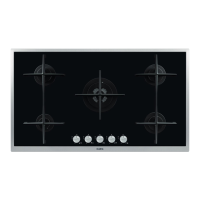
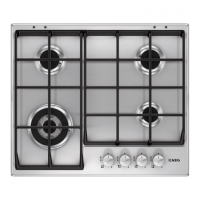
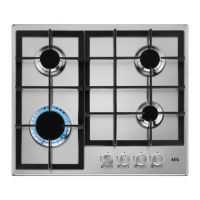
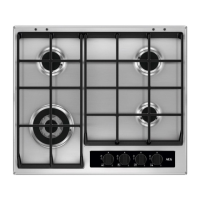
This document is a user manual for the AEG HG995440NB gas hob, providing comprehensive instructions for its installation, safe operation, maintenance, and troubleshooting. The manual emphasizes safety information throughout, highlighting potential hazards and necessary precautions for users and installers.
Function Description
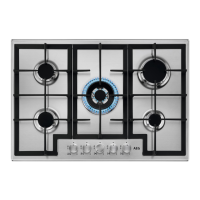
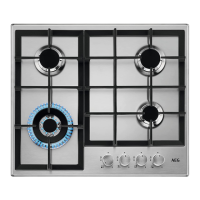
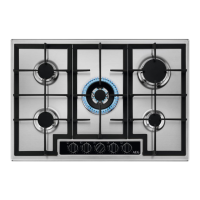
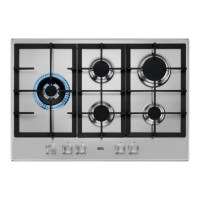
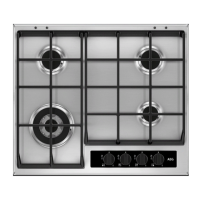
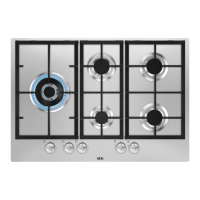
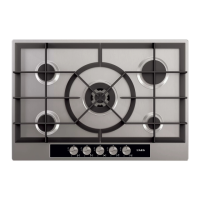
The AEG HG995440NB is a built-in gas hob designed for domestic cooking purposes. It features multiple gas burners, including an auxiliary burner, a triple crown burner, and semi-rapid burners, allowing for various cooking needs. The hob is equipped with control knobs for each burner, enabling users to adjust the gas supply and flame intensity from minimum to maximum settings. An ignition system is integrated to facilitate easy lighting of the burners. The appliance is designed to be installed into a kitchen worktop, providing a sleek and functional cooking surface.
Usage Features
The hob offers several features to enhance the cooking experience and ensure safety:
- Burner Ignition: To light a burner, the user must push down the corresponding control knob and turn it counterclockwise to the maximum gas supply position (ignition position). The knob should be held for a short period (equal to or less than 10 seconds) to allow the thermocouple to warm up, which is crucial for maintaining the gas supply. Once the flame is regular, the intensity can be adjusted.
- Flame Regulation: The hob is supplied with progressive valves, which allow for more precise flame regulation, enabling users to fine-tune the heat for different cooking tasks.
- Wok Stand: A dedicated wok stand is provided for use with the triple crown burner, allowing users to safely and effectively use round-bottomed woks. It's important to ensure the wok stand's recesses fit securely onto the pan supports.
- Cookware Compatibility: The manual provides guidelines on appropriate cookware diameters for each burner type to ensure optimal performance and stability. It advises against using cast iron, clay, earthenware pots, grill, or toaster plates, and emphasizes placing pots centrally on the burner for maximum stability and lower gas consumption.
- Safety Mechanisms: The hob incorporates safety features such as a thermocouple, which interrupts the gas supply if the flame accidentally goes out. It also warns against unattended cooking, especially with fats and oils, and provides instructions on how to extinguish a fat or oil fire safely. A child safety device, if present, should be activated to prevent accidental operation.
- Ventilation: The appliance requires good ventilation in the room where it is installed, especially during prolonged intensive use, to manage heat and moisture production.
Maintenance Features
Regular care and cleaning are essential to maintain the hob's performance and appearance:
- General Cleaning: The hob should be cleaned after each use. A moist soft cloth and neutral detergents are recommended for cleaning the surface. Abrasive products, cleaning pads, solvents, or metal objects should be avoided.
- Burner Components: The enamelled parts, burner caps, and crowns should be washed with warm soapy water and dried carefully before reassembly. The spark plug components (ceramic ignition candle and metal electrode) must be kept clean to ensure easy lighting. Burner crown holes should be checked for obstructions.
- Pan Supports: Pan supports are not dishwasher-safe and must be washed by hand. When replacing them, care must be taken to align them correctly with the center of the burner and to prevent damage to the hob top. Stubborn stains on enamel-coated pan supports can be removed with a paste cleaner.
- Immediate Cleaning: Melted plastic, sugar, or food containing sugar should be removed immediately to prevent damage to the hob surface. Limescale rings, water rings, fat stains, and metallic discoloration should be removed once the hob is sufficiently cool, using a moist cloth and non-abrasive detergent.
- Periodic Maintenance: Users are advised to contact an Authorised Service Centre periodically to check the condition of the gas supply pipe and the pressure adjuster, if fitted, to ensure continued safe and efficient operation.
- Troubleshooting: The manual includes a troubleshooting section to help users identify and resolve common issues such as burner ignition problems, flame extinguishing, or uneven flame rings, often related to incorrect component placement or blockages.

 Need help?
 General

 To Next Page