
 Need help?
Do you have a question about the Aegislink S-RF500 and is the answer not in the manual?
Welcome to the user manual for the AEGISLINK smoke alarm, providing essential operational information.
Overview of the AEGISLINK smoke alarm, highlighting its features and compliance standards.
Critical alerts and warnings for operating the smoke alarm safely and effectively.
Guidance on setting up and wirelessly connecting multiple AEGISLINK smoke alarms.
Procedure for testing the functionality of an individual smoke alarm unit.
Procedure for testing the interconnected network of smoke alarms.
Guidance on areas to avoid when installing smoke alarms to prevent false alarms or malfunction.
Information on activating and functioning of the silence mode during an alarm.
Regulatory notes regarding compliance with FCC rules and potential interference.
The AEGISLINK Wireless Interlinked Smoke Alarm (Model: S-RF500) is designed to provide early warning of smoke in residential environments. This device is part of a series of wireless interlinked alarms, including smoke, carbon monoxide, and combination alarms, all designed to create a unified safety network within your home. When one unit in the interconnected network detects smoke, all other linked alarms will sound, ensuring that occupants are alerted regardless of their location within the house.
The primary function of the S-RF500 is to detect smoke and alert occupants through an audible alarm and visual LED indicators. It utilizes a built-in RF module to wirelessly connect with other compatible X-SENSE interlinked alarms, forming an interconnected safety system. This means that if smoke is detected by any single unit, all alarms in the network will activate simultaneously, providing comprehensive coverage and enhanced safety. The alarm is designed to conform with the European Standard EN 14604:2005+AC: 2008.
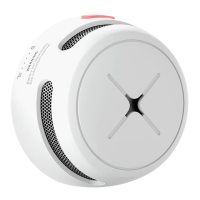
The device features a Test/Silence Button, an LED Indicator, a Buzzer, and a Pinhole Pairing Button. The Test/Silence Button allows users to test the alarm's functionality and silence it during a nuisance alarm. The LED Indicator provides visual cues regarding the alarm's status, such as normal standby, pairing mode, alarm activation, or low battery. The Pinhole Pairing Button is used to establish and manage the wireless interconnection between multiple units.
Interconnection: The S-RF500 is designed for easy wireless interconnection. Units purchased in a multi-pack are typically pre-interconnected, forming their own independent network. If you have multiple multi-packs or wish to expand your network, additional units can be easily added. The interconnection process involves placing one unit into pairing mode and another into searching mode using the pinhole pairing button. Once connected, both units will confirm with a beep and enter standby mode. Up to 24 alarms can be interconnected in a single network, ensuring broad coverage for larger homes or multiple floors. It's important to note that this model is only compatible with other X-SENSE wireless interlinked alarms and not with devices from other manufacturers.
Alarm Test: Regular testing of the smoke alarm is crucial to ensure its proper functioning. It is recommended to test the alarm weekly, as well as when initially turning it on, after any changes to the group configuration, or upon returning from a long trip. To test a single alarm, simply press the Test/Silence Button. The alarm will beep three times every four seconds, and the LED will flash red, indicating a successful test. To test all interconnected alarms, hold down the Test/Silence Button on one initiating unit. This unit will beep continuously with a red flashing LED. After approximately five seconds, other interconnected units will also begin to beep continuously, with their LEDs flashing red and green successively. Releasing the button will stop the test. The test function verifies the smoke sensing circuit without the need for actual smoke.
Silence Mode: In the event of a nuisance alarm (e.g., from cooking fumes), the silence feature can be activated by pressing the Test/Silence Button. This will put the unit into silence mode for nine minutes. During this period, the LED will flash red once every five seconds. After nine minutes, the alarm will automatically revert to normal standby mode. If multiple units are interconnected, pressing the silence button on any unit will silence all interconnected units. However, if the initiating unit (the one that detected the danger) is still alarming, its silence button must also be pressed to silence the entire network. During the nine-minute silence duration, the initiating unit cannot be triggered again, but other interconnected units can still detect and alarm if they sense danger.
Installation Positioning: Proper installation is vital for effective smoke detection. It is recommended to prioritize installation in bedrooms and walkways, ensuring the alarm is audible from all sleeping areas. In homes with multiple bedrooms, an alarm should be installed in each. If only one smoke alarm is installed, it should be placed near all bedrooms, avoiding basements or furnace rooms. Alarms should also be installed above stairways and on every floor. Smoke and heat rise to the ceiling and spread horizontally, so the ideal placement is in the middle of the ceiling. If ceiling placement is not possible, install the alarm at least 20 inches (50 cm) away from room corners. If installed on a wall, maintain a distance of 4-12 inches (10-30 cm) below the ceiling. For rooms or halls longer than 30 feet (900 cm), multiple alarms should be installed. In angled wall or ceiling scenarios, the alarm should be within three feet (90 cm) horizontally from the highest point. In multi-level homes, install at least one wireless smoke alarm on each level, keeping them in a straight vertical line with minimal obstacles to ensure optimal signal transmission.
Locations to Avoid: To prevent nuisance alarms and ensure optimal performance, avoid installing the alarm near large metal surfaces or bundles of wire, and away from fluorescent lights, amateur radios, electrical equipment, or other devices that may transmit RF signals, as electronic "noise" can cause false alarms. If a smoke alarm is installed in a kitchen, ensure it has an accessible silence button and is placed as far away from the stove and sink as possible to minimize false alarms.
To ensure the smoke alarm remains in good working order, regular maintenance is recommended:
Weekly Testing: As mentioned, test the alarm weekly to verify its sound and indicator functionality.
Cleaning: The smoke alarm should be cleaned at least once every three months. This involves removing the unit from the ceiling and using a vacuum cleaner with a soft brush attachment to clean the alarm cover and vents, removing any accumulated dust or dirt.
Avoid Harsh Cleaners: Never use detergents or other solvents to clean the unit, as these can damage the device.
Avoid Sprays: Do not spray air fresheners, hair spray, or other aerosols near the alarm, as these can interfere with its operation.
No Painting: Do not paint the unit. Paint can seal the vents and impair the sensor's ability to detect fire effectively.
No Disassembly: Never attempt to disassemble the unit or clean its interior. Doing so will void the warranty and may damage the device.
Prompt Reinstallation: If the smoke alarm is removed for cleaning or battery replacement, ensure it is placed back in its proper location as soon as possible to maintain continuous fire protection.
Ventilation: If household cleaning supplies or similar contaminants are used in the vicinity, ensure the area is well-ventilated.
Battery Replacement: The device uses a replaceable battery. To replace it, detach the smoke alarm from its mounting bracket by twisting it counterclockwise. Pull the battery removal tab to remove the old battery, then install a new one, ensuring correct polarity. After replacing the battery, test the alarm and then remount it by twisting clockwise to lock it in place.
By following these usage and maintenance guidelines, you can ensure the AEGISLINK Wireless Interlinked Smoke Alarm provides reliable and effective smoke detection for your home.
 General
| Alarm Sound Level | 85 dB at 3 meters |
|---|---|
| Wireless Frequency | 433MHz |
| Sensor Type | Photoelectric |
| Operating Temperature | 0°C to 50°C |
| Operating Humidity | 10% to 95% RH |

 To Next Page