
 Need help?
Do you have a question about the AER BINGO and is the answer not in the manual?
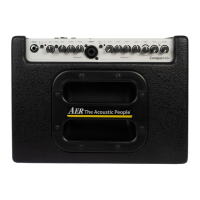
Details on input, sensitivity, clip, gain, color, bass, middle, and treble controls for Channel 1.
Details on XLR input, line/mic, clip, gain, bass, treble, effect pan, select, return, power, and master controls for Channel 2.
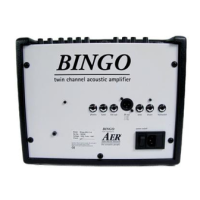
Description of rear panel connections including headphones, tuner, line-out, DI-out, send, return, F/S, and power.
Guide to connecting the amplifier, setting controls, and powering on the BINGO.
How to adjust input sensitivity and gain using the High/Low switch and Gain control.
Explanation of the two and three band tone controls and the Channel 1 Colour switch.
Details on internal reverb/delay, effect selection, intensity, effect-pan control, and foot switch operation.
Description of DI-out, Tuner, and Line out outputs for connecting to sound systems or recording.
Technical details for Channel 1 and Channel 2 inputs, including impedance and sensitivity.
Technical details for Tuner, Line, DI, Send, and Return outputs, including levels.
Details on Tip, Ring, and Sleeve connections for the foot switch.
Specifications for bass, middle, and treble tone controls for both channels.
Details on the Limiter, Subsonic Filter, and Enhancer.
Specifications for the digital reverb and delay effects, including presets.
Specifications for the power amplifier, rating, mains fuse, and speaker system.
Details on cabinet material, dimensions, finish, and weight of the amplifier.
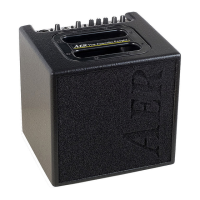
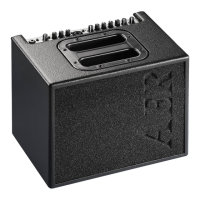
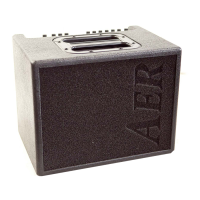
The AER BINGO is a professional, compact, and powerful amplifier specifically designed for acoustic instruments. It features two independent channels, allowing for simultaneous operation of a microphone and an instrument. The amplifier boasts a dynamically controlled power amplifier and a broad-spectrum loudspeaker system, ensuring distortion-free reproduction even at high volumes.
The BINGO amplifier is engineered to provide high-quality amplification for acoustic instruments and vocals. Its dual-channel design caters to the needs of musicians who use both an instrument and a microphone. Channel 1 is dedicated to instruments, offering a 6.3 mm jack input with adjustable sensitivity via a "High/Low" switch. The "High" setting is suitable for instruments with piezoelectric pick-ups, while "Low" is for instruments with active preamplifiers and magnetic sound pick-ups. This channel also includes a "Clip" indicator to warn of input overload, a "Gain" control for input level adjustment, and a "Colour" switch that activates a mid-cut treble-boost filter, particularly useful for fingerstyle techniques. Tone shaping for Channel 1 is further enhanced with "Bass," "Middle," and "Treble" controls.
Channel 2 is more versatile, featuring an XLR combination socket that accepts both a 6.3 mm jack plug and an XLR male socket. The "Line/Mic" switch adjusts input sensitivity, with "Line" suitable for line-level sources and instruments with active preamplifiers or magnetic sound pick-ups, and "Mic" for symmetrical microphone inputs with 30V phantom power. Similar to Channel 1, Channel 2 includes a "Clip" indicator, "Gain" control, and "Bass" and "Treble" tone controls.
The BINGO integrates a digital effects processor, offering a choice between reverberation and delay effects via the "Select" switch. The intensity of the internal effect is controlled by the "Return" knob. An "Eff. Pan" control allows for continuous mixing of the effect portions between the two channels. When turned completely to the left, the internal effect is applied to Channel 1 and an external effect (if connected) to Channel 2. In the middle position, both internal and external effects are distributed to both channels. When turned completely to the right, the internal effect is on Channel 2 and the external effect on Channel 1. For external effects, "Send" and "Return" sockets are provided on the rear panel, allowing connection to an external effect device. A standard double foot switch can be connected to the "F/S" socket on the rear to toggle both internal and external effects on and off.
Rear panel connections expand the amplifier's utility. A "Phones" output allows for headphone monitoring. The "Tuner" output provides a signal for a tuner after the master control, eliminating the need to switch between instrument and amplifier. A "Line-out" offers a preamplifier output after the master control, while the "DI-out" provides an XLR output before the master control, suitable for connecting the BINGO to a sound system. The "Send" and "Return" sockets facilitate the integration of external effect devices or other signal sources, such as a CD player. The "Power" section includes a combined mains switch, a mains socket, and a fuse holder.
To ensure optimal performance and longevity, users should follow specific operational guidelines. Before powering on the BINGO, it is crucial to verify that the mains voltage at the location matches the amplifier's requirements, as indicated on the rear panel under "Dest." and "AC-voltage." The "Master" and "Return" controls should be set to the zero position (fully counter-clockwise), and all other controls to the middle position. Once all necessary cable connections (mains, instrument, microphone) are made, the amplifier can be switched on using the power switch on the rear. A green power indicator lamp will confirm that the amplifier is operational.
Level control is critical for achieving distortion-free sound. The "High/Low" switch and "Gain" control on each channel allow for precise adjustment of various pick-up systems and signal sources. The "Clip" indicator serves as a visual warning if the input signal is too high, prompting the user to reduce the gain or the volume control on their instrument or source. After setting individual channel levels, the overall volume is adjusted using the "Master" control.
The tone controls are specifically designed to meet the unique requirements of acoustic instruments and other sources. The "Colour" switch on Channel 1 is particularly effective for fingerstyle playing, providing a mid-cut treble-boost filter. The integrated digital effects offer a choice of reverberation or delay, with intensity controlled by the "Return" knob. The "Eff. Pan" control provides flexibility in distributing these effects across the two channels. For musicians using external effects, the "Send" and "Return" jacks allow seamless integration, with the external effect device controlling its own intensity. The optional double foot switch offers convenient hands-free control over both internal and external effects.
The various outputs on the rear panel enhance the BINGO's versatility in different performance and recording scenarios. The "DI-out" is ideal for sending a balanced signal to a sound system, while the "Line-out" provides a preamplifier output for further processing. The "Tuner" output ensures that a tuner can be connected without interfering with the main signal path. The "Send" and "Return" jacks can also be used to connect other audio sources, such as a CD player, allowing for practice or playback through the amplifier.
Maintaining the BINGO amplifier involves adhering to basic safety precautions and simple cleaning routines. Users are advised to read and understand all operating instructions to minimize the risk of injury from fire or electric shock. It is essential to use a grounded mains connection with the appropriate supply voltage; if there is any doubt about the grounding, a qualified expert should be consulted.
The amplifier should never come into contact with water, and users should avoid touching it with wet hands. It is important to operate the BINGO in a location where cables will not pose a tripping hazard, preventing damage to the cables or injury to individuals. The amplifier should not be operated near strong electromagnetic fields, such as those produced by large mains transformers, generators, or neon lights, and signal cables should not be laid parallel to power lines.
Before plugging the power cable into the mains, ensure that the BINGO is switched off. For cleaning, the amplifier should be unplugged from the mains supply. A damp cloth can be used for cleaning; harsh cleaning agents should be avoided, and care must be taken to prevent any liquid from entering the amplifier.
The BINGO is designed with no user-serviceable parts inside. All repairs and servicing must be referred to an agent authorized by AER. Any unauthorized repair or servicing will void the two-year warranty. Keeping the operating instructions in a safe place is recommended for future reference.
 General
| Type | Acoustic Guitar Amplifier |
|---|---|
| Channels | 2 |
| Power | 60 W |
| Outputs | Line Out |
| Effects | Reverb |
| Speaker | 8" twin cone speaker |
| Inputs | Channel 1: 1/4" instrument input; Channel 2: XLR/1/4" combo input |




 To Next Page