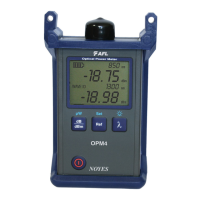
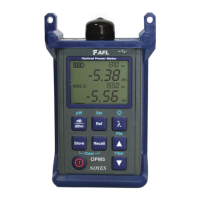
The Noyes OPM 4 OLS 1 OLS 2D is a series of light sources, optical power meters, and related test kits designed for fiber optic testing and inspection. This user's guide provides detailed information on the function, usage, and maintenance of these devices.
Function Description
The OPM (Optical Power Meter) series, including OPM4 and OPM5 models, are used to measure optical power in fiber optic networks. They can display measurements in dBm, dB, or µW. The OPMs are capable of storing measurement data and can be used to set reference levels for loss measurements. They support various wavelengths and can identify wavelengths from ID'd sources.
The OLS (Optical Light Source) series, including OLS1, OLS2, OLS4, OLS7-3, and OLS7-FTTH models, are used to generate stable light signals at specific wavelengths for testing fiber optic links. These light sources are essential for performing insertion loss measurements when paired with an OPM. Some OLS models feature multiple wavelengths and tone generation capabilities.
The overall system, comprising OPMs and OLSs, facilitates the measurement of optical power and insertion loss in both multimode and single-mode fiber optic links. This is crucial for verifying the performance and integrity of fiber optic installations.
Important Technical Specifications
OPM4/OPM5 Optical Power Meters:
- Measurement Units: dBm, dB, µW.
- Display: Shows current measurement, wavelength ID, battery status, and other relevant information.
- Storage: OPM5 models have a "Store" function to save measurements in memory.
- Reference Setting: Allows users to set a reference level (0 dB) for loss measurements.
- Wavelength Identification: Automatically identifies wavelengths from compatible OLS sources.
- Power Supply: Operates on batteries (2xAA) and can be powered via an AC adapter/USB connection.
- Connectivity: Mini-USB port for OPM5 models for PC connection and data transfer.
OLS1-Dual LED Light Source:
- Wavelengths: Dual 850/1300 nm.
- Output: Universal Connector Interface (UCI) supporting SC, ST, FC, and LC connector styles.
- CW Mode: Continuous Wave output.
- Tone Generation: Not explicitly mentioned for OLS1, but other OLS models have this feature.
- Power Supply: Battery operated with an external power indicator and AC power adapter interface.
OLS2-Dual Laser Source:
- Wavelengths: Dual 1310/1550 nm.
- Output: UCI supporting SC, ST, FC, and LC connector styles.
- CW Mode: Continuous Wave output.
- Tone Modes: 2kHz, 1kHz, 330Hz, 270Hz.
- Output Adjust: Allows adjustment of optical output power.
- Power Supply: Battery operated with an external power indicator and AC power adapter interface.
OLS4 Integrated LED and Laser Light Source:
- Wavelengths: 850/1300 nm (LED) and 1310/1550 nm (Laser).
- Output: MM output port (LED) and SM output port (Laser), UCI supporting SC, ST, FC, and LC connector styles.
- CW Mode: Continuous Wave output.
- Tone Modes: 2kHz, 1kHz, 330Hz, 270Hz.
- Power Supply: Battery operated with an external power indicator and AC power adapter interface.
OLS7-3 Triple Wavelength Laser Source:
- Wavelengths: Triple 1310/1550/1625 nm.
- Output: UCI supporting SC, ST, FC, and LC connector styles.
- CW Mode: Continuous Wave output.
- Tone Modes: 2kHz, 1kHz, 330Hz, 270Hz.
- Power Supply: Battery operated with an external power indicator and AC power adapter interface.
OLS7-FTTH Triple Wavelength Laser Source:
- Wavelengths: Triple 1310/1490/1550 nm.
- Output: UCI supporting SC, ST, FC, and LC connector styles.
- CW Mode: Continuous Wave output.
- Tone Modes: 2kHz, 1kHz, 330Hz, 270Hz.
- Power Supply: Battery operated with an external power indicator and AC power adapter interface.
Usage Features
- Intuitive Interface: Both OPM and OLS devices feature clear displays and dedicated buttons for easy operation, including power on/off, wavelength selection, mode selection (CW/Tone), and reference setting.
- Wavelength Selection: Users can manually select the desired test wavelength or utilize the OPM's automatic wavelength identification feature when paired with a compatible OLS.
- Reference Setting (One Jumper Method): This method is used to establish a 0 dB reference for insertion loss measurements. It involves connecting the OLS to the OPM via a single test jumper, wrapping the jumper around a mandrel (for multimode), and then setting the reference on the OPM.
- Test Jumper Verification: Before measuring link loss, the integrity of the test jumpers themselves can be verified by connecting them in series and checking the displayed power level. This ensures that the jumpers do not introduce excessive loss into the measurement.
- Insertion Loss Measurement: After setting the reference and verifying jumpers, the OLS and OPM are connected to the fiber link under test (via a patch panel), and the OPM displays the insertion loss in dB.
- Data Storage (OPM5): The OPM5 allows users to save measurements to internal memory, which can then be retrieved, viewed, or cleared.
- File Management (OPM5): The OPM5 offers file management features to select, create, and manage files for storing measurement data, facilitating organized record-keeping.
- Display Readings: Both OPMs and OLSs provide clear display readings of current measurements, battery status, and selected settings. OPMs can display splash screens for software version and detector type.
- Output Adjust (Laser Sources): OLS2, OLS7-3, and OLS7-FTTH models allow users to adjust the optical output power, providing flexibility for various testing scenarios.
- Tone Generation (Laser Sources): OLS2, OLS7-3, OLS7-FTTH, and OLS4 (for laser output) can generate modulated light signals at specific frequencies (tones), which can be useful for fiber identification or troubleshooting.
Maintenance Features
- Cleaning Optical Ports: Regular cleaning of all optical connections and surfaces is emphasized to prevent contamination (dirt, oils, etc.) that can affect measurement accuracy. Specific cleaning procedures are outlined, including the use of lint-free optical cleaning wipes, cleaning fluids (IPA), and compressed air.
- Cleaning OPM Optical Ports: Detailed steps are provided for cleaning the OPM adapter cap and the OPM port using wipes and cleaning fluid.
- Cleaning OLS Optical Ports: Instructions are given for cleaning OLS ports, including the use of One-Click Cleaners and CCT stick method for different connector types.
- Repair and Calibration: The manual states that repair of NOYES test equipment is not recommended by the user. Calibration is recommended every 12 months by NOYES Calibration Department.
- Battery Replacement: Instructions are provided for replacing the protective rubber boot and the two discharged AA batteries.
- Mandrels for Multimode Transmit Jumpers: Information on available mandrels for multimode testing, including diameter and part numbers, is provided. Mandrels are used to ensure proper launch conditions for multimode measurements.
- Warranty: A warranty policy is outlined, covering product defects for a specified period (1, 2, or 4 years depending on the product). It also details exclusions for unauthorized repairs, misuse, negligence, or accidents.
- Returning Equipment: Procedures for returning equipment for additional information, service requests, or repairs are provided, including contact information for AFL.
- CE Information: The devices are designed and tested to comply with relevant sections of applicable specifications, including full compliance with all essential requirements of all applicable EU Directives.
- Safety Information: Warnings and cautions are provided regarding hazardous radiation exposure, electrical shock, proper use of AC adapters, battery handling, and optical output safety. Users are advised not to look directly into the optical outputs.

 Need help?
 General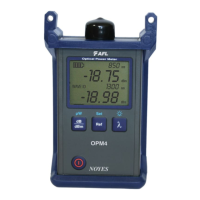

 To Next Page