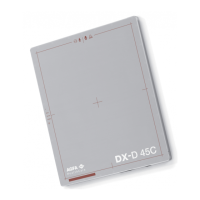
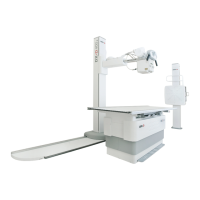
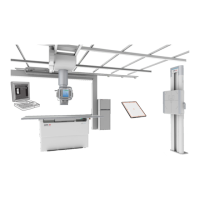
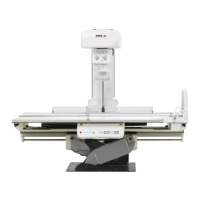
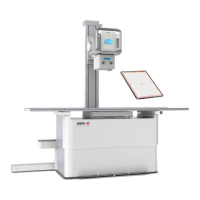
DX- D 600
User Manual
0242F EN 20181218
41
RECOMMENDED SEPARATION DISTANCES BETWEEN PORTABLE
AND MOBILE RF COMMUNICA TIONS EQUIPM ENT AND THE X-RAY SYSTEM
(IEC 60601-1-2:2007)
This DX-D 600 Radiographic Room is intended for use in an electromagnetic environment in which radiated RF disturbances are
controlled. The customer or the user of this DX-D 600 Radiographic Room can help prevent electromagnetic interference by
maintaining a minimum distance between portable and mobile RF communications equipment (transmitters) and the DX-D 600
Radiographic Room as recommended below , according to the maximum output power of the communications equipment.
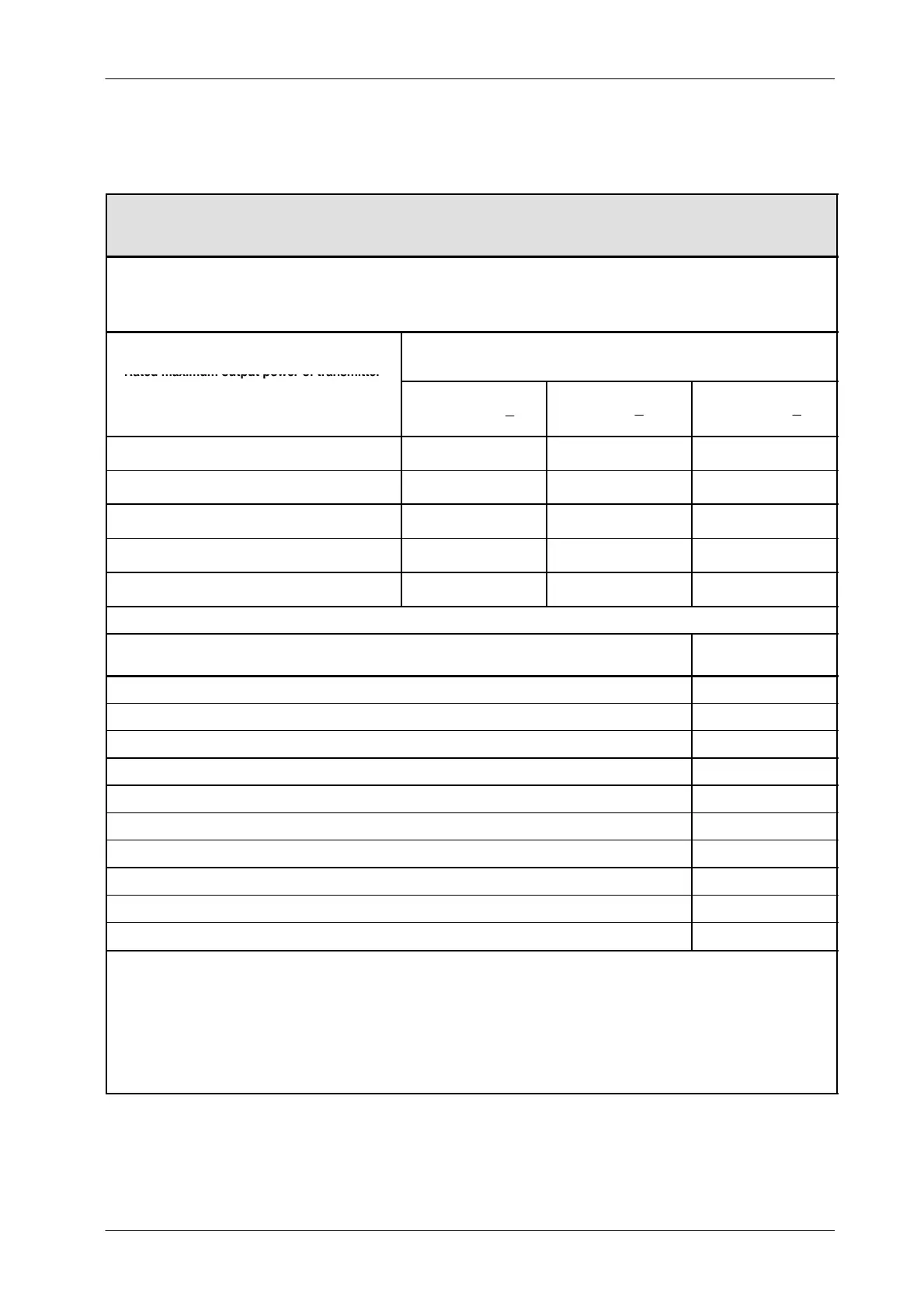
Rated maximum output power of transm itter
Separation distance according to frequency of transmitter
m
W
150 KHz to 80 MHz
d = 1.2 P
80 MHz to 800 MHz
d = 1.2 P
800 MHz to 2.5 GHz
d = 2.3 P
0.01 0.12 0.12 0.23
0.1 0.38 0.38 0.73
1 1.2 1.2 2.3
10 3.8 3.8 7.3
100 12 12 23
TYPICAL RF DEVICES (Worst-Case scenario)
Device: Power @ Frequency
Recommended
distance(m)
GMRS device (Professional Walkie--Talkie): 5 W @ 462--467 MHz 2.7
GSM / UMTS cell phone: 2 W @ 850/1700/1900 MHz 3.3
FRS device (Amateur Walkie--Talkie): 500 mW @ 462--467 MHz 0.9
WiFi / Bluetooth devices: 100 mW @ 2400--2500 MHz 0.8
DECT devices (modern cordless phones): 100mW @ 1880--1900 MHz 0.8
RFID reader (3): 10 mW @ 125--150 KHz / 13.56 MHz 0.12
RFID reader (3): 10 mW @ 902--928 MHz / 2400--2500 MHz 0.23
Station transmitter ATSC TV broadcasting: 100 kW @ 54--800 MHz 380
Station transmitter ATSC TV broadcasting: 100 kW @ 800--890 MHz 730
Station transmitter FM radio broadcasting: 100 kW @ 87.5--108 MHz 380
For transmitters rated at a maximum output power not listed above, the recommended separation distance ’d’ in meters (m) can be
estimated using the equation applicable to the frequency of the transmitter , where ’P’ is the maximum output power rating of the transmitter
in watts (W) according to the transmitter manufacturer.
NOTE 1 -- At 80 MHz and 800 MHz, the separation distance for the higher frequency range applies.
NOTE 2 -- These guidelines may not apply in all situations. Electromagnetic propagation is affected by absorption and reflection from
structures, objects and people.


 To Next Page
 Loading...