
 Need help?
Do you have a question about the Agilent Technologies MSO8104A and is the answer not in the manual?
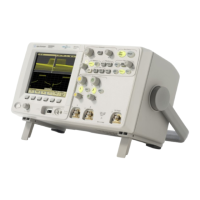
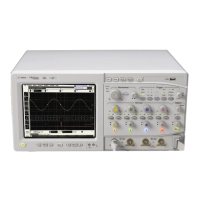
The MSO8104A-05A is a digitizing oscilloscope, a sophisticated electronic test instrument designed to measure and display electrical signals as voltage waveforms in relation to time. This particular model, the MSO8104A-05A, is an updated version that supersedes the MSO8104A-05, indicating a revision or upgrade to its internal components or specifications. The "MSO" prefix typically denotes a Mixed-Signal Oscilloscope, meaning it has the capability to analyze both analog and digital signals simultaneously, making it a versatile tool for debugging and verifying complex electronic designs. The "8104A" likely refers to its model series, and "05A" signifies a specific configuration or revision.
The primary function of the MSO8104A-05A is to capture, display, and analyze transient and repetitive waveforms. This involves converting analog input signals into digital data, which is then processed and displayed on a screen. Users can then examine various characteristics of these signals, such as amplitude, frequency, rise time, fall time, pulse width, and more. For mixed-signal capabilities, it would also allow for the correlation of digital logic states with analog waveform behavior, which is crucial for embedded system development and debugging.
While specific technical specifications like bandwidth, sample rate, and number of channels are not explicitly detailed in the provided document, the context of a "digitizing oscilloscope" implies that these are key performance metrics. A high-performance digitizing oscilloscope would typically feature a high bandwidth (e.g., several GHz) to accurately capture fast-changing signals, a high sample rate (e.g., tens of GS/s) to ensure sufficient data points for waveform reconstruction, and deep memory (ee.g., hundreds of Mpts) to capture long signal durations at high sample rates. For an MSO, it would also have a specified number of analog channels (e.g., 4) and digital channels (e.g., 16 or more). The "A" in the model number often suggests an advanced or improved version within its series.
Usage features of the MSO8104A-05A would revolve around its user interface and analytical capabilities. Modern oscilloscopes like this typically feature a large, high-resolution color display, often with touchscreen functionality (as indicated by the "Touchscreen USB cable" in the parts list). This allows for intuitive navigation of menus, waveform manipulation, and measurement setup. Advanced triggering capabilities are standard, enabling users to isolate specific events of interest within a complex signal stream. Measurement functions, both automatic and manual, would provide quantitative analysis of waveform parameters. Connectivity options, such as USB (front panel USB port is mentioned), Ethernet, and GPIB (Acquisition Interface PCI card into the slot marked GPIB), would allow for remote control, data transfer, and integration into automated test systems. The presence of a CD-ROM drive suggests that it might be used for software installation, data archiving, or loading firmware updates, although this component is being removed in the upgrade procedure.
The provided document primarily focuses on maintenance features, specifically an upgrade procedure for the motherboard. This indicates that the device is designed with modularity in mind, allowing for component replacement and upgrades to extend its lifespan or improve performance. The upgrade from an older motherboard to an "ADLink M880 motherboard w/ 2 SATA cables" signifies a significant internal hardware change, likely involving a newer processor, chipset, and improved I/O capabilities. The need for new cables (SATA, backlight, touchscreen USB, motherboard switch) and other hardware (heatsink/fan assembly, motherboard deck, screws, filler plate, USB front panel label) highlights the comprehensive nature of this internal upgrade.
The upgrade procedure itself details a step-by-step process for disassembling and reassembling the oscilloscope, emphasizing careful handling and proper torque specifications for screws. This level of detail in the service note suggests that the device is intended to be serviceable by trained technicians. Key maintenance steps include:
The "INFORMATION ONLY" classification of the service note implies that this documentation is for internal use by service centers or authorized personnel, rather than being publicly distributed as part of a user manual. This reinforces the idea that while the device is serviceable, complex repairs and upgrades are intended to be performed by skilled technicians. The "Parts Required" section lists the "M880 Motherboard Kit" (P/N D8104-68700) as the primary component for this upgrade, indicating a consolidated kit for the necessary parts. The serial number ranges provided (MY00000000-MY46001900 and SG00000000-SG46001900) specify which units are affected by this particular motherboard upgrade, ensuring that the correct service action is taken for the relevant devices. The "April 5, 2010, Rev. 17" date indicates that this is a mature and possibly frequently updated service document, reflecting ongoing support for the product.
 General
| Brand | Agilent Technologies |
|---|---|
| Model | MSO8104A |
| Category | Test Equipment |
| Language | English |


 To Next Page