This document is an installation manual for PV (photovoltaic) modules manufactured by Shenzhen Aiko Digital Energy Technology Co., Ltd., also referred to as "Aiko." The manual provides essential information for the safe installation, operation, and maintenance of these modules.
Function Description
The Aiko PV modules are designed to convert solar energy into electricity. They are double-glass photovoltaic modules, meaning they utilize glass on both the front and back sides, which can contribute to bifacial power generation by absorbing reflected and scattered light from the rear. These modules are intended for use in solar power systems, including those installed on building roofs and potentially vehicle-mounted applications, depending on local regulations and structural analysis.
Important Technical Specifications
The manual lists several applicable module models, including:
- AIKO-Axxx-MAH72Dw
- AIKO-Axxx-MAH72Db
- AIKO-Axxx-MAH60Dw
- AIKO-Axxx-MAH60Db
- AIKO-Axxx-MAH54Dw
- AIKO-Axxx-MAH54Db
- AIKO-Gxxx-MCH72Dw
- AIKO-Gxxx-MCH54Dw
These modules are classified as Class A for application level, suitable for systems with DC 50V or above 240W that the public may contact. They have a safety level of Class II and a fire protection level of Class C.
Electrical Performance:
- Maximum System Voltage: 1500V.
- Standard Test Conditions (STC): Irradiance 1000W/m², cell temperature 25°C, air quality AM1.5.
- Bifacial Nameplate Irradiance: 1000 W/m² on the module front and 135 W/m² on the module rear.
- Tolerance: There is a ±3% tolerance between the nominal values of electrical performance parameters (Isc, Voc, Pmax) at STC and bifacial nameplate irradiance.
- Open Circuit Voltage (Voc) and Short Circuit Current (Isc): A safety factor of 1.25 needs to be applied when calculating these values, considering potential higher irradiance and lower temperatures.
- Overcurrent Protection: If reverse current exceeds the maximum fuse current, an overcurrent protector of the same specification must be used. For more than two parallel strings, each string requires an overcurrent protector.
Mechanical Specifications:
- Operating Ambient Temperature: Recommended -20°C to 50°C, with a limiting range of -40°C to 85°C.
- Humidity: Lower than 85%rh.
- Altitude: Applicable for operating environments below 2000m above sea level.
- Static Test Load: Maximum front 3600 Pa / back 1600 Pa, with a safety factor of 1.5. Design loads must consider local conditions and relevant specifications.
- Installation Clearance: Minimum gap of 10cm between the PV module frame and the roof when installed parallel. Minimum installation distance of 10mm between two adjacent PV modules.
- Mounting: Can be installed using pressure clamps or bolts.
- Pressure Clamps: Recommended clamps are > 50mm in length and >3mm in thickness. The overlapped distance between the clamp and the module frame (D) should be 7-10mm. At least four clamps per module are required, with six or more recommended for high wind/snow loads. Torque for M8 bolts: 16-20 N·m.
- Bolts: M8 bolts are used through mounting holes on the frame. Recommended washer thickness ≥ 1.7mm. Tightening torque for M8 bolts: 16-20 N·m.
- Junction Box: IP68 protection grade.
- Cables: Dedicated PV output cables with positive and negative poles. Special solar cables with a cross-sectional area of 4mm² or more, UV protection, and minimum temperature resistance of 90°C are required for field wiring.
- Connectors: Plug-and-play connectors with IP68 protection grade.
Usage Features
- Installation Flexibility: Modules can be installed in various configurations, including long-side mounting for single or double rows, and short-side mounting for single or double rows, with specific wiring diagrams provided for each.
- Bifacial Design: Double-glass modules are designed to generate power from both sides, maximizing energy yield by capturing reflected light. However, this feature is not recommended for building-attached PV systems (BAPVs) where the rear side may not receive sufficient light.
- Ventilation: Proper ventilation around the modules is crucial to dissipate heat and moisture, ensuring optimal performance and longevity.
- Corrosion Resistance: The aluminum alloy frame is anodized for corrosion resistance. All contacting materials should also be corrosion-resistant (stainless steel or aluminum).
- Grounding: The PV module frame must be grounded to prevent lightning and electrostatic damage. Specific grounding holes (Φ 4.2mm) are provided, and M4x12mm grounding bolts with M4 nuts, star washers, and flat washers are recommended. The grounding wire should be 4mm² copper corewire, with a recommended torque of 3-7 N·m for grounding bolts.
Maintenance Features
- Regular Inspection: Modules require regular inspection and maintenance, especially during the warranty period. Users are responsible for this and should report any damage or abnormalities to Aiko's customer service.
- Cleaning:
- Dirt and obstructions on the module surface can reduce power output and should be cleaned promptly.
- Rainwater can help clean modules with sufficient inclination, reducing the need for manual cleaning.
- Cleaning is recommended in the early morning or evening when light is weak and module temperature is low.
- Use a sponge moistened with clean water to wipe the glass surface.
- Avoid cleaning agents containing acid or alkali.
- Do not use brushes or other rough tools that could scratch the surface.
- Visual Inspection:
- Check for broken glass or cracks/abnormalities in the backplane.
- Inspect the junction box and cables for damage.
- Ensure no foreign matter or shadows cover the modules.
- Verify that mounting bolts and brackets are secure and free from looseness or rust.
- Confirm proper grounding.
- Connector and Cable Inspection:
- Preventive inspection every six months is recommended.
- Check the tightness of connectors and the firmness of cables.
- Inspect the junction box sealant for cracks.
- Ensure connectors are dry and clean before wiring.
- Avoid connecting when wet or in abnormal conditions.
- Ensure positive and negative poles are fully inserted to maintain IP68 protection.
- Protect connectors from direct sunlight and immersion in water.
- Do not mix connectors from different models.

 Need help?
 General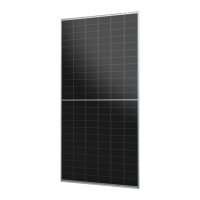

 To Next Page