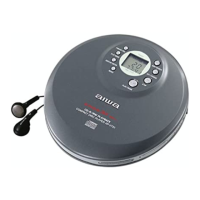
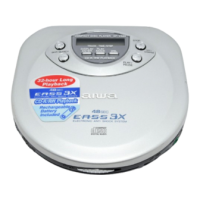
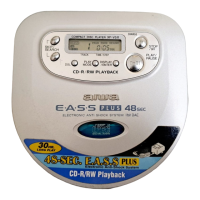
This document is a service manual for the Aiwa XP-V30, XP-V31, and XP-V32 Compact Disc Players. It provides detailed information for servicing and maintaining these portable CD players, including electrical and mechanical parts lists, and a schematic diagram.
Function Description:
The Aiwa XP-V30, XP-V31, and XP-V32 are portable compact disc players designed for personal audio playback. Their primary function is to read audio data from compact discs and convert it into an analog audio signal for output through headphones or connected audio systems. The devices are equipped with basic controls for playback, track navigation, and volume adjustment, making them suitable for on-the-go listening. The inclusion of a "SIMPLE MANUAL" suggests an emphasis on user-friendliness for basic operation.
Important Technical Specifications:
While specific detailed specifications like frequency response, signal-to-noise ratio, or power output are not explicitly listed in the provided pages, the manual does offer insights into the internal components, which can infer some technical aspects:
- CD Mechanism: The devices utilize the KSM-620AAA basic CD mechanism, indicating a standard optical pickup system for CD playback.
- Integrated Circuits (ICs):
- Main ICs: The CXA2542AQ, CXD3009Q, and CXP83409-XXXQ are identified as key ICs. The CXA2542AQ is likely a servo signal processor or digital signal processor (DSP) for CD playback, while the CXD3009Q is typically a digital-to-analog converter (DAC) or a CD-DSP. The CXP83409-XXXQ, given its part number structure, is likely the main microcontroller responsible for overall system control, user interface, and possibly display management.
- Audio IC: The BA3576FS is listed as an audio IC, suggesting it handles audio amplification or processing functions for the headphone output.
- Other ICs: The BH6508FS is also mentioned, which could be related to motor control or other auxiliary functions.
- Capacitors: A wide range of capacitors are used, including chip capacitors (0.1-25, 0.033, 0.047, 0.01 DM, 0.022), electrolytic capacitors (100/4, 220-4, 47-4, 100-16, 22-6.3, 100-6.3, 35V, 6.3V), and ceramic capacitors (100P-50, 220P-50, 330P-50, 150P-50, 100P-50, 2200P-50, 820P-50, 3300P(K), 4700P). The variety indicates different filtering, coupling, and power supply stabilization roles within the circuit.
- Resistors: Resistors with values like 39K-1/10WF and 120K-1/10WF are listed, suggesting precision and low-power applications.
- Diodes: HSM2838CTR, HRW0202A, SB07-015C, and HZM11NB2 (Zener diode) are used for rectification, signal switching, and voltage regulation.
- Transistors: DTC144EK, 2SB1132R, 2SC2412K S, 2SD1664R, 2SA1037AK, 2SA1369G/H, 2SC3439G/H, DTC114EK, and DTC114TKA are present, indicating their use in amplification, switching, and control circuits.
- Coils: Coils with values like 10U, 47UH, and 470U are used for filtering and impedance matching.
- Ceramic Filter: A 16.93MHz ceramic filter is included, which is a common component in CD players for clock generation or signal processing.
- Connectors: ZH V 6-pin and H 52089-1610 16-pin connectors are used for internal wiring.
- Power Source: The devices are designed to operate with an AC adapter (AC-A62 E, AC-A62 HEJ, AC-A62HC) and rechargeable batteries (NB-301 NC, 2PCS). This indicates portability and flexibility in power options.
- Controls: Tact switches (EVQ11G04M) and a push switch (SPPB 51) are used for user input. A rotary potentiometer (RK14J12A0) is used for volume control.
- Display: An LCD (ZHC-7) is used for displaying information, likely track number, playback status, and battery level.
- Audio Output: A 3.5mm stereo jack (W/R GRN) is provided for headphone output.
Usage Features:
Based on the parts list, the Aiwa XP-V30 series offers several user-centric features:
- Portable Design: The inclusion of battery contacts, a DC input jack, and an AC adapter suggests that these are portable devices intended for use on the go.
- Basic Playback Controls: The presence of multiple tact switches implies standard CD player functions such as Play, Pause, Stop, Skip/Search (forward and backward). The "SW, PUSH SPPB 51" and "SW,SL 3-1-2 JSK012N08" could be for power or mode selection.
- Volume Control: A rotary potentiometer (VR 701) is dedicated to volume adjustment, providing tactile control over audio output.
- LCD Display: An LCD (LCD 101) is incorporated for visual feedback, likely showing track numbers, playback time, and possibly battery status.
- Battery Operation: The devices support operation with two NB-301 NC rechargeable batteries, emphasizing their portable nature.
- Power Adaptability: The availability of different AC adapters (AC-A62 E, HEJ, HC) suggests regional power compatibility.
- Headphone Output: A standard 3.5mm stereo jack allows for personal listening with headphones.
- Line Out/Remote (Implied): While not explicitly stated, the presence of a "PLUG, CONVERSION WTN-1157R1" could indicate an adapter for line-out functionality or a remote control connection, expanding its usage possibilities.
Maintenance Features:
The service manual itself is a primary maintenance feature, providing technicians with the necessary information to diagnose and repair the devices. Key aspects relevant to maintenance include:
- Detailed Parts Lists: Comprehensive electrical and mechanical parts lists, including part numbers, descriptions, and suffixes indicating usage across different models (A-I), are crucial for identifying and ordering replacement components.
- Schematic Diagram: The "SCHEMATIC DIAGRAM – 1 (MAIN)" is essential for understanding the circuit layout, signal paths, and component interconnections, aiding in troubleshooting and repair.
- Component Identification: The manual clearly labels components with reference numbers (e.g., C805, R303, IC301), making it easy to locate them on the circuit board and in the parts lists.
- Revision Information: The note "Replace this Service Manual with 'Revision Publishing' when it is issued" indicates that Aiwa provides updates to the manual, ensuring that maintenance personnel always have the most current information.
- Basic CD Mechanism: The use of a "BASIC CD MECHANISM: KSM-620AAA" suggests that common parts and repair procedures for this mechanism might be applicable, simplifying maintenance for technicians familiar with similar CD players.
- Modular Design (Implied): The separation of electrical and mechanical parts lists, along with the schematic, suggests a somewhat modular design, which can facilitate component-level repair rather than requiring full board replacement for every issue.
- Power Supply Components: The detailed listing of power-related components (capacitors, diodes, AC adapters, battery contacts) allows for specific troubleshooting and replacement of power supply issues, a common point of failure in portable electronics.
In summary, the Aiwa XP-V30, XP-V31, and XP-V32 are robust portable CD players designed for personal audio enjoyment, featuring standard playback controls, an LCD display, and flexible power options. The comprehensive service manual supports detailed maintenance and repair, ensuring the longevity and performance of these devices.

 Need help?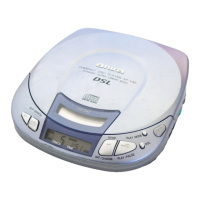

 To Next Page
 General